
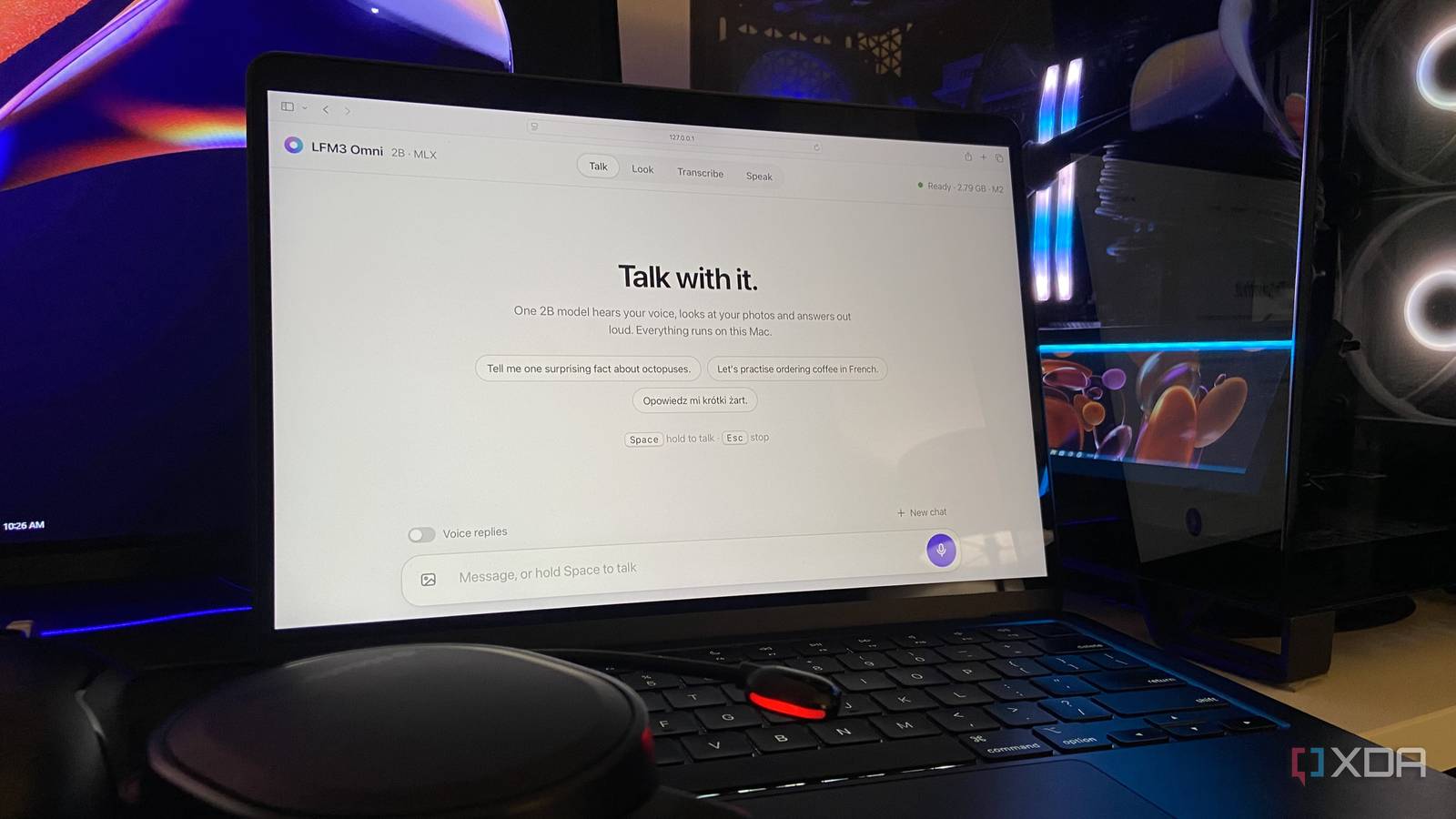
Published Nov 11, 2026, 6:00 AM EST Abhinav pivoted from a career in banking to pursue his first love in writing. Even while working full-time, he continued contributing as an editor-at-large, a role he has held for more than 7 years. A lifelong tech enthusiast who has built three gaming and productivity powerhouse PCs since 2018, his passion for technology keeps him closely following the semiconductor industry, from NVIDIA and AMD to ARM. His MSc dissertation explored how artificial intelligence will reshape the future of work, reflecting his curiosity about the wider social impact of emerging technologies. My M2 MacBook Air has 8GB of system memory, which is something that usually disqualifies it from running any particularly exciting local large language models. A local model that can see an image usually responds through text alone, and giving it the ability to hear, and a voice, usually means running separate models for each capability. Stacking three or four of them on an 8GB system is, understandably, a non-starter. Liquid AI's LFM3-Omni is an ambitious step forward in changing that. It's a small 2.2-billion parameter model that dropped on October 27, and it takes in images, video, and speech, and then responds in text or "out loud." The way it works is that one model handles the listening, looking, and talking, and the whole thing runs on my 8GB Air without ever needing to rely on the network. Here's everything you need to know. One small model on my Mac does the work of four And it does it for less than 3GB of memory The most intriguing part of the pitch when it comes to LFM3-Omni is that it's presented as a single on-device replacement for four separate tools, including speech recognition, a vision model, a chatbot, and a text-to-speech (TTS) engine by Liquid AI. Right now, running all four separately means loading four sets of weights into the same 8GB of memory that macOS needs, each with its own runtime and memory overhead on top. LFM3-Omni is open-weight, released under Liquid AI's LFM Open License v1.0. I tried running it via Ollama first, but it lets this model look and listen, and misses the talking part. To get the model to respond through speech, I ran a free community app called lfm3-mega-demo built by a developer who goes by overment on Github. It runs Liquid's official 8-bit build through MLX, Apple's machine learning framework, and serves a web page on the Mac with tabs to talk, look, transcribe, and speak. I was initially concerned about whether the app itself passes any sampling settings of its own, but my checks revealed that Omni runs on the greedy text decoding that Liquid ships in the model's own config, matching its model card. With the app running, I switched off Wi-Fi and kept it disabled for every test I ran through it. The Activity Monitor clocked the app's process at a peak of 2,968MB, about 2,814MB of which sits in the GPU side of the Mac's shared memory, which is the model itself. That was an astonishingly small footprint for a model that sees, hears, and talks, with roughly 5GB of memory left for everything else. It recognized everything I held up to the camera But maybe don't show it your spreadsheets yet To test its vision capabilities, my straightforward test involved holding up things to the Mac's webcam in the "Look" tab and querying the model. When I held up a DualSense controller, the model accurately recognized it as a "black PlayStation controller", with its D-pad, sticks, and center logo called out correctly. In another test wherein I held up my TKL keyboard, the model correctly recognized it as a mechanical keyboard, although it called it "full-sized" when it's a compact board with no num pad. Then, I decided to hand it a job that a lazy person would. I pulled up a small table of PC components with May and November prices, using round numbers I made up so that every question had one clean answer, and asked it five questions. LFM3-Omni pulled the real figures from the table, and got one answer out of five right on the first run and zero on the second. It fumbled on the arithmetic, stating the GPU got pricier when it got cheaper, and worked out percentage changes for the wrong rows. At this point, I was almost convinced the model wasn't ready for numerical analysis yet. However, the problem turned out to be a design choice, and not its eyes. Of LFM3's text, vision, audio, and omni models, Omni is the only model that can't reason before it answers. Given the same table and prompt via llama.cpp as the runtime, its vision sibling, LFM3-VL-2B, thought through every row and got all five right at 4-bit, which is half the precision Omni ran at. It talks back, and it listens even better Which defies expectations for a 3GB model If I were to evaluate LFM3-Omni fairly today, I'd be paying closer attention to its transcribing and listening capabilities, with speech following close behind. The Speak tab reads typed text aloud in 19 languages and accents. It starts talking in just over a second and generates speech faster than it plays, which makes it handy for hearing a draft read back. As for transcription, it is quicker still. A five-second clip I recorded in the Transcribe tab came back word for word in 0.72 seconds, with the first word in 0.35 seconds. For voice memos, interviews, and meeting recordings, that alone is enough reason to run it because the audio never leaves the Mac. When pointed at the webcam, it also describes what's in front of it out loud with an impressive degree of accuracy, which is exactly the kind of hands-free help Liquid observes would be ideal for in-car assistants. A model of this size being capable of receiving instructions through speech and having vision capabilities to describe what it sees, already has enormous potential for use in various home assistant configurations and smart home automations, particularly those surrounding security systems. LFM3-Omni has me excited about what small models could become An 8GB MacBook Air typically sits far outside the local AI inference discourse, and I'll admit, it's not the first device I look at when it comes to running any new models that have my interest. And yet, LFM3-Omni showed me that the laptop can listen, look, and talk back under 3GB of memory without relying on the network. If a 2.2B parameter model can do it today, I can't wait to see what the next round of small models can do in the near future. It certainly feels like a model that walks so that the future iterations can run.
My 8GB laptop now runs an AI that can see and talk, and it never goes online
Full Article
Original Source
Read the full article at Xda-developers →KhanList aggregates and links to publicly available news content. We do not host full articles from third-party sources. Always verify important information with original sources.