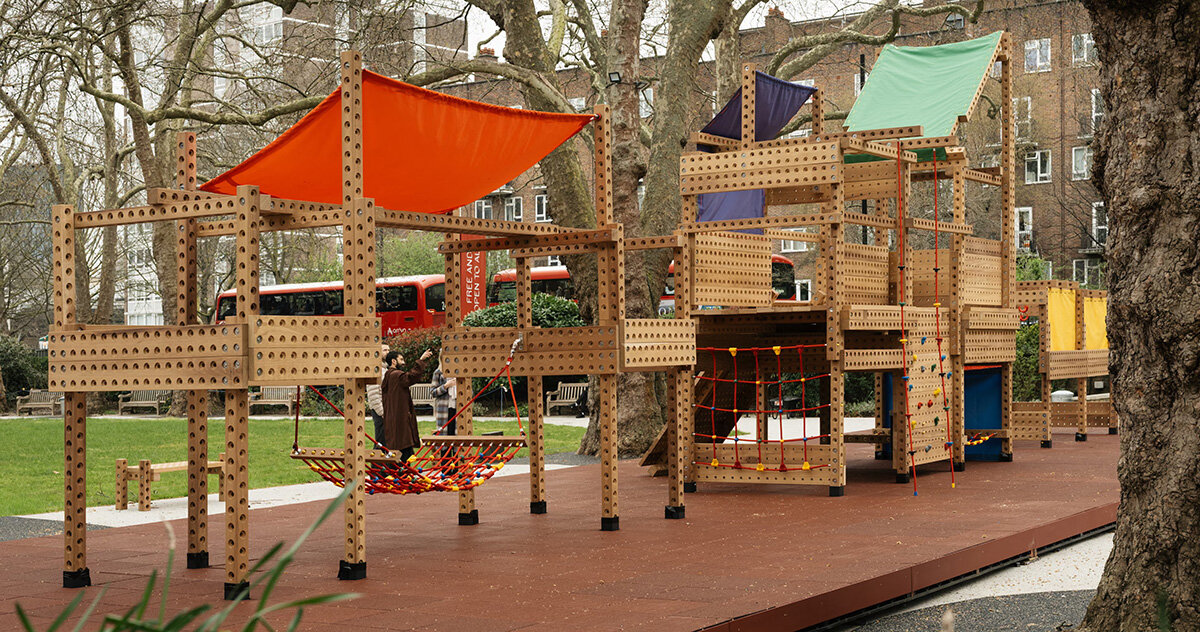
Play as emergency infrastructurePlayrise brings a modular timber playground to children living in refugee settlements and disaster relief sites, beginning with a pilot structure planned for Aysaita camp in Ethiopia.Founded by Alexander Meininger, the project is designed by architecture studio OMMX, engineers Webb Yates, and fabricators SetWorks. It treats play as part of the built environment of care, shaped through a system that can travel, adapt, and can be built with basic tools.The first impression is direct: a raised field of timber frames, perforated panels, rope bridges, climbing holds, canvas roofs, and hammocks. In the London prototype, the structure sits among mature trees and brick buildings, with orange, green, purple, and yellow fabric stretched across a framework of warm hardwood.With the scale of a small piece of architecture, its purpose is immediate and physical. Children climb, crawl, swing, hide, and test their balance across a kit of parts that can shift from site to site.Playrise is designed for children in disaster relief or refugee sites. images © Lewis Ronald (unless otherwise stated)A modular timber kit designed to travelThe Playrise system is built from repeated timber beams and panels, each drilled with a grid of circular holes. Those holes give the modular structure its flexibility. A beam can hold a rope, receive a bolt, support a fabric shade, or frame a climbing route.A panel can become a wall, a balustrade, a climbing surface, or an enclosure. The logic is simple enough to read at a glance, which gives the playground an open, workshop-like quality.That legibility matters in the context of displacement. The project is conceived for places where logistics are complex, budgets are tight, and long-term conditions can change quickly. Flatpack components reduce shipping volume, while repeated parts make repair and reassembly more manageable.Playrise avoids the feeling of a fixed object dropped into place. Its design allows communities, aid workers, and children to take part in shaping how the equipment is used.the playground is designed with OMMX, Webb Yates, and SetWorks as a flatpack kit of partsDesigned through field researchPlayrise was developed after visits and workshops with displaced communities in Ethiopia and Egypt, including Aysaita camp for Eritrean refugees, a Palestinian community hub in Cairo, and a Sudanese refugee community in Karkar.Those conversations pushed the team toward a playground that could respond to different climates, densities, and cultural expectations around play. Shade, visibility, durability, and social use sit within the same design problem.The material choice follows that practical line of thinking. The prototype uses iroko hardwood, selected for strength and performance in hot, dry environments.Metal connectors, security fixings, ropes, nets, and canvas inserts expand the language of the timber frame. Nothing feels hidden. Bolts remain visible, connections are exposed, and each addition shows how the structure can be adjusted over time.perforated timber beams and panels allow the structure to be assembled, repaired and reconfiguredArchitecture for childrenThe Playrise playground works because it thinks spatially. It creates height, thresholds, low rooms, lookout points, and small routes of escape within a compact footprint. A child can move across a rope net, duck beneath a platform, climb a perforated wall, or sit under a canvas canopy.These gestures give the structure a sense of territory, which is especially important in places where children may have limited space of their own.There is also a strong architectural intelligence in the repetition. The gridded timber surfaces give rhythm to the structure, while the bright fabric panels soften the frame and bring shade where needed.From a distance, the playground reads as a small timber village. Up close, it becomes a set of tactile decisions: where to grip, where to step, where to pause, where to look out.ropes, nets, climbing holds, hammocks, and canvas shades turn the frame into a flexible play environmentToward wider deploymentFor architecture and design, the project offers a useful shift in scale. Humanitarian design is often discussed through shelter, sanitation, and emergency logistics. Playrise adds play to that field with a system that is practical, repairable, and spatially generous.Its modular construction gives NGOs a way to transport and assemble the playground, while its open framework gives children room to make the structure their own.The first Playrise set is planned for Aysaita refugee camp, where many children have grown up within the conditions of long-term displacement. The pilot will give the team a chance to test assembly, use, maintenance, and community feedback before wider rollout. In that sense, the prototype is both a playground and a working model for future sites.the system was shaped through field research with displaced communities in Ethiopia and Egypt
modular ‘playrise’ kit brings easy-build playgrounds to children in refugee sites
Full Article
Original Source
Read the full article at Designboom →KhanList aggregates and links to publicly available news content. We do not host full articles from third-party sources. Always verify important information with original sources.