
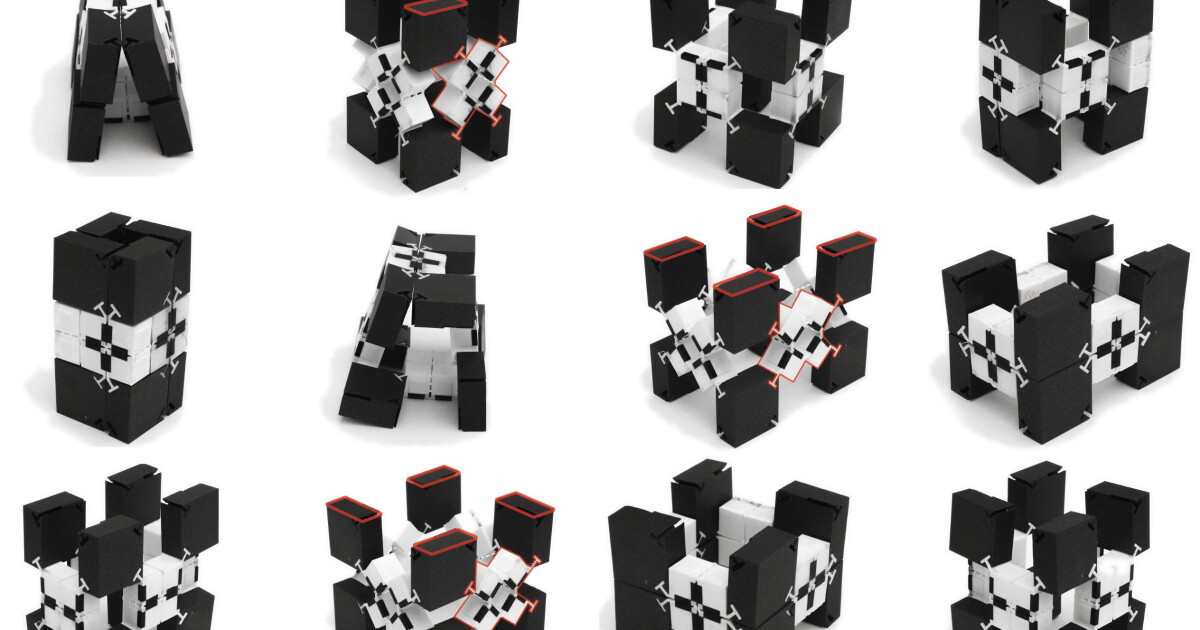
When you were a child, Lego offered the exciting imaginative play of building the shapes of buildings, devices, or robots. Transformers toys manifested the imagination even more fully, with vehicles that metamorphosed into robots and vice versa. But of course, neither Lego nor Transformers could do what actual buildings, devices, or robots could do.But now a team from the Massachusetts Institute of Technology (MIT) has created “bifur-circuit” 3D-printed smart modules that can connect while shifting between myriad shapes without disrupting the electric connections that keep their customizable mechanical functions working.Shape-shifting is an extremely valuable design principle, not only to produce a range of convenient geometries suiting different circumstances, but to provide a strong grip without crushing whatever (or whomever) is being gripped, and for use in disaster conditions and even as extraterrestrial habitation.Because of their collective transformability, the MIT bifur-circuits allow designers rapid improvement from one prototype to the next. Such prototypes have included chairs which convert into tables, and that can also conveniently collapse for storage, while detecting their configuration and relaying relevant information to users via screens. Bifur-circuits: Interactive and Modular Metamaterial Building Blocks Via Bifurcated Geometries Such furniture isn’t just a trivial smart toy.Instead, it could be used for medical assistance and rehabilitation, such as when users need helping shifting posture following surgery or recovery from an accident. Such furniture could also be partially reconfigured as robotic soft grippers. Bifur-circuits might additionally become dynamic shelters at disaster sites. The MIT team has in fact already built a transforming game controller, which depending on how a user has shaped it, will launch one of several video games. The reconfigurable bifur-circuit building blocks can be compressed, stretched, rotated, or bent, offering multiple options for designing interactive devicesMIT In their Human Computer Interaction Engineering paper, lead author Marwa AlAlawi and co-researchers at MIT, the University of Michigan, and the University of Tokyo explore how even after multiple reconfigurations, their modules require no external wires to remain electrically connected. These programmable mechanical metamaterials are simple “base units” open to endless combinations, and are called auxetic because during stretching they become not thinner but wider.“[Mechanical] metamaterials can make complex mechanical assemblies easy to manufacture just by using repeating units,” says AlAlawi, who is an MIT graduate student in mechanical engineering. “Our work is one way to take advantage of their geometry to embed intrinsic intelligence into hardware, which could open many possibilities.”Previously, AlAlawi and colleagues constructed transformable antennae from auxetic metamaterials. The three optional shapes of the design shifted along the frequency range without needing complicated moving parts to do so. But because three shapes alone were too limiting, the researchers developed bifur-circuits for a vast new range of connections, rotations, twists, and compressions, with each shift forming a unique circuit, letting each module communicate with its partners to discern its overall shape.As the bifur-circuits are joined modules instead of a continuous, rigid structure, each unit can maintain electrical connection. As each unit rotates or pivots, the collective form avoids sudden snapping or breaking during bending. According to AlAlawi, this “bifurcation allow us to significantly expand on this reconfigurability space. Just adding one extra unit gives us so many more combinations out of the same structure.” On the top row are two types of connector blocks that link units together – they are internally routed with conductive material in such a way that connecting components activates a unique circuit between adjacent unitsMIT But what substance is both highly and repeatedly bendable while still being an efficient electrical conductor? Called Filaflex 92A, “the conductive material was a constraint we had to work around in the design process,” says AlAlawi, “and it dictated how the sensing between blocks would happen.” During testing, the MIT design endured 10,000 compressions with no loss in electrical connection. Thanks to the team’s easy-to-use construction and simulation software which works with multimaterial 3D printers, designers can generate new bifur-circuits in single printings.“Bifur-circuits are one step toward developing mechanical building blocks with integrated intelligence,” says AlAlawi. “It would be interesting to build on this work and come up with building blocks that allow us to create a structure with any form or shape we want, and which are structurally stable and can be actuated.” Such structures, he says, would include more interactivity and increased range of metamaterial configurations.AlAlawi’s co-senior authors include MIT electrical engineering and computer science (EECS) graduate student Ticha Sethapakdi, and MIT associate professor on EECS and Mechanical Engineering leader Stefanie Mueller, who is the director of the Human-Computer Interaction Group at the Computer Science and Artificial Intelligence Lab (CSAIL).Source: MIT
MIT fuses best of Legos & Transformers into shape-shifting building blocks
Full Article
Original Source
Read the full article at Newatlas →KhanList aggregates and links to publicly available news content. We do not host full articles from third-party sources. Always verify important information with original sources.