
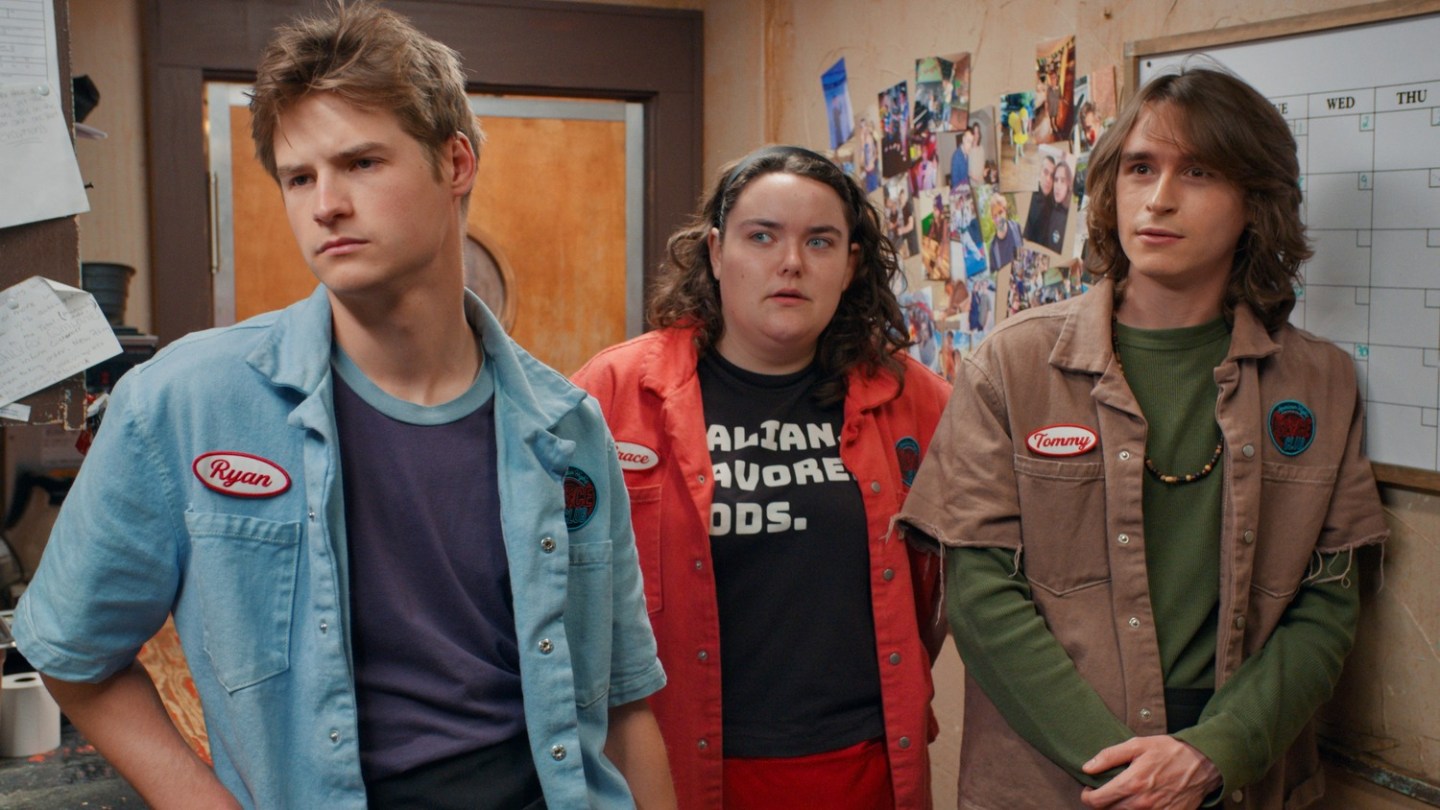
Logo text There were plenty of reasons why Quibi, the short-form streaming platform, failed within eight months of its 2020 launch. There was the poor timing, obviously: A streamer intended to offer viewers quick bites of programming perfect for wedging into a commute or office lunch break launched as a global pandemic was temporarily halting commutes and office lunch breaks. Minimum Wage The Bottom Line Not much substance, but fast and likable. Airdate: Monday, October 26 (Netflix)Cast: Aidan Micho, Grace Reiter, Hyde Healy, Julia Dicesare, Luke Burke, Ryan Micho, Tommy Armstrong and Randall ParkShowrunners: Jeremy Garelick and Will Phelps There was the silly, mispronounced name. (Though is “Quibi” actually sillier than “Tubi” or “Mubi?) Then there was the decision to offer a forward-looking format, which the streamer entrusted to a bunch of behind-the-curve showrunners who couldn’t distinguish between “actual micro-programming” and “traditional programming cut into 10-minute chunks.” I made fun of Quibi and I’ll continue to, but one thing I won’t deny: The executives behind Quibi were probably right that shorter episodes were a key element of the future of storytelling, if not the entirety of the future. Two weeks ago, Freeform released Coven Academy, a supernatural YA drama that aired on television with standard episodic lengths but then streamed with episodes running between 12 and 23 minutes. I won’t tell you that Coven Academy is a good show, but thanks to the length of episodes it moves along like gangbusters, especially at a time when power players like HBO and Netflix still insist that hour-long dramas should be closer to 65 or 70 minutes per episode if they’re “prestigious.” But longer isn’t exclusively better at Netflix. Enter Minimum Wage, a streaming version of the web series of the same name from the production company American High. The first season of Minimum Wage will be 28 episodes, premiering in two batches of 14 — I’ve seen the first batch — ranging between 12 and 20 minutes apiece. Like Coven Academy — in this particular way, but not most ways — Minimum Wage is wedged somewhere between the past and the present. Episodes are short, but still frequently feel padded. Much of the young cast, who are also the creators of the format and the writers and directors of most episodes, have evident and immediate potential — Grace Reiter has already landed a featured slot on Saturday Night Live — but they aren’t all ready for primetime. And maybe this won’t be a problem for people watching on tablets, phones or fancy watches, but on a big TV, the series looks as conspicuously cheap as it presumably was. Still, the episodes move along so fast and the bursts of talent emerge with enough frequency that Minimum Wage makes for an amusing, energetic, instantly disposable binge. Stars Reiter, Aidan Micho, Hyde Healy, Julia Dicesare, Luke Burke, Ryan Micho and Tommy Armstrong play characters with the same names, the only employees at the Slice Club, part of a chain of pizzerias in Upstate New York. There are no evident shifts at Slice Club, even though most of the characters are high school students. Expanding the world in and around Slice Club might have allowed for a little additional diversity to be inserted between the web series and the Netflix series, but that clearly was not a priority in a show that’s very white, very heteronormative and probably a bit blander than was necessary. Oh well. The only main character who isn’t underage is Burke’s Luke, a 20-something delivery guy who just started sleeping with the mother of Dicesare’s Julia, the home-schooled ingenue all the other guys might or might not be in love with (because when it comes to character relationships, Minimum Wage has only limited imagination). Reiter’s Grace is the manager, which doesn’t really matter very much. Armstong’s Tommy has a girlfriend who lives in “the city” — Albany — and with whom he’s constantly trying to break up. I’d be hard-pressed to give descriptions for most of the rest of the characters, because traits wax and wane in importance. Ryan Micho’s Ryan is a little more serious-minded and hoping to go to college. Aidan Micho’s Aidan is introduced as somewhat dumb and credulous, though those aren’t consistent details. Honestly, though, specifics barely matter for showrunners Jeremy Garelick and Will Phelps (Rolling Loud: The Movie). The things you need to know about Minimum Wage are that these characters work close to full-time at Slice Club, with “work” probably deserving to be in quotation marks; that they have no additional outside friends; and that Slice Club is the center of their lives and their social circle. It’s less a job and more a likably dysfunctional family. Hoping to make Slice Club function better is Terry Sylvester (guest star Randall Park), founder of the franchise. Terry is facing an ugly divorce and his wife is getting all the other stores, each profitable, leaving him with just this one branch, the only money-loser in the portfolio. Terry has big and not-so-big ideas for turning around the fortunes of this story, but really he just needs a basement to live in. With a jittery mockumentary style that is never explained or justified — just add it to the list of questions you don’t ask when you’re spending five or 10 minutes on an episode but that begin to pop up when the running times double or triple — Minimum Wage has a lot of The Office in its DNA, along with traces of Party Down, hints of Superstore, and a bit of the earliest DIY days of It’s Always Sunny in Philadelphia, minus the edge. There’s some Tires here, too. And maybe just a bit of the short-lived Special, one of the last times Netflix tried out the micro-comedy format. I don’t know if it’s a show that feels like it’s made by people with extensive food service experience, but it definitely feels like it’s made by people who have watched a lot of shows about food service and general minimum wage work. Despite those hints of Superstore, it doesn’t have anything meaningful to say about the condition of minimum wage employment in contemporary America. Some of the episodes have simply contained storylines, like the gang finding a pile of lottery tickets in an unoccupied booth and strategizing how to spend their modest winnings; the gang shooting a commercial for the restaurant; or, in the only episode that actually leaves Slice Club behind, the gang having a slumber party. Sometimes the plots are as simple as a small incident revolving around customers — an unruly high-school drama club, a couple dramatically breaking up over dinner — and sometimes there are hints of decently constructed farce. More than anything, though, Minimum Wage is a hangout show. Nobody’s really working very hard. Nobody’s the least bit stressed out about how many hours they’re working or how much money they’re making. Instead, they’re just goofing off and talking in rapid-fire, reference-driven bursts of dialogue filled with years of inside jokes and nods to things that happened earlier in the series. The dialogue is silly-smart and grounded with just enough heart to make you believe that these characters like each other, even if the nature of their relationships is vague. I think everybody other than Luke has a crush on Julia at some point and that Julia has a crush on at least two or three of the guys in a wholly innocent, never-been-kissed sort of way. Grace and Ray appear to have a closer friendship based on one episode featuring their escalating celebration of each other’s birthdays, but it’s a friendship that’s almost never relevant otherwise. Performance-wise, force-of-nature Reiter and likably loopy Dicesare have the most definition and are the most memorable. As for the guys, it’s an absolute blessing that they wear uniforms displaying their names the entire series; without that help, I’d have difficulty distinguishing between them and the characters they’re playing. Healy and Armstrong have the broader roles and don’t fit in as well when Minimum Wage tries to be naturalistic, but they get laughs. Ryan Micho flaunts well-utilized comic precision and Burke delivers hints of too-old-for-this-shit pathos. Park is the big addition here, and he pops up for a few minutes now and then, does something wacky and then goes unmentioned for an episode or two. It’s a good gig, and one to which he contributes a fair amount of his trademark unselfconscious energy. He’s a little bit too Michael Scott and not enough of an actual person, but that’s fine. Loose and populated by talented people, Minimum Wage fits in with a lot of the more web-friendly programming that Netflix has been tip-toeing around recently with podcasts and medium-jumping formats. It has “This is how kids are watching TV now” written all over it, without the self-important Quibi aftertaste. Nothing lingers and nothing is supposed to linger. Episodes would be perfect to watch on a short commute or during a lunch break.
‘Minimum Wage’ Review: Netflix’s Format-Breaking Hangout Series Makes Good on the Promise of Short Episode Running Times
Full Article
Original Source
Read the full article at Hollywoodreporter →KhanList aggregates and links to publicly available news content. We do not host full articles from third-party sources. Always verify important information with original sources.