
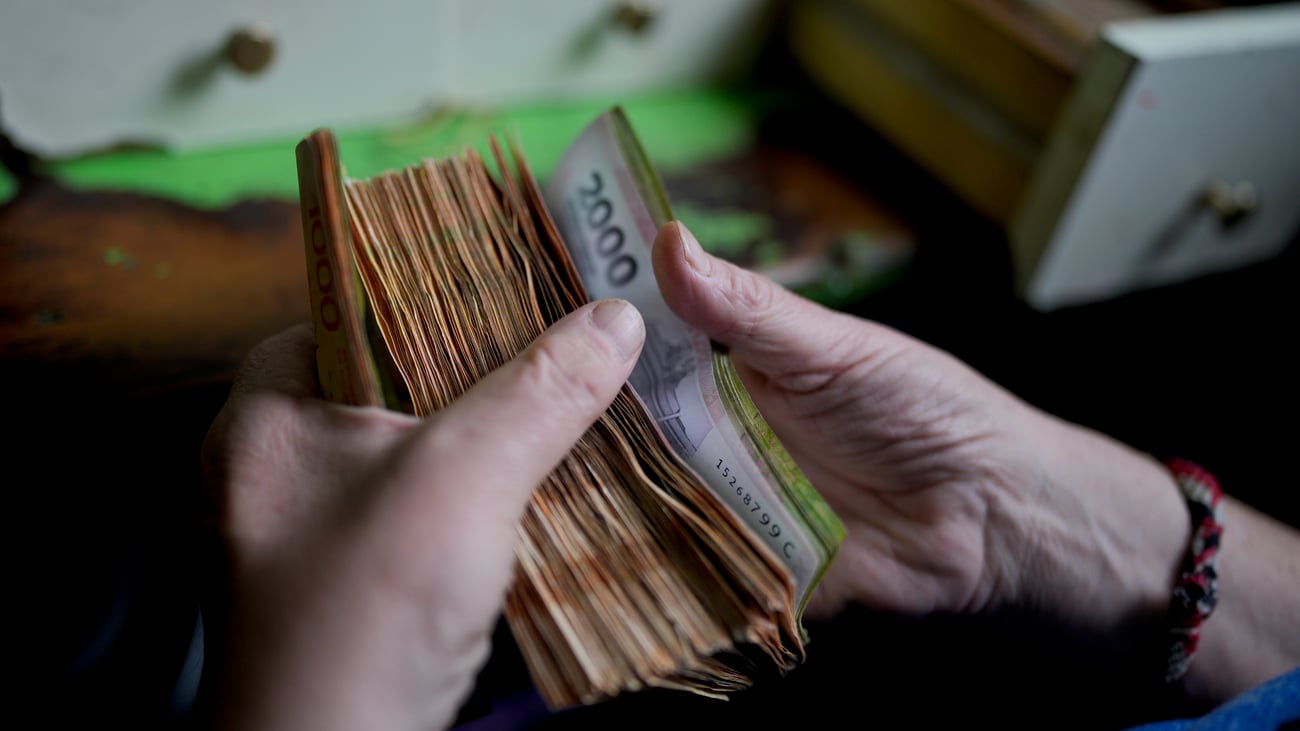
BUENOS AIRES (CN) — It all started with a credit card bill.Andrea, 60, had just lost a close relative and was facing unexpected expenses. She pushed the bill payment forward, covering only the minimum required by her bank. At the time, she owed roughly $130.But interest accumulated month after month, as did other living costs like rent and utilities. In an act of desperation, she took out a loan with Mercado Pago, one of Latin America’s top online financial services companies.One year later, Andrea now owes about $4,500 in bank and Mercado Pago debt. The company’s interest rates can amount to more than 1,375% annually, according to some estimates.“It became an uphill battle,” she said, speaking discreetly outside her office in downtown Buenos Aires. “It overwhelmed me.”Across Argentina, nearly 6 million people are in arrears, meaning they’re at least 90 days late on debt payments. Nearly 13% of Argentine families are in debt, and household indebtedness has reached record levels.According to Argentine consulting firm Management & Fit, 33% of indebted Argentines are using debt to pay for basic costs like food. And yet libertarian President Javier Milei has blamed the debtors, claiming without evidence that poor Argentines are falling into debt after buying televisions they couldn’t afford to watch World Cup games. In fact, data from Management & Fit shows that fewer than 10% of indebted Argentines got that way with appliance purchases.“The World Cup came and many people bought televisions,” Milei said in a recent speech. “What do you think is happening now? They stopped paying.”Argentina's President Javier Milei, center, talks after legislative provincial election polls closed in La Plata, Argentina, Sunday, Sept. 7, 2025. (AP Photo/Gustavo Garello)Milei, who won office in 2023 by pledging to fix Argentina’s chronically unstable economy, has slashed public spending and pushed privatization and deregulation.Inflation has slowed, market risk indexes have improved, and the country has strengthened its position with international lending organizations like the International Monetary Fund. But life has become harder for many citizens, who have lost purchasing power since 2024 and increasingly turned to informal gig work to make up the gap.Under Milei, financial deregulation has led to higher credit costs and increased rates of debt distress. Although personal loan rates from traditional banks have fallen, increasing numbers of Argentines are relying on fintech companies like Mercado Pago, where rates are significantly higher. Between the end of 2023 and August 2026, the percentage of Argentines in arrears ballooned from 4.2% to 17.5%.Opposition leaders have proposed more than 30 bills to alleviate the crisis — but Milei’s La Libertad Avanza (Liberty Advances) party hasn’t budged.Lilia Lemoine, a prominent lawmaker from the party, said in a recent TV interview that “it is not the job of any government to take care of the microeconomy.” Milei has likewise said he won’t consider any policy that could harm the country’s fiscal balance.“They’re trying to blame the government,” he said in a recent speech. “We said what we were going to do, and we kept our promises.” But with Milei facing reelection next year and opposition leaders now forming alliances over the debt issue, it remains to be seen how all of it will affect his political fortunes.As Liberty Advances defends its economic policies, growing numbers of regular Argentines are facing mounting debt burdens.An ad for Mercado Pago, entitled "Ganamos Todos" (Everybody Wins), shows a bus driver with the app open. Milei's government has pushed for deregulation for financial services like this one. (YouTube screenshot via Courthouse News)Andrea, who asked not to use her real name to protect her privacy, at first felt a sense of shame about her situation.She lives by herself. Working in the public sector, her salary has been frozen since the start of 2025 due to austerity policies. More than half of her $1,500 monthly earnings go to rent and utilities, while the rest goes to other basics including medical treatments, public transport and recently, debt payments.Realizing her debt was unmanageable, she asked her job’s human resources office for a salary advance. That’s when she learned she wasn’t the only one struggling: Many of her colleagues had discreetly asked for advances, too.“Until then, I was ashamed, feeling I had been unable to manage my own life,” she recalled. She also found relief in Movida Ciudad (City Movement), a Buenos Aires grassroots organization offering community and legal counseling for people like her. Its numbers are growing fast: In just the past six months, more than 200 people have asked to join.A few months ago, Elena Trotta’s financial situation became suffocating. A 43-year-old history teacher and single mother, her salary of roughly $600 per month was not enough to cover basic expenses. Her monthly rent rose to $570. She also has an 8-year-old son to support.To supplement her teaching income, Trotta started selling candles and cakes on the weekends. “I have never been in such a critical situation in my whole life,” she said in a phone interview. She’s gone nearly three months without making a debt payment and is close to falling into arrears. Although she says her current debt level is not enormous, she’s trying to avoid taking on even more debt or refinancing with the current high interest rates.Like many middle-class Argentines, Trotta carried debt shame. But like Andrea, she found comfort by networking with others in the same situation. In her case, it was the organization Endeudados Organizados (Organized Debtors).Trotta hopes to restructure her debt under terms she can actually afford. Until then, she says that organizing with other indebted people has given her a sense of hope she did not have before.“The movement, the mobilization, gives me hope,” she said.Draped in an Argentine flag, Javier Milei gesticulates wildly at 2021 rally for his La Libertad Avanza (Liberty Advances) party. (YouTube screenshot via Courthouse News)Milei was elected on a promise to fix the Argentine economy. But while some macroeconomic indices have gained strength, many everyday Argentines aren’t reaping the benefits.“The economic situation for Argentines was supposed to improve, but these levels of debt show that’s not happening,” said Luci Cavallero, a sociologist and part of Movida Ciudad. And with deregulation of the financial sector, she says the interest rates now charged by banks or fintech companies can sometimes amount to usury.Many citizens feel they are being asked to sacrifice without seeing benefits to their own economic well-being, Cavallero said. She says many people come to Movida Ciudad feeling overwhelmed with household finances and ashamed of their debt.Feelings of debt shame are particularly strong among middle-class Argentines, she said. Some do not even tell their families about the situation, instead choosing to confide in Movida Ciudad.“The state has to intervene,” Cavallero said.Experiences like Trotta’s and Andrea’s reflect a broader trend in Argentina, said economist Laura Vernelli.As basic costs have risen but wages have not, many have turned to debt to maintain their lifestyle.Real disposable income is 8% lower than in 2023. Factor in rent, building fees, utilities, internet and education, and the decline reaches 17%. Increases in utility rates, combined with deregulation of education and health insurance, are adding to the pressure.“People’s incomes are not keeping pace with mass indebtedness,” Vernelli said. The situation is particularly bleak for those working in the public sector, where incomes have fallen in real terms and new jobs are lower-skilled and lower-paid.She described the situation as paradoxical: Although Argentina has some of the lowest levels of household credit in the region, a large share of those who borrow fall into arrears. Rates of debt delinquency are at their highest levels since 2018.Banco Santander, one of the largest banks in Argentina, seen here in Junín, Buenos Aires. (Germanramos/Wikimedia via Courthouse News)All of it helps explain why in Argentina, the fastest-growing forms of borrowing are personal loans and credit-card debt, Vernelli said. For people like Trotta and Andrea, debt isn’t about buying new things: It’s about covering what they already owe and paying for the basic necessities of life.As more and more Argentines fall into the debt trap, shame around debt is giving way to feelings of solidarity and injustice.Andrea said her experience has changed the way she understands her own indebtedness. She now sees her situation not simply as a personal failure but as part of a broader problem.“The state has gone MIA,” Andrea said. “Yes, I got into debt, but I reached a point of desperation and took out a loan with outrageous interest.”“It’s not a consolation, but I understand that I’m not wrong, that it wasn’t my fault,” she said. “Now, we’re sitting down together to organize ourselves, to assert our rights.”Lucía Cholakian Herrera is a Courthouse News correspondent covering Latin America. She is based in Buenos Aires, Argentina.Subscribe to our free newslettersOur weekly newsletter Closing Arguments offers the latest about ongoing trials, major litigation and rulings in courthouses around the U.S. and the world, while the monthly Under the Lights dishes the legal dirt from Hollywood, sports, Big Tech and the arts.Additional Reads
Millions of Argentines face debt trap amid deregulation, rising costs
Full Article
Original Source
Read the full article at Courthousenews →KhanList aggregates and links to publicly available news content. We do not host full articles from third-party sources. Always verify important information with original sources.