
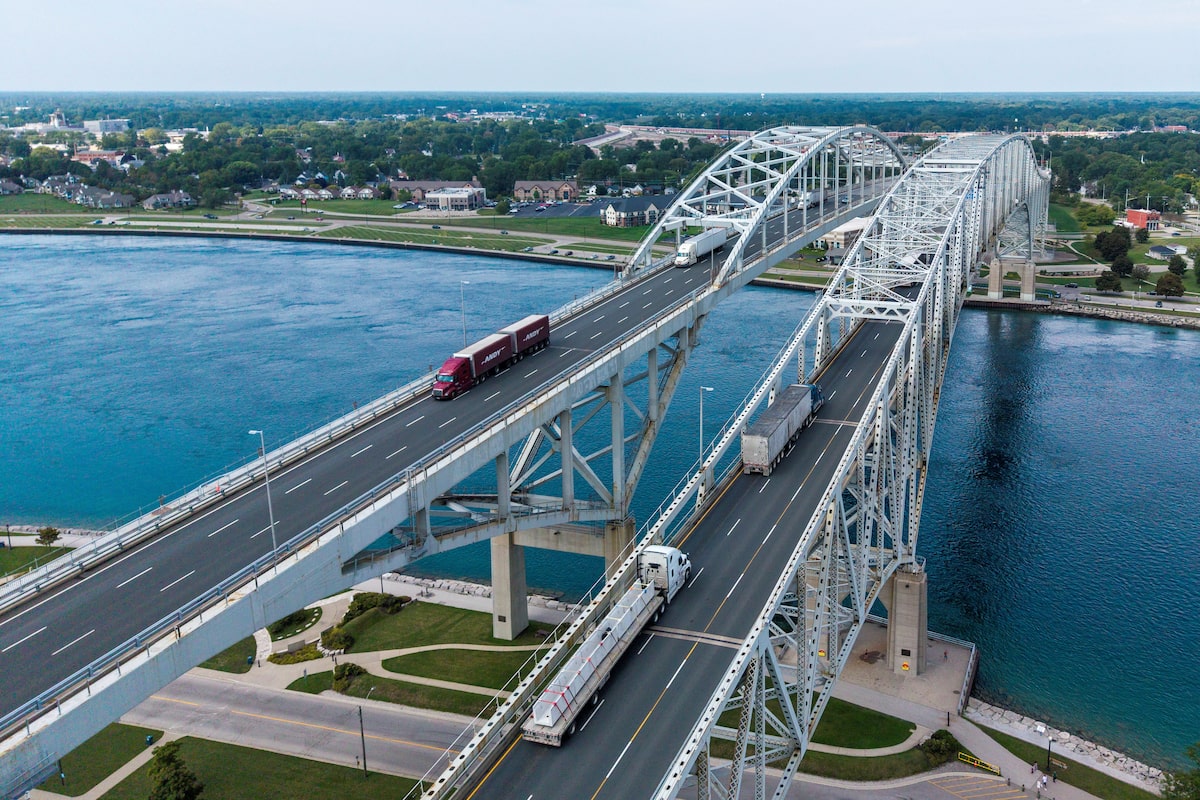
Open this photo in gallery:Vehicles cross the Blue Water Bridge between Sarnia, Ont., and Port Huron, Mich., on Wednesday.Carlos Osorio/ReutersFor a raft of businesses north of the U.S. border, the punishing 50-per-cent tariffs imposed by President Donald Trump represent an existential threat.For many south of the 49th parallel, the Canadian countertariffs expected to take effect next week look very different. Some expect pain, but not suffering.“Am I happy about what’s going on? Absolutely not,” said Daroll Frewing, owner of US Bowling, a family-run maker of pinsetters, bumpers and bowling lanes based in Nevada. “But is it something that I would fight for, for our company? No, it’s not worth it. Because it’s not that big a percentage of our business.”The Trump administration has frequently touted the overwhelming size advantage of the American economy in its increasingly pitched trade battles with Canada. “I don’t think you can be in a tit-for-tat with someone who’s 13 times larger than you are,” Treasury Secretary Scott Bessent said earlier this week. U.S. Trade Representative Jamieson Greer, meanwhile, called the sky-high tariffs – on more than $27-billion of Canadian goods, which Ottawa says it will match next week – “more their emergency than ours.”The dismissive response from U.S. leadership glosses over ways in which Canadian measures have caused real problems. Stripping U.S.-made alcohol from most provincial shelves has acutely stung makers of Kentucky bourbon and California wine alike. Northern U.S. towns, in particular, have seen a decline in business from the fall in cross-border travel.A high tax rate on U.S. goods, too, forms a protective economic rampart around Canadian-made alternatives.Here’s how Canada’s countertariffs could hit your walletStill, the insouciance of some U.S. manufacturers in the face of Canada’s looming action offers a striking reality check for those hoping Ottawa’s measures will spark a revolt. The U.S. Chamber of Commerce, the country’s leading industry group, has said only that it hopes negotiators return to the table, lest escalating tariffs raise costs and impede economic growth.Some manufacturers who spoke this week with The Globe and Mail had not even heard that new tariffs were coming.For bowling suppliers, “truly, Canada is not a big market to any of us,” said Mr. Frewing.The lengthy list of U.S. goods soon to be subject to Canadian tariffs includes furniture and milk products, steel goods, athletic supplies, golf clubs, motorcycles, chains, flooring, billiards tables and fishing rods.They stand to strike communities across the U.S. – Dalton, Ga., the American “carpet capital of the world”; Jefferson, Iowa, where American Athletic Inc. builds gymnastics equipment; and Woodland, the small city in southern Washington State that Alex Maslov calls “the Silicon Valley of fishing-rod manufacturing.” For decades, Woodland has been a haven of American-made lightweight fishing-rod blanks, graphite reel seats and carbon-fibre handles. In depth: From flower farmers to cheesemakers, meet the business owners affected by the trade warThe local industry was founded in the shadow of aerospace giant Boeing, whose materials expertise and supply chains – in carbon fibre, in particular – have helped to spawn a high-tech outdoors industry.Today, three-quarters of American-made fishing rods are manufactured in Woodland; the remainder in Park Falls, Wis. Foreign competition dominates the market, but domestically manufactured product still accounts for just under 10 per cent of U.S. sales. High-end goods made in Woodland are sent around the world, too.“We manufacture fishing rods for the global market. They ship to Asia and Europe. “And we do sell to Canada,” said Mr. Maslov.Still, the tariffs don’t have him especially worried. Roughly 10 per cent of sales go to Canada. A 50-per-cent tariff “makes it difficult for the U.S. domestic manufacturer to compete in Canada,” he said. “So, there’s definitely going to be an impact. Whether it’s completely crippling, I don’t believe so.”He is hopeful, nonetheless. Past tariffs have been defeated by legal action. Perhaps the same will happen once again. “Legal representation seems to be the way that tariffs end up being reversed in the long run. And we feel that this will end up going its way through the court system again.”In the meantime, “if goods are tariffed, business always finds a way to reduce tariffs, to move goods and services between geographies,” he said.Tim Shufelt: Trump’s push to isolate Canada falters as foreign investors start to buy inThose with long memories recall previous moments when tariffs have forced new ways of doing business. The fishing-rod industry in Woodland was built in part by Gary Loomis, a former U.S. Navy machinist and avid steelhead angler who began making carbon-fibre rods roughly a half-century ago.Today, Mr. Loomis remains a business partner with Mr. Maslov. Decades ago, he recalled, they turned to final assembly at a manufacturing facility in Canada to ease the burden of another round of Canadian tariffs. It’s an idea that the men have already discussed reviving this year.“A lot of companies will do the same thing, where they will set up kind of a midpoint assembly,” Mr. Maslov said. It’s simple math: $75 worth of components will incur a smaller tariff bill than a $200 finished product. Still, he worries that the sudden rush of tariffs between Canada and the U.S. will add to the burden on consumers already grappling with years of inflation. For makers of expensive fishing rods – and perhaps for others, too – it suggests a dimming of future fortunes.“If the tariffs do end up coming through on both sides and maintaining over the long term, it will slow the refresh cycle. Instead of buying a new fishing rod once a year, they may go to buying once every two or three years,” he said.“I do hope that cooler heads will prevail and our leaders will get back to the negotiating table and figure this out. Who this benefits in the end are manufacturers that are outside of the U.S. and Canada – and not domestic manufacturers.”
U.S. businesses think looming countertariffs will inflict pain, but not misery
Full Article
Original Source
Read the full article at Theglobeandmail →KhanList aggregates and links to publicly available news content. We do not host full articles from third-party sources. Always verify important information with original sources.