
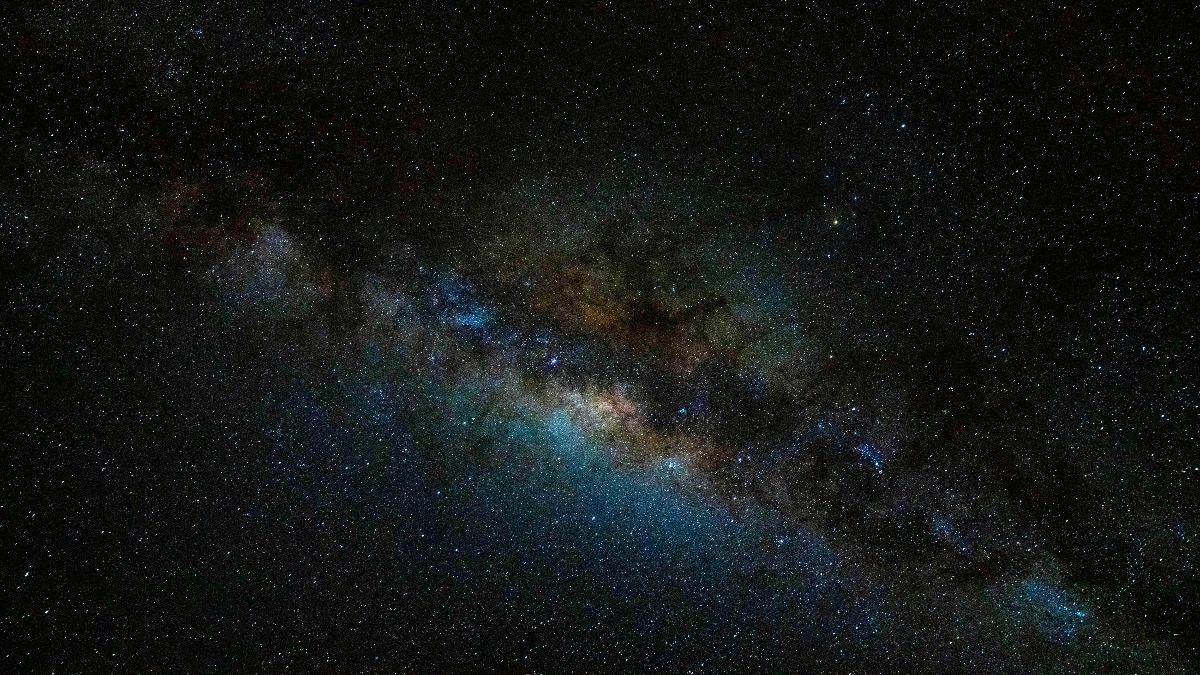
Several of the month's best sights can be seen without a telescope. Here's your guide to the best sights in this September's busy night sky.The Milky Way stretches across the night sky as seen from the Atacama Desert. (Photo: AP)September is bringing a packed show to the night sky.From a dazzling Venus and the hazy centre of the Milky Way to the year's Harvest Moon rising beside Saturn, there will be plenty for skywatchers to look out for this month.And the best part? Several of these sights can be enjoyed without specialised equipment.Here's what the month has in store. A man is seen skywatching. (Representational Photo: X) FROM MOON TO MILKY WAYBetween September 14 and 20, the Moon will act as a guide to some of the most recognisable sights in the evening sky.About an hour after sunset, look towards the south and find the Moon. As it moves across the sky from night to night, it will pass close to Antares, the bright reddish star marking the heart of Scorpius.The Moon will then point towards the Teapot, a distinctive group of stars in Sagittarius that looks remarkably like its namesake.From a particularly dark location, you may see a faint, cloudy band appearing to rise from the Teapot's spout. Silhouette of a telescope with the Milky Way in the background. (Photo: Pexels) That glow leads towards the centre of the Milky Way galaxy, marking a sight that is often and unfortunately washed out by city lights.VENUS TO TAKE CENTRE STAGEOn September 18, turn west shortly after sunset for one of the month's easiest-to-see sights.Venus will be at its peak brightness during its current evening appearance.The planet will appear low above the western horizon as an exceptionally bright point of light, shining brighter than any star nearby.A clear view towards the horizon will give you the best chance of seeing it before it sets.The following day, on September 19, is International Observe the Moon Night, giving skywatchers another reason to spend some time looking up. Silhouette of trees with crescent moon and Venus in the night sky. (Photo: Pexels) A HARVEST MOON MEETS SATURNThe month ends with another rare pairing.On September 26, the Harvest Moon will rise in the east shortly after sunset. Saturn will appear nearby, while much fainter Neptune will form a broad triangle with the Moon and Saturn.A Harvest Moon is the full Moon closest to the September equinox, traditionally associated with the period when farmers could harvest crops by its bright light.Saturn can be seen with the unaided eye, but Neptune is far harder to spot.At around magnitude 8, it is too faint for naked-eye viewing and will require binoculars or a telescope. An image shows the phases of the Moon in September 2026. (Photo: SciTech) September 22 also marks the September equinox, when the Sun is directly above Earth's equator and autumn officially begins in the Northern Hemisphere.For Indian skywatchers, the month therefore offers an invitation to find a darker patch of sky, look up and let the Moon, Venus and the stars guide the way.- EndsPublished On: Sep 5, 2026 12:44 IST
Milky Way, Moon and more: A guide to September's rare cosmic screenings
Full Article
Original Source
Read the full article at Indiatoday →KhanList aggregates and links to publicly available news content. We do not host full articles from third-party sources. Always verify important information with original sources.