
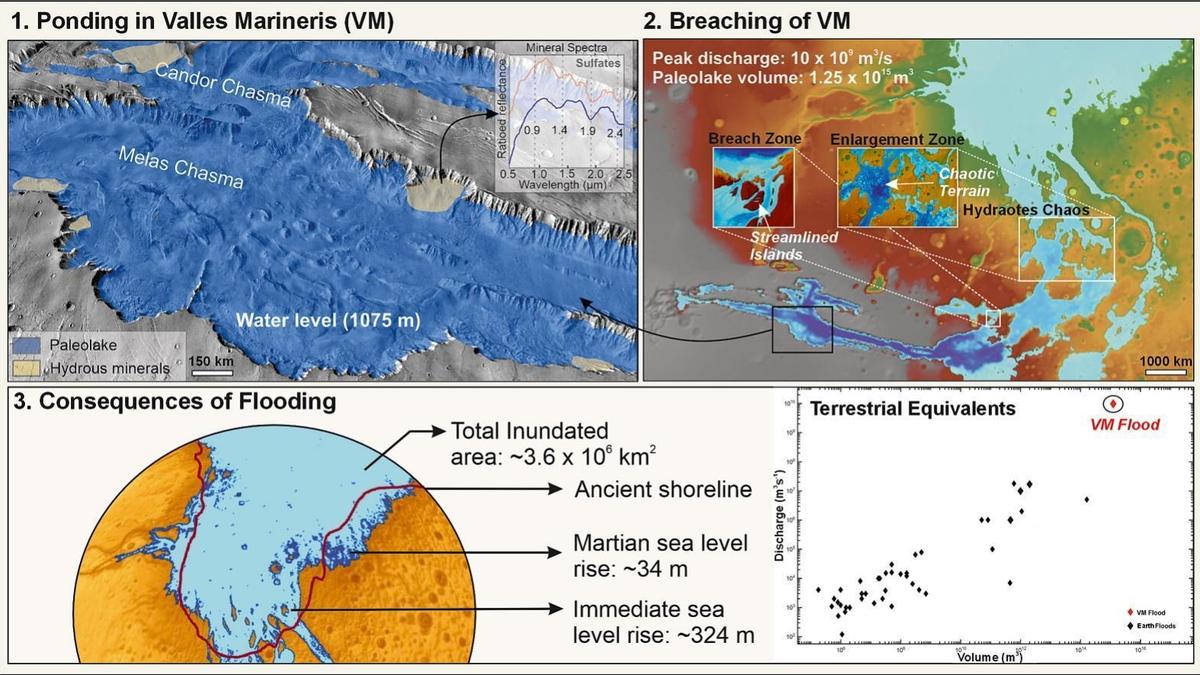
Valles Marineris stretches more than 4,000 km across Mars’s equatorial region and is thought to have once contained extensive bodies of water, including paleolakes. Researchers estimate that these waterbodies contained about 2,369 trillion cubic metres, with simulations suggesting that roughly half was released during the catastrophic breach. | Photo Credit: Special Arrangement The recent catastrophic flash floods in Nepal, apparently triggered by the collapse of a glacier rock mass that sent ice, rock, and sediment downstream, causing a sudden surge of water and debris in the river, highlight the destructive power of such events.A vastly larger outburst flood occurred on Mars during the Late Hesperian to Early Amazonian, when the breaching of paleolakes in Valles Marineris, the largest canyon system in the Solar System, unleashed a massive deluge. The flood, which originated in the ancient canyon system, is estimated to have released 1,245 trillion cubic metres of water and may have raised the global mean level of the hypothesised ancient Martian ocean by about 34 metres, according to a new study published online in the peer-reviewed journal Icarus.The researchers estimate that an equivalent discharge on Earth would have inundated about 3.6 million sq km of land.The study was conducted by Sajin Kumar, assistant professor in the Department of Geology, University of Kerala, and his team, along with researchers from the Indian Institute of Space Science and Technology, Okayama University in Japan, and the University of Mississippi and Michigan State University, both in the United States.The researchers used two-dimensional hydraulic modelling to reconstruct the flood and assess its impact on the hypothesised ancient Martian ocean.According to the researchers, the principal breach occurred at Eos Chasma, where the Valles Marineris trough connects eastward to Aurorae Chaos, allowing the floodwaters to escape. Smaller breaches were modelled at Daga Vallis and Columbia Valles, with the floodwaters routed through Chryse Planitia before ultimately reaching the northern lowlands and the hypothesised ancient ocean known as Oceanus Borealis.In addition to the estimated global mean rise, the hydraulic modelling showed the sudden discharge would have produced a local transient rise of 324 metres at the outflow terminus.Valles Marineris stretches more than 4,000 km across Mars’s equatorial region and is thought to have once contained extensive bodies of water, including paleolakes. Researchers estimate that these waterbodies contained about 2,369 trillion cubic metres, with simulations suggesting that roughly half was released during the catastrophic breach.Mr. Kumar said an equivalent discharge on Earth would have severe global consequences. “These would include the loss of habitable land and fertile deltas, disruption of marine ecosystems and ocean currents, and large-scale displacement of populations,” he added. Published - September 05, 2026 07:00 am IST
Valles Marineris flood may have raised ancient Martian sea level by 34 metres: study
Full Article
Original Source
Read the full article at Thehindu →KhanList aggregates and links to publicly available news content. We do not host full articles from third-party sources. Always verify important information with original sources.