
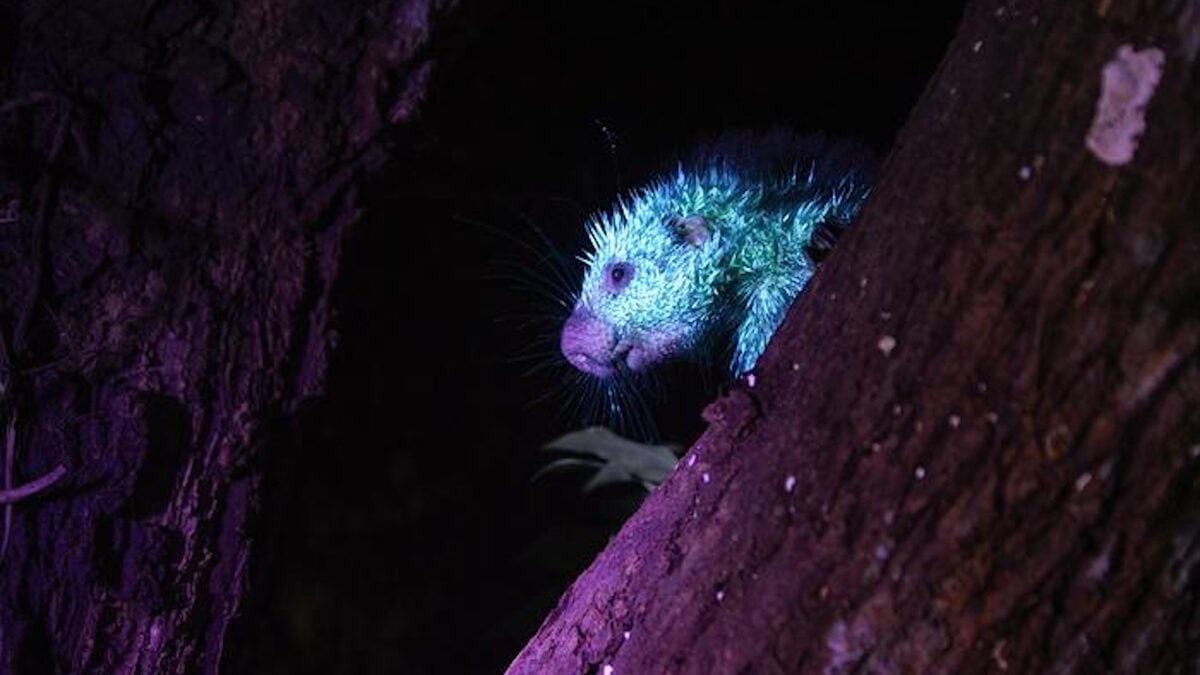
The trees of Mexico’s seaside city of Chetumal, along its southern border with Belize, have a small, solitary, nocturnal interloper who smells deceptively like human gym-rat body odor, the Mexican hairy dwarf porcupine. For years, conservation biologists and other wildlife researchers have been helping the city rescue, clinically test, and generally manage these smelly creatures as they climb around the city like curious, spiky toddlers. Now, thanks to a discovery by wildlife veterinarian Jonathan Pérez-Flores, that challenging odd job has gotten a bit easier. Mexico’s hairy dwarf porcupine, Pérez-Flores and his partners report in a new study, glows in vivid shades of blue, green, and yellow under ultraviolet (UV) light, like it’s on its way to a rave. The researchers argue that simple, off-the-shelf tools—like the consumer LED UV flashlight that Pérez-Flores employed—“could be a useful tool for locating these animals in the wild.” “To the best of our knowledge, no photoluminescence observations have ever been made in live individuals of the Mexican hairy dwarf porcupine (Coendou mexicanus),” Pérez-Flores, the study’s senior author, and his colleagues wrote in their study. But, then again, there’s a lot that scientists don’t know about C. mexicanus. While international conservationists list the porcupine in the “Least Concern” category, in terms of endangerment or extinction risk, its elusive nighttime habits have left the species largely a mystery. “Despite being a common species, there is a paucity of information regarding its basic ecology and behavior,” the team said. “Therefore, conducting nighttime censuses using ultraviolet light could be a useful technique for studying C. mexicanus populations in their natural habitat.” Another UV-lit image of the Coendou mexicanus porcupine out in the field. Credit: Jonathan Pérez-Flores Monkey-like porcupines Given the porcupine’s furtiveness, some of the more interesting aspects of how C. mexicanus interacts with its ecosystem have been inferred indirectly. The species typically hides out during the day in tree hollows and tangles of vines, only venturing out into the dense, leafy, tree cover at night—using its spineless, padded, prehensile tail much like a small primate would. This can leave the Mexican hairy dwarf porcupine off the usual low-elevation, low-angle trail cams that many conservationists deploy, according to biologist Vincent Losasso, co-founder of Costa Rica-based Guanacaste Wildlife Monitoring. “The large majority of my camera traps are located on the forest floor where I very rarely record porcupines themselves,” Losasso explained in a 2023 essay for the Tico Times. “However, on several occasions, I’ve recorded evidence of their existence in the form of ocelots walking around with a bunch of quills in their face.” A glowing inquiry Working with his colleagues at Mexico’s publicly funded research center El Colegio de la Frontera Sur (ECOSUR), Pérez-Flores spent three months after his initial UV flashlight discovery methodically reproducing these findings. A total of 20 adult hairy dwarf porcupines, 17 females and three males, were temporarily captured and studied for their UV-induced photoluminescence. And two naturally preserved older specimens were taken out of ECOSUR’s museum for similar analysis. “All the porcupines exhibited photoluminescence, but the live animals did so with greater intensity and in different colors (blue, green, and yellow) compared with the museum specimens, which had an ambiguous yellow-green photoluminescence,” the team wrote in its study, published this November in the journal Neotropical Biology and Conservation. Quills of the living porcupine (A and B) glowed more vividly under UV light than those of the 10-year-old museum specimen (C and D). Credit: Pérez-Flores, et al. / Neotropical Biology and Conservation This distinction may one day help explain the exact biological mechanism for how, if not why, this species glows under UV light in this way. But Pérez-Flores and his team are interested in the why, too. The researchers hope future research may help explain whether or not C. mexicanus—like many birds, snakes, and even reindeer—possesses the special pigments and/or retinal cones in its eyes required to detect otherwise invisible ultraviolet light itself. They also hope to learn if the porcupine’s neon glowing quills help it with intra-species “communication, mimicry, or camouflage.” But, for now, the “ecological and communicative role of the trait is unknown.”
Mexico’s Nocturnal Porcupine Has Been Keeping a Secret. It Glows in Neon Colors Under UV Light
Full Article
Original Source
Read the full article at Gizmodo →KhanList aggregates and links to publicly available news content. We do not host full articles from third-party sources. Always verify important information with original sources.