
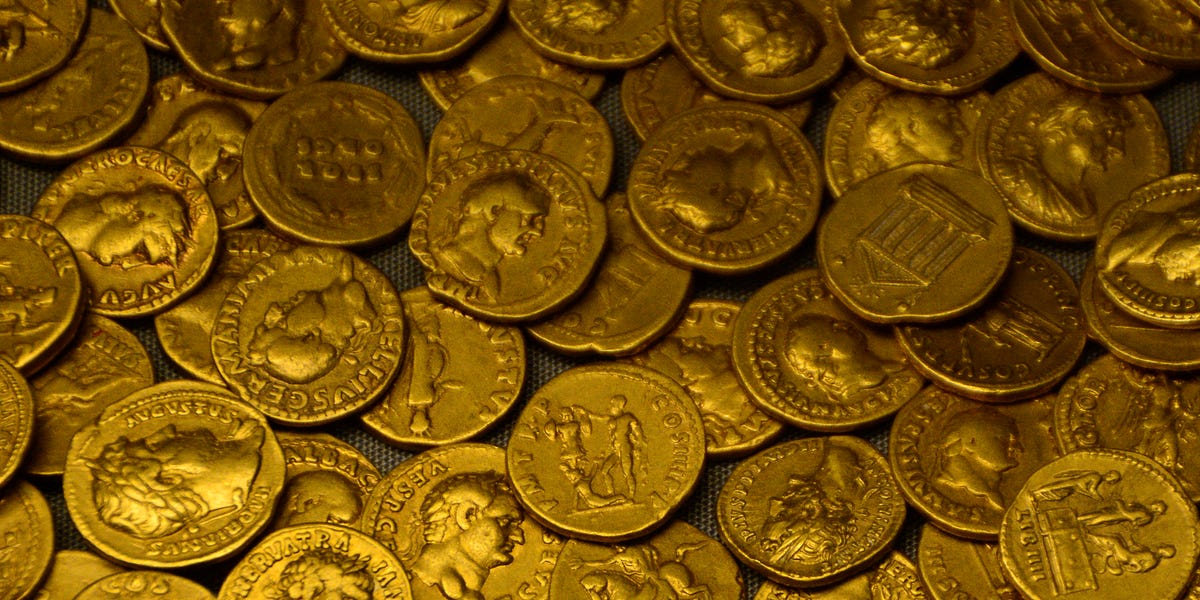
5 min readHere’s what you’ll learn when you read this story:In 2018, an amateur discovery of ancient gold coins in Luxembourg led archaeologists to even more coins, totalling 141 coins in all.Dated to between 362 and 402 C.E., the coins were minted in different locations, but the most surprising find is that many originated in Anatolia. Who deposited the coins during the late 4th century, and why they were deposited, remains a mystery, as there were no serious crises at the time. Sometime during the mid- to late-fourth century, a hoard of gold coins stamped with the faces of Roman emperors was buried in a field in what’s now northern Luxembourg. Why the stash was buried, and who buried it, remain unknown. It’s possible whoever secreted it away might have thought they would return for it. But after about 1,600 years, the hoard was still waiting to be uncovered until a pair of fieldworkers with a metal detector came upon it at the previously surveyed site of Um Rank in Holzthum, Luxembourg. They had no idea what it was about to reveal—or that it would stay secret for years.After the fieldworkers reported the 38 gold coins they’d found to the National Institute for Archaeological Research (INRA) in September 2019, the institute launched an excavation project that would unearth the remains of a type of Roman fortification called a burgus. These formidable stone watchtowers were often several stories high, and their remains have been found in locations throughout the extensive area once covered by the Roman Empire. The archaeologists searched where the metal detectorists found the first 38 coins, and they soon found more for a total of 141 gold solidi, or pure gold coins, from the late Roman period. There may have been more at the site in antiquity, but it suffered damage during World War II. It was only after the completion of extensive excavations between 2020 and 2024 that the government of Luxembourg officially announced their discovery.Researchers David Wigg-Wolf, David Weis, and Lynn Stoffel examined the coins closely and determined that they’d been minted between the years 362 and 402 C.E. The coins came from nearly every Roman mint operating during that period. They also depict almost every emperor of the era, omitting only Magnus Maximus and his son and co-emperor, Flavius Victor. Especially surprising was that no remotely similar regional assortment was listed in Coin Hoards of the Roman Empire, an Oxford database of some 14,000 hoards from across the empire. What stood out above all was that 17 coins, more than a tenth of the total, were struck at a mint in the ancient Anatolian city of Nicomedia. No comparable regional hoard on record contains so many coins from that city, which was Diocletian’s imperial seat in the East on the site of today’s İzmit, Turkey.“The hoard contains several noteworthy pieces, including two fragmentary plated coins of the RESTITVTOR REIPVBLICAE type, a type that was produced in large quantities in 364-367, as well as by Magnus Maximums in smaller number in 383-388,” the researchers said in a study recently published in Schweizer Münzblätter. “Judging by the style forte bust, one of the plated coins is most likely an imitation.”Other coins betrayed that they were not completely made of gold. Despite being stamped with the bust of an emperor and appearing official, one of them had a dark sheen that seemed to indicate that it had higher levels of tin (seen as valuable at the time because of its rarity in Earth’s crust) or silver. Its actual metal content has not yet been analyzed. Another coin’s bent edge shows that the metal disk it was made from was not the usual single layer, but actually two bonded layers. This could mean the original sheets of metal the disks were cut out from had been hammered and bonded beforehand. The coin in question could have had its layers separated because it was cut from where the two strips met, been dented during World War II, or affected by agricultural activity later on. Wigg-Wolf, Weis, and Stoffel plan to analyze it soon.Also unexpected was the significant number of coins that had come from the bustling trade hub of Antiochia. While these coins date between 364 and 367 C.E., Emperor Caracalla had journeyed there about a century and a half earlier, which explains why Antiochian coins have been found in other hoards from Luxembourg, Belgium, Western Germany, and the Netherlands. Later coins that arrived in Antiochia would have been stamped with the profile of Emperor Valentinian I right after he arrived in Ancyra (now the Turkish city of Ankara) with his army and was given the name Augustus.Why the cache was buried remains a mystery. Though the researchers scoured records, they couldn’t find any battles, crises, times of political upheaval, or other reasons that would explain why the hoard’s owner needed to hide that much wealth, though they reasoned that the coins might serve as a record of how imperial troops moved through the territories they conquered. The Nicomedia and Antioch coins likely traveled west in soldiers’ purses. They were all minted between 364 and 367, C.E., a period when Valentinian I was proclaimed emperor in Anatolia, paid out accession donatives in gold, and then marched west to defend the Rhine frontier at Trier, barely 50 kilometers from Holzthum. Why the coins were buried three decades later, around the year 395, is a different question, but it’s likely that the hoard survived because nobody ever came back for it. Based on the rarity of some coins and their remarkable state of preservation, Luxembourg’s Ministry of Culture paid roughly $322,000 to acquire the hoard for the state.Further study may uncover where the coins traveled and the reason they were left behind.“There are no specific historical situations or events with which the depositions and non-recovery forte Holzthum hoard can be directly connected,” the researchers said. “The hoard post-dates the usurpation of Eugenius, and the political and military situation in the region was stable into the early fifth century…the situation only changed with [later invasions].”Elizabeth Rayne is a creature who writes. Her work has appeared in Popular Mechanics, Ars Technica, SYFY WIRE, Space.com, Live Science, Den of Geek, Forbidden Futures and Collective Tales. She lurks right outside New York City with her parrot, Lestat. When not writing, she can be found drawing, playing the piano or shapeshifting.
Metal Detectorists Dug up 141 Roman Gold Coins—Along with a 1,600-Year-Old Mystery
Full Article
Original Source
Read the full article at Popularmechanics →KhanList aggregates and links to publicly available news content. We do not host full articles from third-party sources. Always verify important information with original sources.