
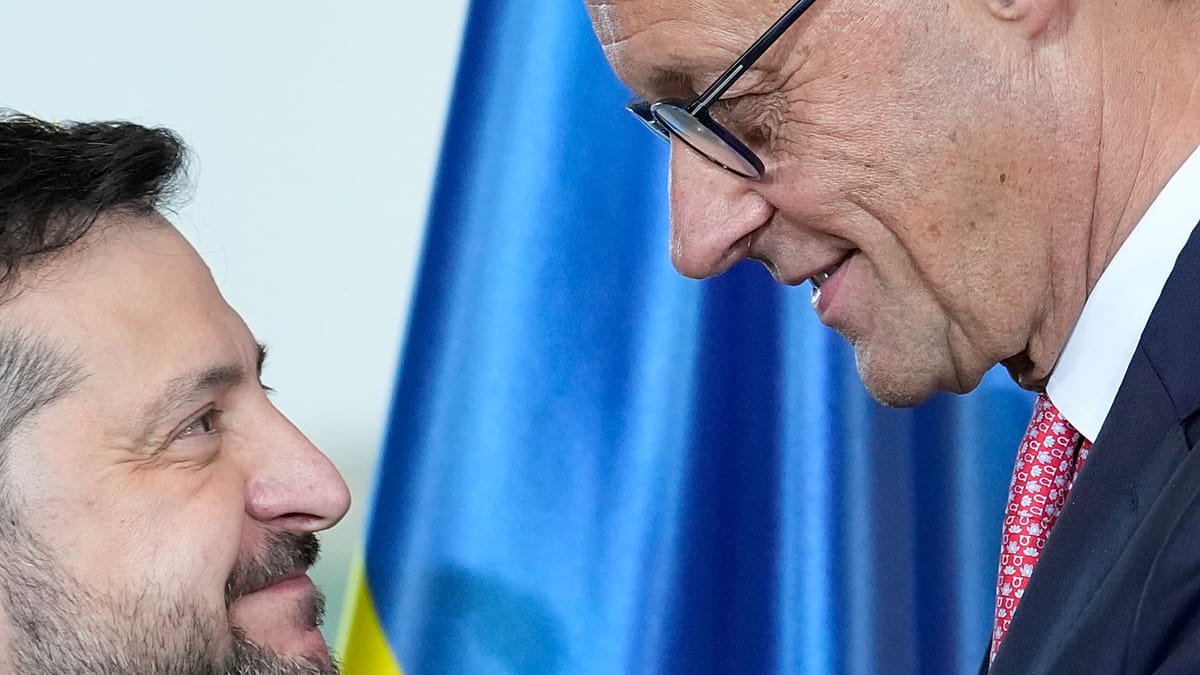
No Ukraine, no budget. German Chancellor Friedrich Merz is threatening to block the EU’s next long-term budget unless all member states commit to financing Ukraine beyond 2027, a move that could open a new front in the already fraught MFF negotiations. ADVERTISEMENT ADVERTISEMENT Berlin wants governments to agree a durable funding arrangement for Kyiv, including covering the cost of servicing Ukraine-related debt, as Ukraine faces an estimated €70bn funding shortfall next year. The German leader is not alone in thinking that the EU budget should bring a permanent solution to Kyiv's financial needs. "To have an honest multi-annual budget for Europe, that has to involve considering the question of the funding for Ukraine,” Ireland's Finance Minister Simon Harris said in reply to my colleague Jorge Liboreiro’s question. “Any other conversation would be an incomplete one.” The EU intends to cover roughly €45bn of the gap, on top of the €90bn Ukraine Support Loan already agreed for 2026-2027. Hungary, Slovakia and Czechia opted out of that loan and are not expected to contribute to any top-up. Bulgaria has also signalled it will not contribute further. However, Merz wrote that the solution should be the result of a “collective commitment that all of us, without exception, will contribute fairly,” suggesting he is opposing additional opt-outs. Regarding possible opt-outs from a new loan, Economy Commissioner Valdis Dombrovskis said proposals to cover Ukraine’s financing gap should be backed “by the EU27, not by the EU24 or any number of countries”. At the same time, Germany, which is part of the “frugal” countries seeking cuts to the EU budget, had already tried to tie the budget talks to Ukraine financing at the special European Council at the end of the month, to put pressure on the “Friends of Cohesion”. In other words, Merz’s gamble raises the stakes further, but it could backfire. Countries that want to opt out of financing Ukraine could feel cornered if they are made to pay for Kyiv and also accept cuts to cohesion funding. In a post-Orbán EU, expect Slovakia’s Robert Fico to play disruptor-in-chief. Outside of the triangle. The EU will send a joint team of senior officials from the European Commission and the European Council to the US-mediated peace talks between Ukraine and Russia taking place today and tomorrow in Abu Dhabi, aiming to secure Brussels a presence in negotiations that could shape the continent’s future security architecture. The delegation will be led by Björn Seibert, head of Commission President Ursula von der Leyen’s cabinet, and Anna-Maria Boura, chief foreign policy adviser to European Council President António Costa. The EU team will be joined by national security advisers from France, Germany and the UK. Italy will also be represented, as part of a wider E4 format, after Prime Minister Giorgia Meloni criticised Rome’s exclusion from the talks. NATO will be represented by Geoffrey Van Leeuwen, chief of staff of NATO Secretary-General Mark Rutte. The precise format of European participation remains unclear, with the main negotiations between Ukraine, Russia and the US expected to stay trilateral. European officials have left open the possibility of engaging directly with the Russian delegation, although it is not yet clear whether such a meeting will happen. "Any meaningful discussions about Europe's security architecture can only be undertaken once a ceasefire in Ukraine has been achieved. It must take place in an appropriate forum, in particular with NATO allies and EU members," von der Leyen said at a press conference in Bucharest yesterday, in an indirect reply to US Special Envoy Jared Kushner. Ukraine’s delegation chief Rustem Umerov has confirmed that Kyiv will hold separate coordination meetings with its European partners in Abu Dhabi. Sink or swim. Von der Leyen completes her two-day whistlestop tour of Romania and Bulgaria today, seeking to respond to escalating security threats after drone attacks on commercial ships killed seafarers in the Black Sea. As Angela Skujins writes in, von der Leyen announced on Monday in Bucharest, alongside Romanian President Nicușor Dan, €10m for Romanian search-and-rescue operations. Dan has said the Black Sea will only become truly safe once Russia’s invasion of Ukraine ends. She also pledged to fast-track the Black Sea Maritime Security Hub, with a “clear timeline” for its completion and an additional €50m in dedicated funding. Ironically, she did not provide an exact timeline nor a completion date. The hub is a centrepiece of the Commission’s Black Sea Strategy, published in May 2025. Former NATO Secretary-General Anders Fogh Rasmussen told Angela that stronger security in the strategic maritime corridor could follow the Baltic Sea template. “We should set up a maritime mission in the Black Sea to ensure free navigation,” he said. Iran’s frosty attacks. French Foreign Minister Jean-Noël Barrot, speaking on the sidelines of the G7 foreign ministers’ meeting in France, blamed Iran’s Islamic Revolutionary Guard Corps for last month’s cyberattacks on supermarket refrigerators. The attacks hit thousands of refrigeration units across at least 350 French supermarkets. Barrot said the Iranian ambassador would be summoned and that the issue could prompt further European action. "If they are attributed, our response should be stronger", EU foreign policy chief Kaja Kallas said, indicating that the issue will be on the table of the next Foreign Affairs Council on 16 November. The ECB package. The President of the European Central Bank, Christine Lagarde, has kicked off the race to succeed her by announcing her resignation a few months ahead of the French presidential elections. In fact, there are two other senior posts at the ECB up for grabs, namely the chief economist and an executive board member. "This is quite unprecedented," Kyriakos Pierrakakis, Greek Finance Minister and Eurogroup President, told Euronews. "Many see this as a package; I think this is fair," he said, pointing to the need to reach a decision at leaders' level by the end of the year. The contest for Lagarde's succession is centred around Pablo Hernández de Cos of Spain and Klaas Knot of the Netherlands. Spanish Economy Minister Carlos Cuerpo told Euronews his country's economic performance, with consistent growth, reduction of the debt-to-GDP ratio and investor confidence, gave the candidacy a strong basis. However, Madrid is heading toward elections this month, with Prime Minister Pedro Sánchez due to skip the informal European Council in Dublin on Friday. "What we are presenting is a Spanish candidate, not a governmental candidate," Cuerpo said. UK’s final push. UK Business Secretary Jonathan Reynolds and European Relations Minister Hamish Falconer are in Brussels today to iron out the final details ahead of the UK-EU summit on 20 November. They will meet Executive Vice-President Stéphane Séjourné and Commissioners Maroš Šefčovič and Andrius Kubilius to discuss industrial cooperation, space and UK-EU supply chains. Expect the definition of “Made in Europe” to be a sticking point, as London has been pushing to be included in the EU’s local-production regime for public contracts under the proposed Industrial Accelerator Act. Dukes in da hood. There might be even more noteworthy Brits walking around Brussels today, as Prince Harry and Meghan Markle, the Duke and Duchess of Sussex, are expected in the European Parliament to attend the opening of Lost Screen Memorial, an exhibition honouring children who lost their lives after experiencing harm on social media. Europe talks green at COP31 – but scrambles for more fossil fuels Brussels wants the COP31 to speed up the transition from fossil fuels, but in a world where energy security and affordability are rising up the agenda, more and more governments are seeking short-term oil and gas options. While European leaders gather at COP31 to discuss how to wean their economies off fossil fuels, many of their governments are scrambling to secure more of them. The energy turmoil triggered by the US-Israeli war on Iran has kept oil and gas at the centre of Europe's economic and geopolitical calculations. Faced with soaring energy prices, potential supply shortages and mounting pressure from struggling industries, several EU governments are prioritising affordable, reliable energy over longer-term climate commitments – even as delegates at the UN climate summit debate how to phase out fossil fuels. Although all 27 member states have endorsed the EU's position at COP31, the reality on the ground tells a different story. Marta Pacheco and Sandor Zsiros have the story. More from our newsrooms Trump says post-war Ukraine will have a 'different shape' ahead of Abu Dhabi talks US President Donald Trump suggested that Ukraine's territory could change as part of a future agreement with Russia, days before US-mediated talks between Kyiv and Moscow in Abu Dhabi. Sasha Vakulina has the report. Viktor Orbán's brother reportedly detained over suspected people-smuggling Viktor Orbán's brother, Áron Orbán, has been taken into custody on suspicion of people smuggling, Péter Magyar said on his Facebook page on Monday. Read more. EU to blacklist ten manipulative online design 'traps', leaked draft shows From fake notifications to free trials that quietly turn into paid subscriptions, the Commission’s long-awaited Digital Fairness Act would name and ban the traps that keep users clicking, spending and subscribed. Simon Ormiston has the details. We’re also keeping an eye on Commission President Ursula von der Leyen travels to Bulgaria for talks with Prime Minister Rumen Radev and a visit to the Nikola Vaptsarov Naval Academy. G7 foreign ministers continue their meeting in Paris, with discussions focused on Ukraine, Iran and Middle East security. EU finance ministers meet in Brussels for the Economic and Financial Affairs Council (Budget), focused on the 2027 EU annual budget. Defence Commissioner Andrius Kubilius participates in the second board meeting of the EU-Ukraine Drone Alliance in Brussels. Research Commissioner Ekaterina Zaharieva opens the European Research and Innovation Days 2026 in Brussels. Trade Commissioner Maroš Šefčovič co-chairs the EU-UK Withdrawal Agreement Joint Committee alongside UK Minister Hamish Falconer. COP31 in Antalya focuses on energy and transport, including energy security, electrification and the diversification of energy supplies. That’s it for today. Angela Skujins and Jorge Liboreiro contributed to this newsletter.
Merz’s budget gamble: no Ukraine funding, no EU budget
Full Article
Original Source
Read the full article at Euronews →KhanList aggregates and links to publicly available news content. We do not host full articles from third-party sources. Always verify important information with original sources.