
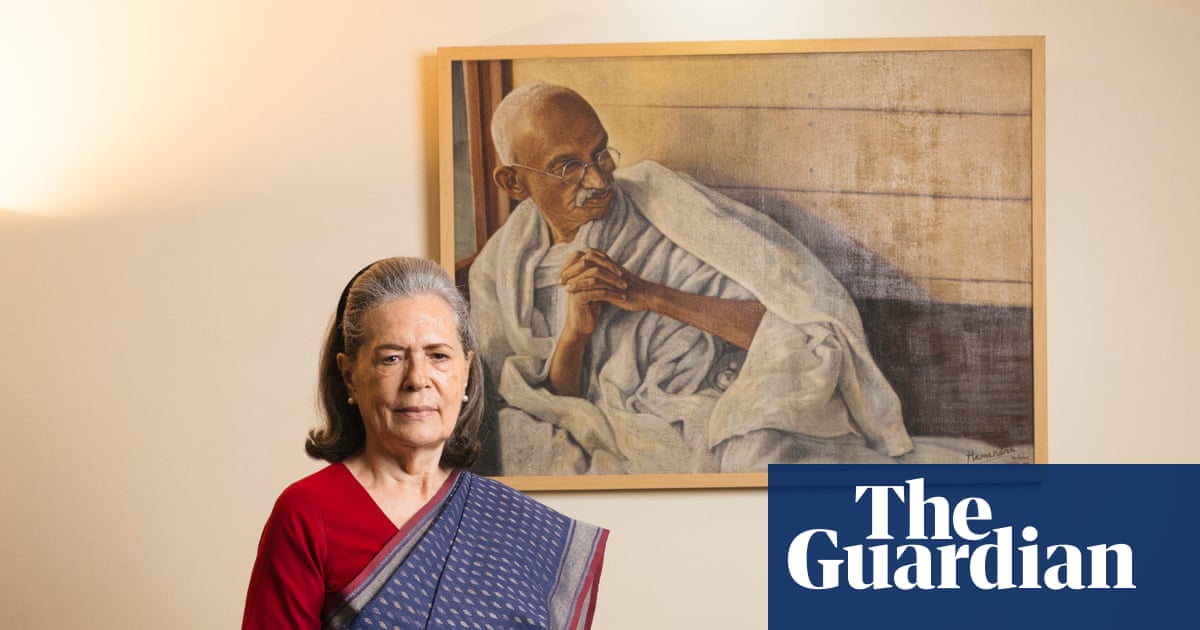
Few love stories have been as closely entwined with a nation’s history as that of Sonia and Rajiv Gandhi. The former’s much-awaited political memoir, Belonging, offers a strikingly candid account of her journey from a small town in Italy to the highest echelons of power in India – all for love, she says.The veteran Congress party leader has been fiercely protective of her personal world. In Belonging, she opens up for the first time about the extraordinary twists and turns of a life that has largely unfolded in full public view. (The Guardian’s Hannah Ellis-Petersen has a rare in-person interview with Gandhi, and you can read an excerpt from the book here.)Belonging, published today, contains moving glimpses of Gandhi’s private grief. She writes about the loss of her first child, who died shortly after birth, and the chilling discovery of grenades in a room of their house after Operation Blue Star, the 1984 military operation against Sikh separatists at the Golden Temple in Amritsar. She also provides a ringside view of several turbulent chapters in Indian politics, not least the violent assassinations of her mother-in-law, Indira Gandhi, in 1984 and her husband, Rajiv, in 1991.Her book also revisits some of the darker episodes that have dogged the Gandhi family and the Congress party, including Indira’s imposition of the Emergency in June 1975, a 21-month period during which civil liberties were suspended, political opponents were jailed and the press was gagged, which caused fear and dismay across the country. In Gandhi’s account, italso caused a rift within the family.Ultimately, Gandhi’s memoir is a vivid record of six decades of India’s political transformation from the Congress-dominated secular republic she moved to in 1968 until today, when Hindu nationalism has become the dominant political force under Narendra Modi.Here are five key takeaways from her memoir and what they reveal about the state of Indian politics today.Gandhi has had no real contact with Modi for the last 12 yearsSonia Gandhi, widow of former Indian prime minister Rajiv Gandhi, shown in March 1998 when she was elected president of Congress party. Photograph: John Mcconnico/APGandhi’s account offers a glimpse of how deep the political polarisation runs in Indian politics today. In one revealing passage, Gandhi writes that she has had “practically no real contact” with Modi in the 12 years he has led the nation. In fact, at times when the two have been in the same rooms, such as the speaker’s small chamber, Modi “tends to look away, avoiding eye contact”, she says. On occasion, she adds, he has asked briefly about her health after a hospital stay.For her, this breakdown is a departure from the past, when leaders on opposing sides of the aisle “would treat one another with cordiality”. After the 2001 terror attack on parliament, Gandhi immediately called then-BJP prime minister AB Vajpayee to enquire about his safety, a gesture he appreciated.Gandhi sees an increasingly authoritarian style of politics, in which those in power seek to “belittle and torment” opponents. For years, Gandhi’s son, Rahul, has been the subject of BJP’s ridicule, which calls him Pappu, a derisive term intended to portray him as inexperienced and naive. She adds that similar things are happening elsewhere in the world, an observation that can be read in the context of US President Donald Trump’s use of personal insults and ridicule against opponents.It’s lonely at the top for India’s female politiciansIndia has an illustrious history of women occupying top leadership positions, long before many other democracies. But their rise has often come at a cost – that of loneliness in navigating a male-dominated political world.In the book, Gandhi describes a 2012 conversation with Hillary Clinton on the countrys’ female leaders and their backgrounds. In her recollections of Indira, she shares that, despite wielding authority, Indira could feel besieged and profoundly alone, and this was particularly acute, Gandhi writes, in the months leading up to the declaration of the Emergency by her mother-in-law.Gandhi also writes of her own isolation, including when she decided to take on the leadership of the Congress out of a sense of duty to her family’s political legacy.Those in power are increasingly stonewalling the pressA poster showing Indian prime minister Narendra Modi at a protest by the Congress party and its allies in New Delhi on 1 November. Photograph: Manish Swarup/APAmong the many ways in which Gandhi charts the erosion of India’s democratic conventions in Belonging, one particularly telling shift is the changed relationship between the media and those in power. She recalls a time when journalists had opportunities to question prime ministers directly.In 12 years in power, Modi has not addressed a single press conference on his own. He has sat in on one press briefing at the conclusion of an election campaign, and appeared alongside US presidents at joint press encounters after bilateral meetings, where they took questions from the press. Modi has consistently avoided facing journalists in an open forum, and his media interactions have largely been one-on-one interviews with sympathetic, pro-government news anchors or in one much publicised exchange with a Bollywood actor who asked him how he liked to eat mangoes.And it’s not just media …The book’s publication has brought renewed attention to concerns about the space for free expression in contemporary India, and the extent to which apprehensions about repercussions may influence what can be said, written and published.Penguin Random House India was to publish Gandhi’s memoir but withdrew from the project in August. Gandhi told the Guardian that it was “uneasy in general with the criticism of the government” and said it had dropped the book after she declined certain suggested edits. Penguin has disputed her account, saying that the suggestion it decided not to publish the book because of refused editorial changes “does not accurately reflect the circumstances”.The book, released in the US by Alfred A Knopf, is being published in India by HarperCollins.In June, Penguin had also pulled out of plans to distribute graphic journalist Joe Sacco’s The Once and Future Riot, about the 2013 Muzaffarnagar communal violence. The publisher cited an inaccurate map of India and unresolved citation issues. Sacco, however, blamed the decision on the “current political climate in India”.She’s had quiet fallouts with the ‘thoroughly dishonest’Western political memoirs, particularly by former heads of government or senior politicians, are often forthcoming in naming political adversaries, recounting private exchanges and offering candid assessments of colleagues. David Cameron’s 2019 memoir, For the Record, took aim at his former friend, Michael Gove, describing him as “mendacious” and a “foam-flecked Faragist”.skip past newsletter promotionafter newsletter promotionGandhi, in contrast, is restrained. She writes warmly of the closeness between the Gandhi family and that of Bollywood superstar Amitabh Bachchan, whose parents she lived with when she first moved to India, but she makes no mention of the subsequent estrangement between the two families. In another instance, she does not name the political leader she describes as “thoroughly dishonest” and who she says she trusted in 1999, when Congress unsuccessfully attempted to form a coalition government.What else we’re reading aboutA painting from the series, When No One Moves by Baaraan Ijlal, who is showing at Art Mumbai. Photograph: Artist Baaraan IjlalArt | Art Mumbai runs from 12-15 November at the Mahalaxmi Racecourse. Among the highlights of this year’s edition is artist Baaraan Ijlal’s collaboration with the celebrated lyricist Javed Akhtar, turning his evocative Urdu couplets into paintings. The two will be in conversation with curator Ranjit Hoskote on Friday.Government | The official bungalow of Andhra Pradesh’s chief minister, N Chandrababu Naidu, was renovated by a government-owned enterprise for Rs 6.5 crore (£518,000), according to the Indian Express (£). The renovation work on the Delhi property included was said to have had a major makeover.Film | Bollywood’s ambitious rendering of Hindu epic Ramayana, starring Ranbir Kapoor and Sai Pallavi, was released on 5 November. Touted as the most expensive Indian film ever made, it earned praise from the Guardian’s Peter Bradshaw, who described it as “thoroughly engaging, rousing and spectacular”.Your Diwali celebrationsReaders from India and around the world on the festival of lights and tell us how they celebrated.Diwali celebrations have touched readers around the world. Photograph: Firdous Nazir/NurPhoto/Shutterstock double quotation markIn India, Diwali comes to you. You can see it in the streets, hear it in the neighbourhood and feel it in the atmosphere. In the UK, it is different. Life carries on around you. But traditions do not have to disappear when you move countries – they can change shape. A small light in a quiet room can carry the same meaning as an entire street illuminated for Diwali. Aman, Plymouth, UK double quotation markMy favorite part of Diwali back home was getting up before sunrise on Narak Chaturdashi and having a ceremonial bath, followed by a breakfast of traditional Marathi Diwali snacks. I have been living abroad for over 10 years now and it’s always a bittersweet time of the year where I miss my family and the general vibe of Diwali in India. But I am trying to build new traditions as one half of an Indian-Austrian couple, which includes trading the traditional boxes of mithai for Manner Schnitten and marzipan. Charu, Germany double quotation markThere used to be more of a community spirit to Diwali. As kids, we would be tasked with going door to door, exchanging sweets and snacks with neighbours (sometimes to our great displeasure, because it made for awkward conversation with those we had annoyed with our antics). Nowadays, the celebrations are mostly private. Group celebrations are walled off within exclusive clubs, families light their own fireworks almost competitively, and people send each other sweets through a delivery service. Samyuktha, Chennai Count itA number worth knowingEmployees of IDBI protest against the sale of a stake in the bank. Photograph: Anushree Fadnavis/Reuters52,878The government has approved the sale of a 60.7% stake in IDBI bank to Canadian Fairfax Holdings for Rs 52,878 crore (£4.22bn).Vibe checkNow you see it … freestyler Riswan’s football tricks have gone viral on Instagram. Photograph: SuppliedIt’s hard to take one’s eyes off Muhammed Riswan when he’s at work. The 23-year-old football freestyler from Areekode in Kerala’s Malappuram district conjures tricks with the ball in a delicately choreographed dance. It glides between his feet, next it is rolling on to his back right before he leaps into the air to catch it with one hand.Riswan, who’s been freestyling for eight years, is one of the two Indians to win Instagram Rings 2026 award recognising creators. The other is Chanel model Bhavitha Mandava.Riswan’s big break came with a video filmed at Keralamkundu waterfall, where he pulled off a freestyle move before gracefully arching the ball into the water. The clip has since clocked more than 600m views. Last year, he was invited to watch his sporting idol, Lionel Messi, play in Argentina.Get in touchDo you have any thoughts or responses to this week’s newsletter? Is there anything you’d like us to cover in the future? Share your feedback by replying to this, or emailing us at thisisindia@theguardian.com and we may include your response in a future issue.
Grenades, grief and a deepening political divide: five takeaways from Sonia Gandhi’s new memoir
Full Article
Original Source
Read the full article at Theguardian →KhanList aggregates and links to publicly available news content. We do not host full articles from third-party sources. Always verify important information with original sources.