
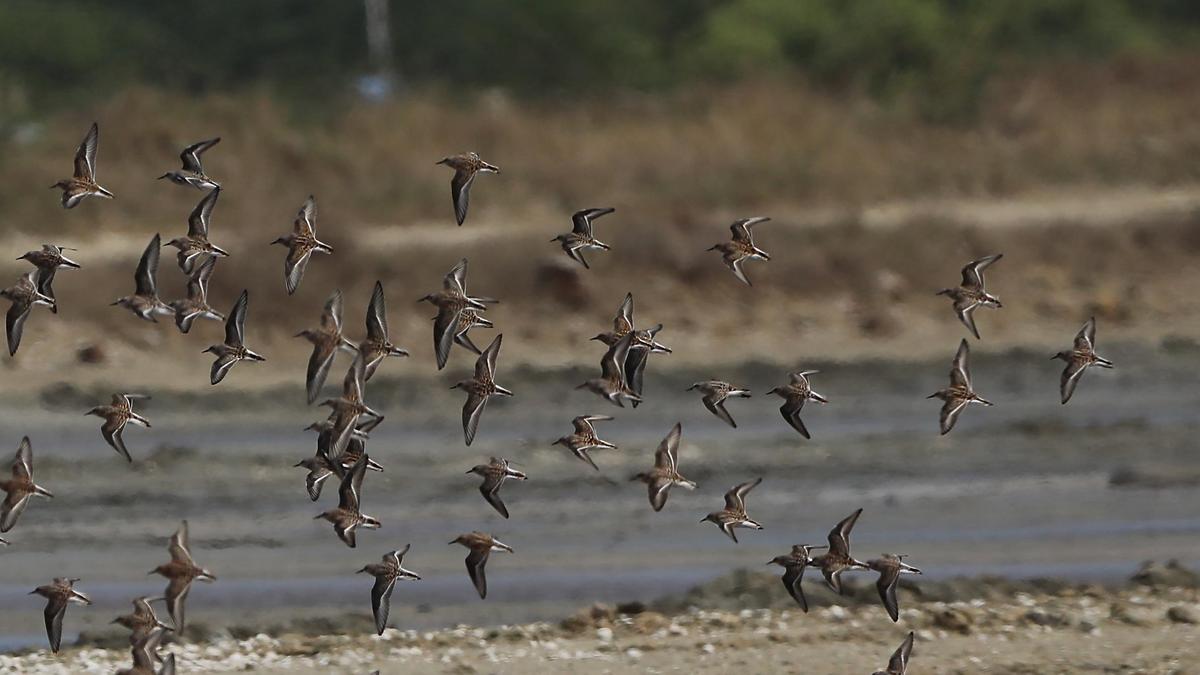
The little stint, a 25-gram shorebird, comes in lakhs from the Arctic to the shores of India, particularly to Point Calimere. “It’s an unforgettable sight,” says S Sivakumar, who has been involved in monitoring shorebirds in the Gulf of Mannar for over a decade. The birds remain through the winter months and depart between March and April, sometimes later in May. “In the 1980s, the little stint could be seen in several lakhs at any point of time. Even now, the numbers are still over a lakh as the Point Calimere Wetland Complex covers over 300 kilometres across coastal Tamil Nadu,” says Sivakumar, assistant director at the Bombay Natural History Society’s Bird Migration Study Centre at Point Calimere, adding that such long-term observations help scientists understand how bird populations and their habitats are changing. The birds remain through the winter months and depart between March and April, sometimes later in May | Photo Credit: S Sivakumar The tiny bird’s annual migration journey, a feat of endurance, involves multiple stopovers across different landscapes, each of which must provide sufficient food and safe resting grounds. As shrinking mudflats and changing landscapes threaten its feeding and resting habitats, this tiny shorebird tells an important story about conserving wetlands.Ashvin Viswanathan, scientist at Bird Count India, places the little stints as the most visible representatives of a special group of shorebirds that breed in the Arctic. “ This group is declining rapidly due to climate change and loss of habitat. Little stints too are declining in India according to SoIB,” he says, referring to the State of India’s Birds assessment. Their widespread presence, he adds, indicates the health of wetland ecosystems in India as well as conditions in the Arctic. The fact that the little stint is still a fairly common bird does not mean that it is beyond risk. It’s numbers and distribution can help draw attention to changes taking place across the habitats it depends on. The numbers are still over a lakh at Point Calimere wetlands | Photo Credit: S Sivakumar The bird’s preparation for migration is as fascinating as the journey itself. “Before setting off, they enter a phase of intense feeding called hyperphagia. They feed voraciously to build up fat reserves that act as fuel during its journey.This can add 50 to 75 percent to the bird’s body weight. There are also physiological changes, some organs shrink in size as the bird prepares for the demands of sustained flight,” explains Sivakumar adding that India is an important destination along the Central Asian Flyway that connects the bird with wintering habitats further South. The birds can be found along several coastal wetlands, including Point Calimere, Pulicat, parts of Puducherry and Kanyakumari, the Sundarbans, and the mudflats of Gujarat and Maharashtra. Across Tamil Nadu, the species is familiar to birders. “You can spot them at wetlands such as Kurichi and Ukkadam in Coimbatore,” says birder K Selvaganesh adding that the flock plays an important part of the food chain as prey for raptors, including the Western marsh marrier and the brahminy kite.Goa-based Rakesh Dhareshwar, a wildlife photographer says Goa and the wider west coast are reliable places to find them each season. “This year, I was delighted to see them inland too, at Bhigwan in Maharashtra, during a mid-Novemeber trip. However, shorebirds worldwide are in decline. Loss of coastal and inland wetlands, reclamation of mudflats, and pollution threaten stopover and wintering sites these birds depend on. The good news is that we can fix this. Protecting wetlands, salt pans and estuaries, and sharing spaces thoughtfully with people can make a real difference.” Shorebirds worldwide are in decline | Photo Credit: Special Arrangement In his new book, Little Stint: A Migrant’s Tale (Neythal Pathipakam), author Byju H explores the bird’s remarkable journey through a blend of science and unconventional storytelling allowing the bird to narrate its own life, beginning with emerging from an egg in the Arctic tundra. “I wanted readers to travel with the bird,” he says adding that the book also highlights the fact that the bird’s ability to navigate vast distances depends on the availability of suitable wetlands along its migratory route. File photo of little stints and kentish plovers | Photo Credit: PRINCE FREDERICK For more than four decades, researchers have been monitoring shorebird populations in the Gulf of Mannar region. “The numbers have fallen by 60 percent across the monitored shorebird population. The mudflats are not merely places to pause, they are feeding stations where the birds replenish the energy needed for their onward journeys. When these habitats disappear, there is no easy alternative,” says Sivakumar. The numbers have fallen by 60 percent across the monitored shorebird population in the Gulf of Mannar region | Photo Credit: Special Arrangement The ringing studies have also revealed an interesting aspect of tittle stint’s site fidelity. “When we ring a bird and it is sighted again at the same place, it shows that it has returned to a familiar site. If that habitat is altered or destroyed, it faces a serious problem,” he says adding that the Yellow Sea mudflats, for example, are critical gathering grounds for migratory shorebirds travelling along multiple flyways. Large scale reclamation have significantly affected these habitats. Hunting is another concern. A new book explores the bird’s remarkable journey through a blend of science and unconventional storytelling | Photo Credit: Special Arrangement While awareness remains limited in several coastal regions, a better understanding of these wetlands could open up Nature-based tourism and birding-related livelihoods for local communities. Byju hopes that the book encourages young birders to eventually turn conservationists. For Sivakumar, its annual return is a reminder. He says, “As long as these birds continue to arrive, it’s a sign that these habitats have something to offer. There is an opportunity to restore and protect them.”
Meet the little stint: The tiny Siberian traveller visiting India’s wetlands
Full Article
Original Source
Read the full article at Thehindu →KhanList aggregates and links to publicly available news content. We do not host full articles from third-party sources. Always verify important information with original sources.