
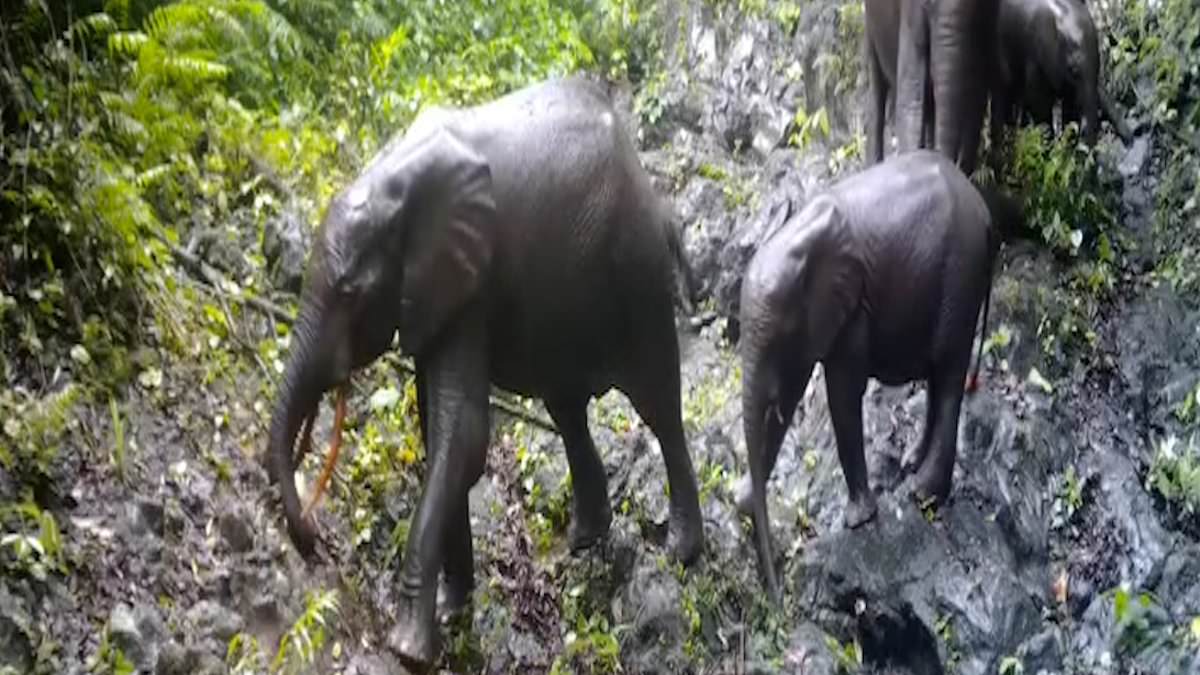
From venomous snakes to stealthy Great White Sharks, the animal kingdom is full of ferocious predators. But which creatures are capable of inflicting the worst deaths?After a Swiss man was killed in an elephant rampage on the slopes of Mount Cameroon, Gordon Grice, author of The Book of Deadly Animals, has revealed the unsuspecting animals that can do the most damage.Alongside elephants, the expert says that lions, hippos and crocodiles are amongst the animals that would finish you off the quickest. However, if you take one thing away from his advice, it might be to stay well clear of hyenas. Although they look like dogs, these animals have bone-crushing jaws that no human would want to get too close to. After a Swiss man was killed in an elephant rampage on the slopes of Mount Cameroon, Gordon Grice, author of The Book of Deadly Animals, has revealed the unsuspecting animals that can do the most damage A 21-year-old woman was bitten in the neck by a lion after being dragged off a horse during a South Africa safari - but miraculously survivedLionsLion attacks are not uncommon in regions where the animals live in close proximity to humans, with an estimated two people killed per year, according to a 1994 study. Their tactic for attack is to seize the shoulders of their prey with their claws and throw them off balance, before suffocating them by biting their throat.Mr Grice explained: 'They usually kill people from a bite and they normally go for the head or throat. 'People can survive but if they don't get medical attention straight away they can end up with a nasty infection.'They would attack a human in the same way they would attack their prey in the wild.' Leopards While leopards are much smaller than lions, they can be just as dangerous.'Leopards kill in a similar way to lions by going for the neck, but they are much more efficient. Death in this way would be very quick,' Mr Grice explained.'There are many records going back to pre-historic times of humans being killed by leopards. 'But they will only attack if they feel their personal space is being invaded or are in need of food.' In 2024, company director Roland Cherry survived a hippo attack whilst on holiday with his wife Shirley in ZambiaHippos Though they appear to be lazy animals who lurk in the water, hippos should not be underestimated, according to Mr Grice. The animals can run surprisingly fast – at around 18mph – and have enormous teeth measuring up to two feet long. The expert explained: 'On the whole they spend most of their time in the water and aren't interested in people.'But they have a very overdeveloped sense of personal space and can attack if a person stands in the way of their path.'They have a very dangerous bite and will go for your middle section so they can bite you clean in half.'Crocodiles According to the CrocAttack database, roughly 4,989 crocodilian attacks were recorded from 2015 to 2024, resulting in about 2,509 deaths worldwide. That's an average of roughly 250 deaths per year across all species.These ancient creatures can hurl themselves vertically out of the water and lunge up to 30ft to attack their prey using their 66 sharp teeth and powerful jaws. Because they can't chew, crocodiles will spin their prey round and shake it – tearing limbs off in the process. Mr Grice said: 'Crocodiles are masters of the ambush as they are camouflaged and usually attack if a person comes down to get water.'They will bite at limbs, twist them and then pull people into the water, and then people ultimately drown.'People can survive if they can get away but often they can be left with missing hands or arms.' Crocodiles can hurl themselves vertically out of the water and lunge up to 30 feet to attack their prey using their 66 sharp teeth and powerful jawsHyenas Hyenas would inflict one of the most awful deaths, according to Mr Grice.'The spotted hyena is an incredibly dangerous animal that would cause a lot of suffering if it were to attack,' he said.'There are instances where they have attacked people who are camping out and are asleep.'They will maybe bite off a part of your face or another sensitive body part and just start eating you. This would be one of the worst deaths as it would be very long.' ElephantsAs we sadly saw in this week's attack, elephants can inflict terrible deaths.Mr Grice explained: 'First of all they have tusks which they can use to stab with and their trunks can also be used to beat people.'Then of course they can trample you and there are even instances where they have squashed people to death if they can pin them against a wall.'Unfortunately, victims can be taken completely unaware, because the animals secretly communicate through vibrations in the ground.Mr Grice added: 'They will attack if they feel their space is being invaded or their food source.'There are even stories of humans clearing trees they use for their food and when elephants come looking for the food again, the herds have gone on the rampage through villages.'In 2019, an enraged rhinoceros attacked and flipped an animal keeper's car three times as she drove through a German safari park Rhinos While rhinos often run away from conflict, they have been known to attack humans if they approach a baby. Once they charge, they're hard to escape as they can run at up to 30mph – often letting out a screaming groan in the process. Mr Grice explained: 'Rhinos tend not to be that interested in hurting people but if they are feeling threatened with anything they can use their horns to stab and gore people and, like elephants, trample on them.'JackalsLike hyenas, jackals look very similar to dogs – but you definitely don't want them as pets in your home. Mr Grice said: 'On the whole they are not that dangerous but they can attack humans, especially children as they are a lot smaller.'They usually attack in packs and work as a group with each dog taking one part of the body before stretching the victim out.' BuffaloFinally, Mr Grice urges any safari-goers to be wary around buffalo, which are often considered the most dangerous of the 'big five' animals. Despite weighing over 100st, buffalo can run at speeds of over 30mph, using their horns to inflict painful deaths. 'Cape buffalo in Africa can also be very touchy about their personal space, which makes them very dangerous,' explained Mr Grice.'They can usually kill with the first strike of their horns and can also trample on people.'ARE HUMANS BORN WITH A FEAR OF SNAKES AND SPIDERS?Researchers at MPI CBS in Leipzig, Germany and the Uppsala University in Sweden conducted a study which found that even in infants, a stress reaction happens at the sight of a spider or snake. They found that this happens as young as six months-old, when infants are still very immobile and have not had much opportunity to learn that these animals can be dangerous.'When we showed pictures of a snake or a spider to the babies instead of a flower or a fish of the same size and color, they reacted with significantly bigger pupils,' says Stefanie Hoehl, lead investigator of the underlying study and neuroscientist at MPI CBS and the University of Vienna.'In constant light conditions this change in size of the pupils is an important signal for the activation of the noradrenergic system in the brain, which is responsible for stress reactions.'Accordingly, even the youngest babies seem to be stressed by these groups of animals.'The researchers concluded that the fear of snakes and spiders is of evolutionary origin, and similarly to primates or snakes, mechanisms in our brains allow us to identify objects and to react to them very quickly.
Revealed: The animals that inflict the worst deaths - as a trekker is killed in an elephant rampage on the slopes of Mount Cameroon
Full Article
Original Source
Read the full article at Dailymail →KhanList aggregates and links to publicly available news content. We do not host full articles from third-party sources. Always verify important information with original sources.