
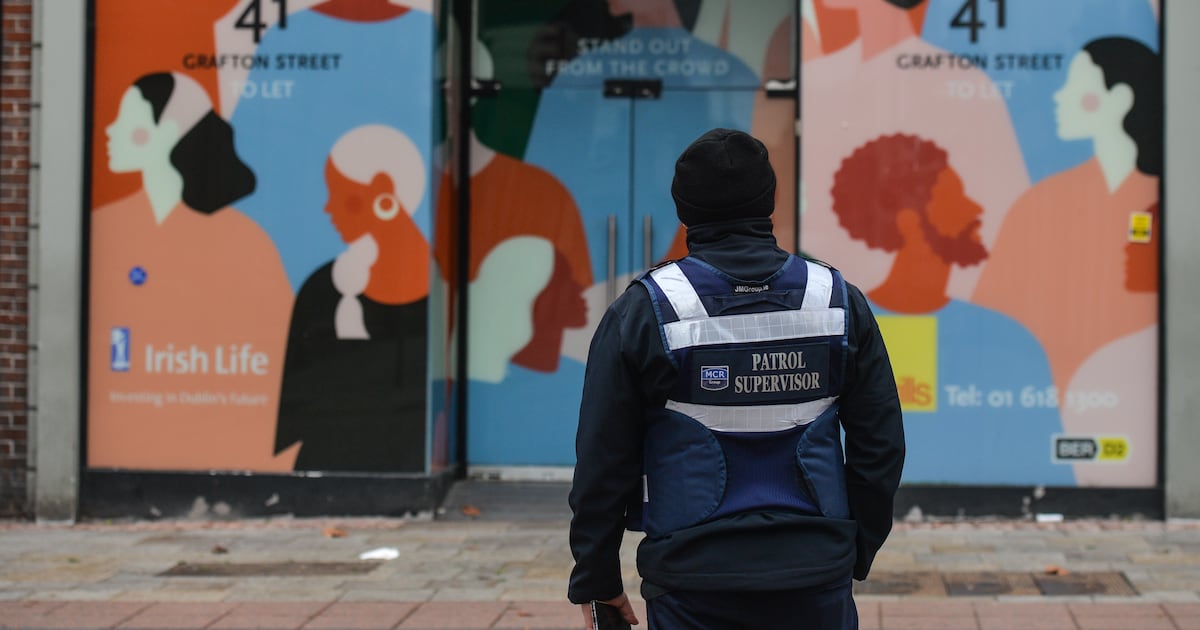
Earlier this week this newspaper revealed plans are under way to hire private security contractors whose “safety operatives” will patrol the streets of Dublin city centre. The plans, which are at the draft tender stage, are part of a joint initiative by the Dublin City Development Company, a body formed earlier this year to lead redevelopment of the city centre, and DublinTown, a business improvement district representing some 2,500 city centre businesses. The idea is that these operatives will “complement” the work of gardaí in policing the city centre and generally maintaining public order.The fact that this initiative has even progressed to the proposal stage is remarkable for a whole range of reasons. The first is the question of the legal basis for private security in public spaces. You could, in a narrow sense, argue that there is some precedent for this. The private security sector in Ireland is regulated under the Private Security Services Act 2004. The Act provides a fairly broad definition of private security; a security guard is someone who, in return for payment, guards or patrols, or otherwise provides protective services for, people or property. This covers a whole range of familiar roles, from nightclub bouncers to shopping centre security guards, to the elite mercenary units tasked with hunting down and summarily executing fare dodgers on the Luas. In a discussion of the issue on RTÉ’s Today with David McCullagh programme on Wednesday morning, Olga Cronin of the Irish Council for Civil Liberties pointed out that, traditionally, private security is something that is associated with either private venues or particular events like concerts. Although these private security guards, as she put it, have powers to protect property and people, remove trespassers and manage crowds, they are not gardaí. “And so given that conversations around public safety in Dublin have primarily been around ‘we need more guards, we need more visibility of guards’, the idea that we’re bringing in security guards in this instance raises questions to what is envisaged in terms of what their powers are.” (In a statement released after The Irish Times report on Wednesday, the council asserted that these security operatives “would not have additional statutory powers to arrest, demand identification, require a person to leave a public street, to search people or issue fines/enforce local authority bylaws”.)[ Private security patrolling Dublin would not have additional capacity to arrest peopleOpens in new window ]The discussion also featured Green Party councillor Janet Horner, whose contribution was, at times, less measured. At one point, she compared the idea of such private street security to Ice – the US Immigration and Customs Enforcement agency – whose masked agents have arbitrarily abducted immigrants from the streets, and shot and killed protesters. At the risk of stating the obvious, Ice is a federal law enforcement agency, and a heavily politicised one at that.READ MOREWhen Horner made the comparison, McCullagh rightly pushed back, pointing out that whatever private security contractors might be hired, they were hardly likely to be armed. This is true, and the comparison is an absurd one. But that’s also part of the issue: if they’re not going to be armed, and if they’re not going to have the powers of detention and arrest that gardaí have, then what use would their presence be? For the avoidance of doubt, my very firm preference would be to not arm private security guards, and my even firmer preference would be to not have them in the first place. Even the most benign version of this set-up – less a fascist death squad acting on behalf of a department store than something like a team of public order-focused litter wardens – could only ever be a poor substitute for the increased presence on the streets of actual gardaí with the requisite training and legal authority to deal with antisocial behaviour. And Garda presence on the streets, of course, is itself only a kind of emergency triage for a cluster of problems – addiction, homelessness, antisocial behaviour – that require deep and long-term structural remediation.Toward the end of that radio segment, McCullagh made a comment that seemed to me to hint toward a particularly insidious aspect of this whole issue. In response to Horner’s complaint that it all seemed to be happening without any clarity on accountability structures, without any public scrutiny or oversight, he said this: “I suppose some people would say that going through all the procedures you’ve mentioned, everything takes an age, nothing ever seems to happen, and that maybe this is a way of getting something done that would actually bring a sense of security to the streets of Dublin.” The sentiment was almost immediately reinforced by a text he then read out from a listener who worked in Dublin 1, who felt the area was overrun with dealers and addicts, and that the proposal was a “great idea”.To me, this seems to indicate a total lack of faith in the capacity of the State to provide solutions, even surface-level ones, to social problems. This attitude both emerges out of, and feeds back into, an ideology of free-market supremacy. Government, with its endless red tape and its hulking democratic machinery, is, according to this ideology, simply too sluggish and too inefficient to provide the kind of lithe and dynamic services a modern society requires; and so it is the private sector that must be turned to for those services. But it’s the under-resourcing of the public realm – in this case, the gardaí – that leads to this situation in the first place. [ Private security on O’Connell Street would be undemocraticOpens in new window ]The decision to outsource public services to the private sector is always an ideologically driven one, just as the degradation of those public services and of shared urban spaces is invariably rooted in political failures that are themselves ideologically determined. When public institutions are underfunded and under-resourced, the private sector is offered as the quick fix, and each outsourced service makes the next round of underinvestment easier to justify.
Mark O'Connell: Security guards on the streets of Dublin are not ‘another Ice’. Nor are they a solution
Full Article
Original Source
Read the full article at Irishtimes →KhanList aggregates and links to publicly available news content. We do not host full articles from third-party sources. Always verify important information with original sources.