
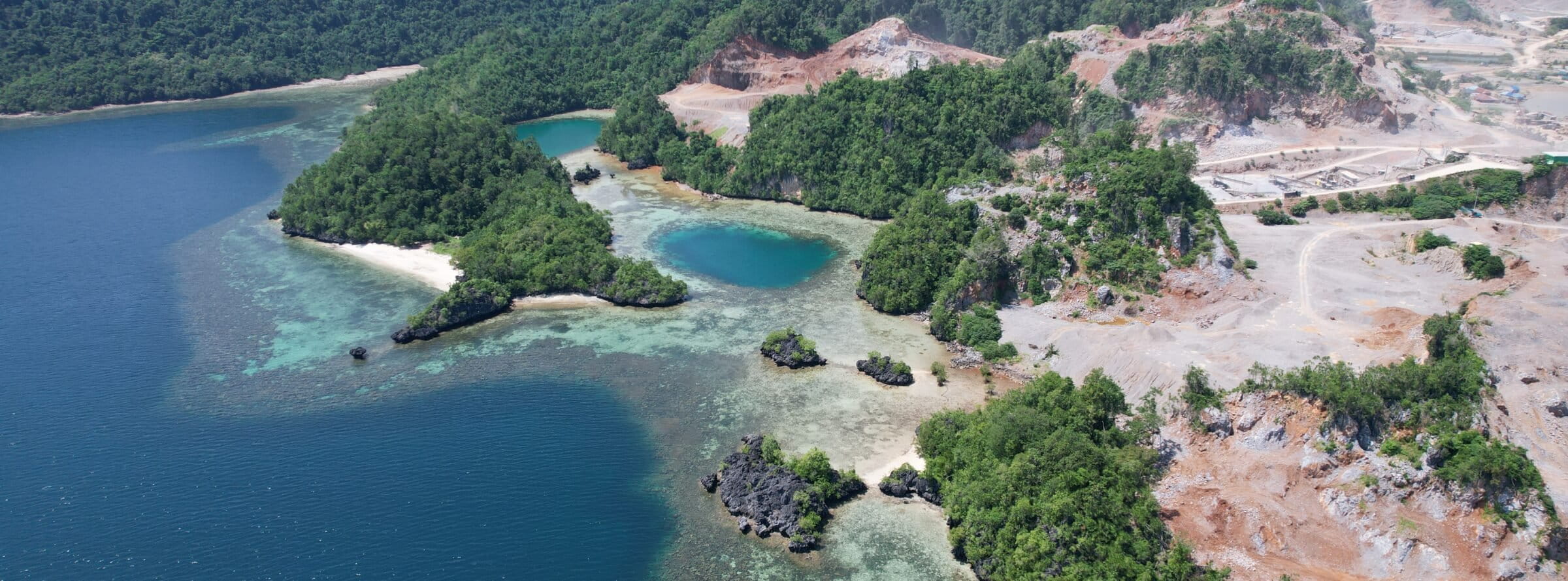
Pressure on a protected marine area in Indonesia’s Southeast Sulawesi province is growing as conservation efforts intersect with mining activity.Moramo Bay is part of the Coral Triangle, one of the world’s richest marine biodiversity regions, and provides habitat for humphead wrasse and other protected species.Researchers and officials say the health of its coral reefs and marine life is increasingly under scrutiny as development expands around the conservation area. SOUTH KONAWE, Indonesia — A marine protected area in Indonesia’s Southeast Sulawesi province is home to a critically depleted population of humphead wrasse. The species presence helped the area gain its protected status, but mining permits overlap parts of the conservation zone and line its coast. A 2024 government survey, published the following year, found just 22 humphead wrasse (Cheilinus undulatus) across 10 sampling stations — an average density of 1.17 fish per hectare — in the Moramo Bay local marine protected area (LMPA) in Southeast Sulawesi’s South Konawe district. It recorded no fish at three sites where the species was still observed in 2018. Officials and researchers say the bay’s coral reefs face mounting pressure from sedimentation, pollution, vessel activity and other threats, but no study has established a direct link between mining and the wrasse’s decline. “In a polluted area … this fish will definitely disappear,” Sasanti Retno Suharti, a coral reef fish ecology researcher who has been researching humphead wrasse since 2006, told Mongabay Indonesia in August. “It will move far away into deeper waters.” “If it is no longer there, eventually the crown-of-thorns starfish will take over and feed on the corals,” she added. “The ecosystem will be damaged.” The presence of humphead wrasse was one reason Southeast Sulawesi first proposed Moramo Bay as a LMPA in 2011. The proposed area expanded to 21,786 hectares (53,834 acres) in 2016 from 10,371 hectares (25,627 acres) in 2014. In 2021, the Ministry of Marine Affairs and Fisheries designated Moramo Bay and surrounding islands as a 21,902-hectare conservation area spanning parts of South Konawe, Konawe regencies and the coastal city of Kendari. The designation was intended to protect coral reefs, seagrass meadows, mangroves and protected fish species, including the humphead wrasse, said Anung Wijaya, a conservation analyst at the Southeast Sulawesi Marine and Fisheries Agency. The waters lie west of the Banda Sea within the Coral Triangle, a region known as “the Amazon of the Seas” for its rich marine biodiversity. A 2024 study led by Anung, however, found a 12.6% decline in coral cover between 2018 and 2024 on the waters off Lara Island, where the humphead wrasse is now virtually extinct and where coral bleaching linked to global warming has exacerbated decline in coral cover there. His study warned that ongoing limestone mining in Wawatu, a village on the mainland, could affect coral reefs around Lara Island, which is less than 2 km from the mining area, through sedimentation and reduced water quality. “Reclamation activities to build infrastructure supporting mining operations, such as special terminals, as well as the transportation of processed mining materials, can contribute to increased water turbidity in the surrounding area,” Anung writes in his study. Anung told Mongabay Indonesia that no study had established a direct link between mining and the decline in the humphead wrasse population in Moramo Bay. “If we talk about the connection, it is possible,” he said, adding that his agency can only convey its findings to government agencies responsible for mining. The humphead wrasse, one of the largest reef fish in the Coral Triangle, plays an important role in maintaining healthy coral reef ecosystems. Image by Riza Salman/Mongabay Indonesia. The humphead wrasse, one of the largest reef fish in the Coral Triangle, plays an important role in maintaining healthy coral reef ecosystems by feeding on a range of reef organisms, including crown-of-thorns starfish (Acanthaster planci). In Indonesia, where the humphead wrasse is protected based on its size, its presence is also considered to be an indicator of a relatively healthy reef habitat, while declining numbers can signal broader degradation of coral reef ecosystems. Jupri, a marine and coastal ecosystem manager at the Denpasar Marine Management Agency’s Southeast Sulawesi working area, also raised concerns about nickel mining upstream of the Wandaeha River, which flows into Moramo Bay. Agency observations found sedimentation, coral reef damage and water visibility of less than 10 meters (33 feet) around Gala and Woru-woru islands near the river mouth. “The Wandaeha area used to be a producer of ebi [baby shrimp],” he said. “There is no longer any ebi production because of mining operations on land.” Land within the conservation area should also be protected from mining as it is a habitat for sea bamboo (Isis hippuris) and sea turtles, he added. Jupri said a production permit for Class C quarry materials, such as limestone and construction stone, is also located opposite Lara Island, although operations have not started. “If this mining begins operating, we don’t know what the future of the Moramo Bay LMPA will look like,” he said. Limestone mining site around Moramo Bay, Southeast Sulawesi. Image by La Ode Risman Hermawan/Mongabay Indonesia. At least 12 mining permit areas for Class C quarry materials are located along the Moramo Bay coast, not counting a nickel mine upstream of the Wandaeha River and nearby shipyards and special terminals. Mining permit areas for Class C construction materials, such as limestone and other quarry materials, also overlap the conservation area, according to a comparison of zoning data from the marine affairs ministry and the Energy and Mineral Resources Ministry’s ESDM One Map Indonesia. “Ideally, if it is a conservation area, there should not be any mining industry around it,” Jupri said, adding that he had reported findings on potential threats from mining to the Southeast Sulawesi Marine and Fisheries Agency. Three companies have production operation permits for quarry materials, while the others remain at the reservation or exploration stage. The three companies are PT Citra Khusuma Sultra (CKS), PT Ramadhan Moramo Raya (RMR; also formerly known as CV Ramadhan Moramo) and PT Hoffmen Energi Perkasa (HEP). HEP borders the Moramo Bay LMPA, while the permits held by CKS and RMR extend into the sea and overlap the conservation area. Muhammad Hasbullah Idris, head of the minerals and coal division at the Southeast Sulawesi Energy and Mineral Resources Agency, said the permits predated the designation of the conservation area. “These are old mining permits,” Hasbullah told Mongabay Indonesia in July. “Before they were issued, we would certainly have requested confirmation of their conformity with the spatial plan from the regency government. The regency government declared the areas suitable for mining.” CKS and RMR received mining permits in 2015 for 122 hectares and 11 hectares, respectively, and later secured extensions to operate through 2030. Hasbullah said the permits were issued under South Konawe Regional Regulation No. 19/2013, which set the district’s 2013-2033 spatial plan. Meanwhile, HEP received an exploration permit in 2023 and a production permit covering 11 hectares from 2026 to 2031. Hasbullah said he visited the mining sites with other government agencies in February to check for signs of pollution entering the conservation area. “When we went down there, we could still see that the water was clear. I went there in February, and it was still clear,” he said. Some mining permits, however, cover marine areas and tourist destinations that should be off-limits to mining under South Konawe Regional Regulation No. 5/2020 on the 2020-2040 spatial plan, which revoked the earlier 2013 regulation. Hasbullah said no mining would take place in those areas, “That’s why it became controversial later on, when it turned out to be a tourist destination.” Class C quarrying permits issued over marine waters and small islands around Moramo Bay, Southeast Sulawesi. Image by Rudyworldpacker for Mongabay Indonesia. Andi Rahman, executive director of the Southeast Sulawesi chapter of the Indonesian Forum for the Environment (Walhi), the country’s biggest green NGO, criticized the extension of mining permits that overlap the Moramo Bay LMPA. He also questioned the Southeast Sulawesi Energy and Mineral Resources Agency’s claim that there had been no pollution in waters around the mining sites, saying the assessment was not based on standardized indicators. “Our question is, if the area is damaged and polluted, who will be held responsible? For the past two years, we have been calling for an evaluation while the permits had not yet expired,” Andi told Mongabay Indonesia in August. According to Andi, the issuance and extension of the permits did not take into account coastal and small-island spatial planning aimed at protecting marine species. He said the government should have reviewed the permits after South Konawe revised its spatial plan. “If the reason is that the permits had already been issued, fine,” he said. “But when the spatial plan changes, that should be grounds for evaluating and revoking the mining permits.” This story was first published here on August 30, 2026. Basten Gokkon, senior staff writer for Indonesia at Mongabay, adapted this reporting. See related: Nickel miners dig up Indonesia’s Gebe Island despite Indigenous and legal opposition FEEDBACK: Use this form to send a message to the author of this post. If you want to post a public comment, you can do that at the bottom of the page. Credits Topics
Marine conservation collides with mining in Indonesia’s biodiversity-rich Moramo Bay
Full Article
Original Source
Read the full article at News →KhanList aggregates and links to publicly available news content. We do not host full articles from third-party sources. Always verify important information with original sources.