
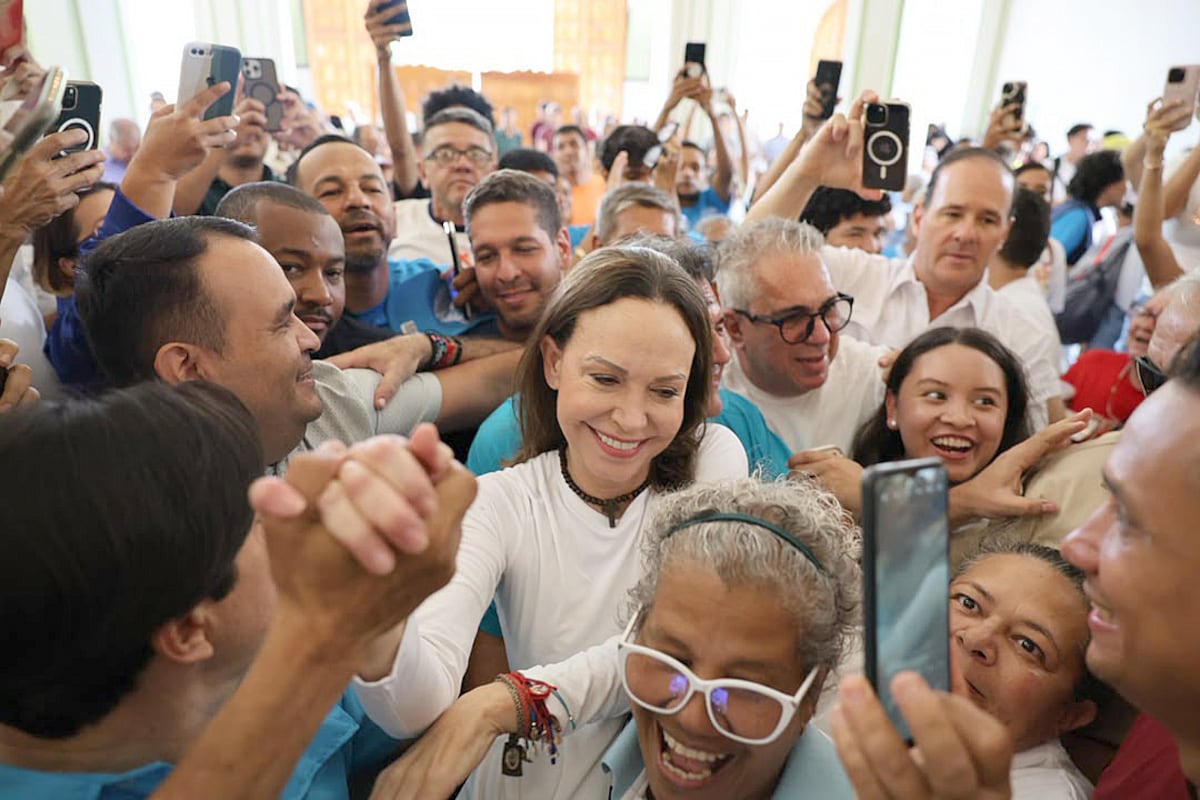
After nearly 10 months abroad, María Corina Machado, the anti-Chavista opposition leader and Nobel Peace Prize laureate, has returned to Venezuela. “I am here, with you,” the opposition figure wrote on social media on Sunday morning. Shortly after her cryptic message, former presidential candidate Edmundo González Urrutia confirmed her return: “Venezuela! I am thrilled to announce that our leader, my dear María Corina, is on Venezuelan soil. Today is an important day for Venezuelans. Our sovereign voice returns with her to lead and guide this process!” he said, while also assuring supporters that he too would return “very soon.” Machado’s path back to Venezuela has not been easy. Over the past three months, she made at least seven attempts to return to Venezuela, traveling by boat, commercial and private flights, and overland routes. She attempted to return from Virginia in the United States, Panama and Curaçao. Each attempt fell through, either after being blocked or canceled at the last minute, sometimes because of alleged technical problems and other times without any explanation. Although no one in her circle has publicly said who was behind the obstacles, there is little doubt that her passage depended on approval from the United States, which was not forthcoming. Newsmax, a pro-Trump television network, reported that Machado entered the country via Colombia and is scheduled to make a public appearance on Sunday.For months, her expected return fueled rumors and unconfirmed reports about how and when she would make it back to Venezuela, keeping the Venezuelan government — led by acting President Delcy Rodríguez — on edge. The opposition leader has returned with the stated intention of throwing herself back into politics.Her mere presence in Venezuela is a direct challenge to Washington, which has spent months trying to delay her return and, at times, prevent it altogether, according to reports by several media outlets. It is also a challenge to Chavismo, the political movement founded by former president Hugo Chávez, whose leaders regard her as public enemy number one. The government now insists it never opposed her return and even argues that her presence could ultimately play to its advantage, betting that she will quickly lose momentum. However, officials have also warned that the opposition leader will have to answer for her actions when she returns to the country.Among other accusations, the regime claims that she promoted a U.S. invasion of the country. Interior Minister Diosdado Cabello even warned on his television program: “I’m not going to tell you what surprise I have in store for her.”Chavismo had spent months trying to undermine Machado’s leadership and had found some backing in Washington, which had signaled that, for now at least, it did not want her back in Venezuela. But returning home was critical to Machado’s political future. Although she remains the country’s most popular political leader, with 57.4% support according to AtlasIntel’s August Latam Pulse poll for Bloomberg, she has virtually no influence over the political decisions being made in the country she hopes to govern.Machado has returned with the intention of taking the helm of the opposition to Chavismo ahead of a potential, though uncertain, electoral process.Since leaving Venezuela in December to receive the Nobel Peace Prize, Machado has directed a lobbying campaign from Washington, and later Panama, aimed at securing her return. She held daily meetings with influential figures across the political spectrum in an effort to return to Venezuela. Yet as the months passed, discussions about the country’s future increasingly took shape without her at the table.For months, figures in Trump’s orbit, with the encouragement of Chavismo, had sought to sideline Machado to the point of exploring a transition for Venezuela that excluded her altogether. “I cannot lead this process from abroad,” she said in mid-September, days before attempting to return from Panama.Since August 1, the Rodríguez government and Dinorah Figuera — the president of the 2015 National Assembly whose return to Venezuela was backed by the United States — have been negotiating a roadmap focused on the complete overhaul of the Supreme Court and the National Electoral Council, reforms that Machado had also championed. But the proposal also includes holding gubernatorial and mayoral elections before the presidential race, an idea Machado flatly rejected in a meeting with opposition leaders last May.That was not the only sign that Washington did not share Machado’s sense of urgency about returning. The defining episode of her months abroad came in the aftermath of the twin earthquakes that struck Venezuela in June and left more than 6,500 people dead. Machado tried twice to return from Central America, but on both occasions the effort was blocked by senior U.S. officials. When asked about the matter at the time, U.S. President Donald Trump denied it: “Oh, no, no, not at all. No, she’s terrific, she’s a wonderful person.”Until then, Washington had justified its position by citing concerns about Machado’s safety if she returned to Venezuela. Later, U.S. Secretary of State Marco Rubio said: “María Corina Machado, a Venezuelan citizen, has every right to enter her country whenever she wants to return.” Yet while Delcy Rodríguez was attending the United Nations General Assembly in New York, Machado made three more unsuccessful attempts to return to the country.Machado — who founded the opposition political party Vente Venezuela — left the country in early December 2025 after spending more than a year and a half in hiding. Her escape was a risky journey that took her in disguise along the highways of western Venezuela and then across the sea to Curaçao in a precarious boat, during which she sustained injuries, before continuing to Oslo to receive the Nobel Peace Prize.After being barred from the 2024 presidential race, Machado became the chief backer of opposition unity candidate Edmundo González Urrutia. Chavismo claimed victory in the election, but tally sheets suggested González had won by a landslide, with 70% of the vote.Sign up for our weekly newsletter to get more English-language news coverage from EL PAÍS USA Edition
María Corina Machado returns to Venezuela
Full Article
Original Source
Read the full article at English →KhanList aggregates and links to publicly available news content. We do not host full articles from third-party sources. Always verify important information with original sources.