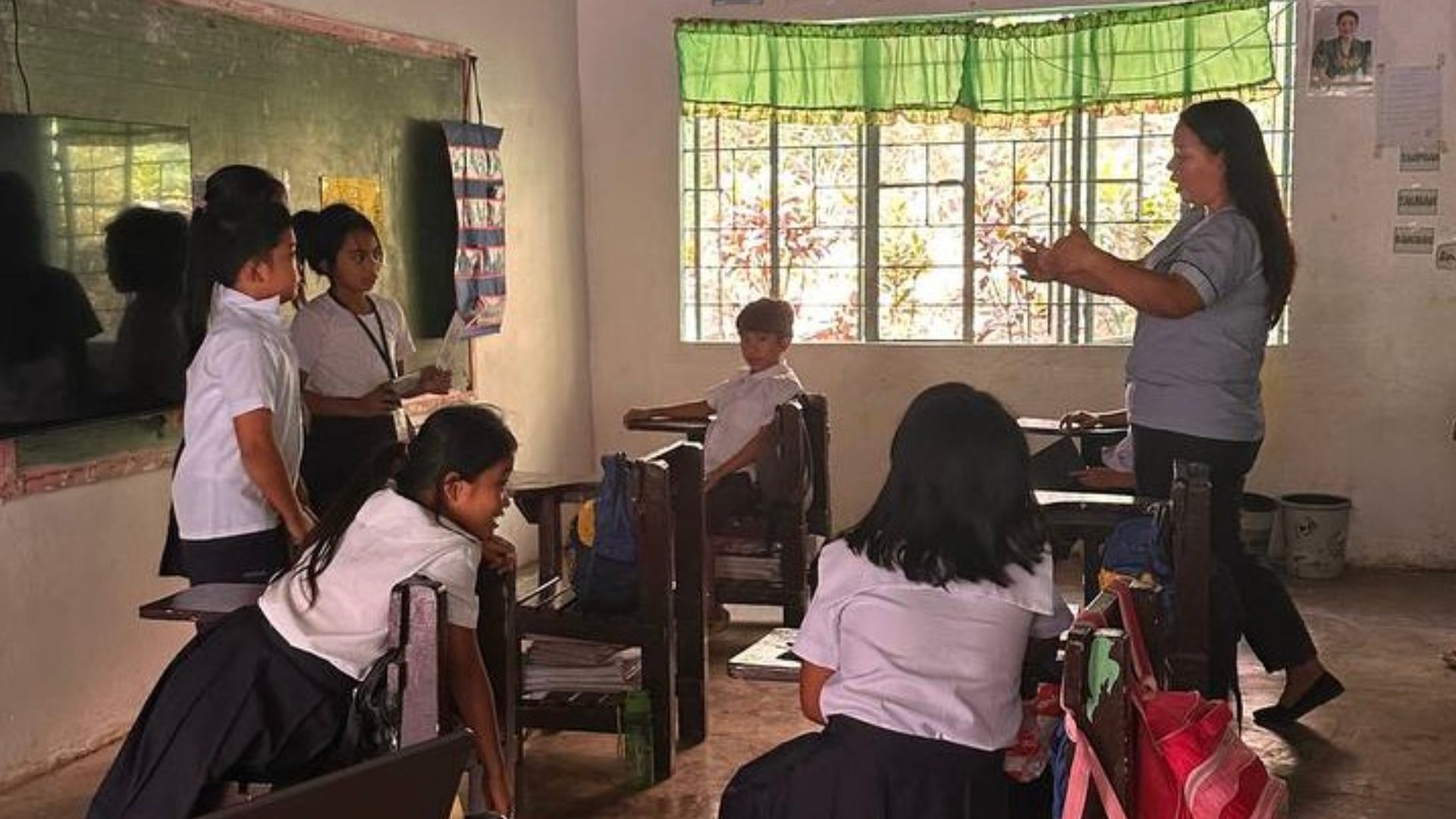
LAST MILE. A teacher talks with her students at the Pulong Mindanao Elementary School, a last mile school in Sta. Maria, Laguna. Second Congressional Commission on Education President Ferdinand Marcos Jr. enacts the Last Mile and GIDA Schools Act days before delivering his fifth State of the Nation Address MANILA, Philippines – President Ferdinand Marcos Jr. has signed into law a measure institutionalizing support for public schools located in geographically isolated and disadvantaged areas (GIDA) in the country. Marcos enacted Republic Act (RA) No. 12321 or the “Last Mile and GIDA Schools Act” on Wednesday, July 22, and was made public on Friday, July 24. It was just days before delivering his fifth State of the Nation Address on Monday, July 27. Under the law, last mile and GIDA schools refer to those located in “remote, hard-to-reach, underserved, or economically disadvantaged communities where access to safe, adequate, and quality basic education is significantly constrained by limitations in infrastructure, resources, personnel, and prevailing social and environmental conditions.” The Second Congressional Commission on Education (EDCOM 2) said that there are 9,000 last mile schools in the country, catering to 1.6 million students. Half of these schools are located in the Bangsamoro Autonomous Region in Muslim Mindanao. (READ: 1,500 public schools don’t have electricity; 1,000 without toilets) Many last mile and GIDA schools still have multi-grade classrooms. In this set-up, two or more grade levels simultaneously use a classroom, with only one teacher facilitating their lessons and activities. RA 12321 institutionalized the Last Mile and GIDA Schools Program under the Department of Education (DepEd) to address gaps in resources, facilities, and other essential education inputs in schools and communities that have not met standard allocation criteria, particularly in the GIDAs. Here are the indicators of last mile and GIDA schools: Public schools with more than 75% of learners belonging to IP groups Located in or serving communities affected by conflict, insecurity, disaster vulnerability, or other conditions that significantly impede safe access to education Any other indicators deemed necessary by the DepEd The law mandates that students shall have access to a public school within a walkable distance of three kilometers from their residence. “Where access is not feasible due to terrain, geography, or safety considerations, the DepEd and local government units (LGUs) concerned shall provide support services to learners through the provision of alternative delivery modes and transportation, respectively,” the law provided. With this, the DepEd is tasked to adopt and implement a national school accessibility standard for school sites, as well as construction standards for last mile and GIDA schools. Also, the DepEd has one year from the law’s effectivity to develop a National Last Mile and GIDA Schools Mapping System, which will serve as basis for planning, resource allocation, and program implementation. The DepEd will have to collaborate with various government agencies, LGUs, civil society organizations, and other stakeholders to provide roads, electricity, internet connectivity, and transportation, among others, to the last mile and GIDA schools. According to the law, teachers and non-teaching personnel assigned to last mile and GIDA schools must have a comprehensive support package that includes the following: Additional compensation and allowances Housing and accommodation support Professional development and teacher pipeline Localized recruitment and engagement mechanisms The EDCOM 2 found that only 0.13% of Grade 12 learners in last mile and GIDA schools, Indigenous Peoples (IP) Education, and Madrasah Education Program, and hardship post schools reached proficiency level in the National Achievement Test for school year 2023 to 2024. “This suggests that proficiency gaps are even more severe in structurally disadvantaged school settings, reinforcing the need for equity-weighted learning recovery and school support so vulnerable learners are not left further behind as they complete basic education,” it said in its final report published in January. – Rappler.com How does this make you feel? Loading
Marcos signs law ensuring support for public schools in far-flung areas
Full Article
Original Source
Read the full article at Rappler →KhanList aggregates and links to publicly available news content. We do not host full articles from third-party sources. Always verify important information with original sources.