
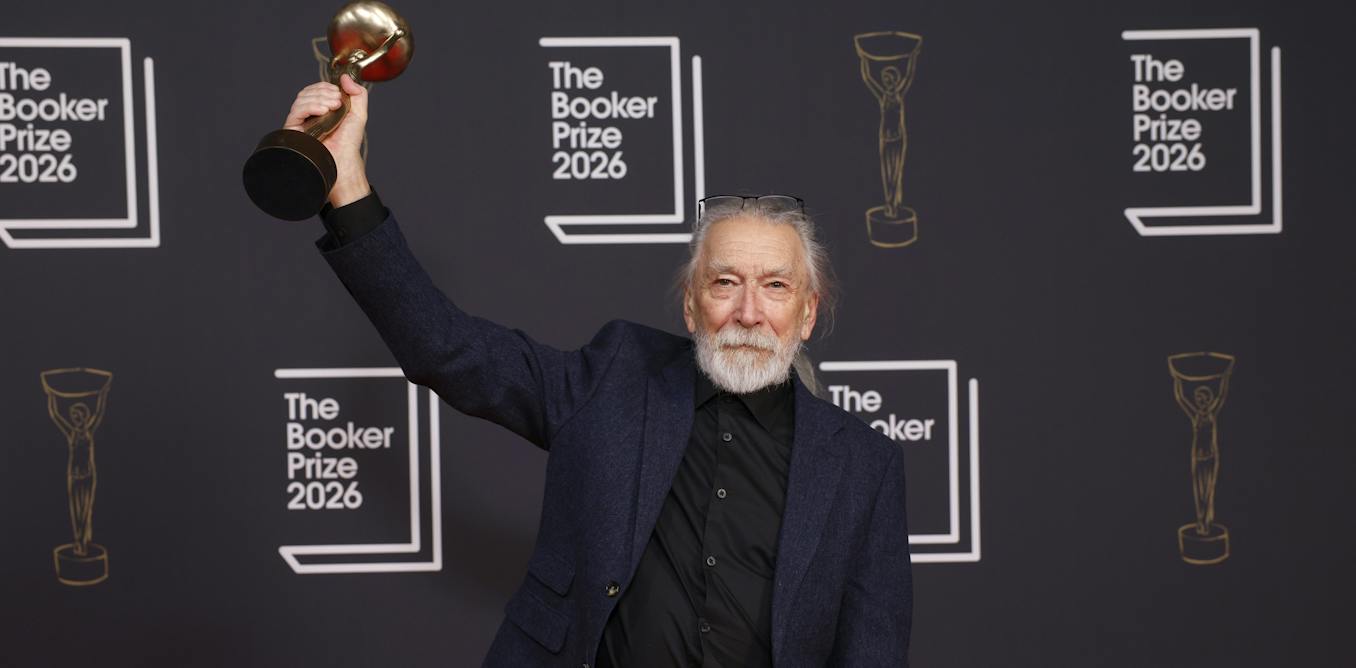
M. John Harrison’s 2026 Booker prize win has come as a surprise to many. Not because he didn’t wholly deserve it, but because, at 81, his legacy seemed already settled and secure. He was to be one of the trailblazers for science fiction. Among fans he has been celebrated as an underappreciated writer, who was unfairly ignored by a mainstream literary elite who could not see past tired cliches of aliens and spaceships. Harrison’s novel, The End of Everything, is not the first winner to draw on the conventions of science fiction. For instance, The Blind Assassin (which won the prize in 2000) by Margaret Atwood includes a pulpy science fiction story embedded within its multi-layered narrative. But Harrison is the first author to come clearly from the world of science fiction and scoop the award. Many readers are hailing the win as the end of snobbery towards the genre. To appreciate the full arc of this achievement, it’s worth remembering that in the second half of the 20th century and even early 21st, authors like Harrison were struggling to be taken seriously as writers. In fact, science fiction was a genre some writers avoided associating with at all. In 2009, Atwood, for example, was criticised by science fiction great Ursula K. Le Guin for refusing to categorise novels like Oryx and Crake (2003) as science fiction. “She doesn’t want the literary bigots to shove her into the literary ghetto,” Le Guin bemoaned. But could she be blamed when other high-profile reviews for that book began with statements like “science fiction will never be Literature with a capital ‘L’”? There have been fewer limitations on science fiction’s commercial appeal and potential for literary recognition in recent decades. M. John Harrison’s The End of Everything is a work of speculative fiction featuring futuristic technology and aliens. David Parry/Booker Prize Foundation Science fiction now permeates almost every area of our cultural life, from blockbuster film and TV franchises to video games. On top of this, tech billionaires proudly cite AI films like Blade Runner (the 1982 adaptation of Philip K Dick’s novel Do Androids Dream of Electric Sheep?) and Her (2013) as sources of inspiration, seemingly oblivious to the films’ dystopian warnings. But cultural arbiters responsible for fiction awards have been slower to overcome some deep-seated prejudices. So Harrison’s win represents an important nod of acceptance from a literary crowd that once sniffed at the speculative. Of course, genre snobbery hasn’t always gone one way. The author Carmen Maria Machado describes the relationship between genre fiction and literary or mainstream fiction as an “unending, utterly exhausting fight”, usually taking the form of “tedious cliches” and “petty squabbling”. Perhaps understandably, the more a community feels marginalised, the more it moves to define itself in opposition to the mainstream from which it feels excluded. In a 1998 article, writer and critic Jonathan Lethem lamented that Thomas Pynchon’s postmodern classic Gravity’s Rainbow was not awarded the 1973 Nebula award – one of the most prestigious awards for science fiction and fantasy. Pynchon’s book plays with ideas of fantastic, speculative technologies and was considered divisive even in literary circles. The Pulitzer advisory board described it as “unreadable”. But had it won the Nebula it would have signalled to the world that artistic aspiration, however divisive, was a key driver of science fiction. For Lethem, its loss marked “the death of the hope that science fiction was about to merge with the mainstream”. While Lethem was right that resistance from within the science fiction community has also been a barrier to mainstream recognition, his comments inevitably provoke familiar debates about what exactly the “mainstream” is, let alone how to define science fiction. One of the great American novelists, Gene Wolfe, who died in 2019 without his M. John Harrison moment of recognition, argued that science fiction represents literature’s real mainstream: “When I look back at the foundations of literature, I see literary figures who, if they were alive today, would probably be members of the Science Fiction Writers of America. Homer? He would certain belong to the SFWA. So would Dante, Milton, and Shakespeare. That tradition is literature’s mainstream.” When future literary historians look back on the genre snobbery of the 20th century, it will hopefully appear as little more than a temporary blip. Science fiction is a broad church, and there remain plenty of readers who will continue to prefer generic content – representations of the future, encounters with aliens and technological imaginings, for example – over artistic aspiration. The End of Everything is not for everyone, let alone every science fiction reader. But Harrison’s win is a testament to the breadth of the genre and, hopefully, the last nail in the coffin of a snobbery that has unfairly dogged science fiction. This article features references to books that have been included for editorial reasons, and may contain links to bookshop.org. If you click on one of the links and go on to buy something, The Conversation UK may earn a commission.
M. John Harrison’s 2026 Booker prize win signals an end for literary snobbery towards science fiction
Full Article
Original Source
Read the full article at Theconversation →KhanList aggregates and links to publicly available news content. We do not host full articles from third-party sources. Always verify important information with original sources.