
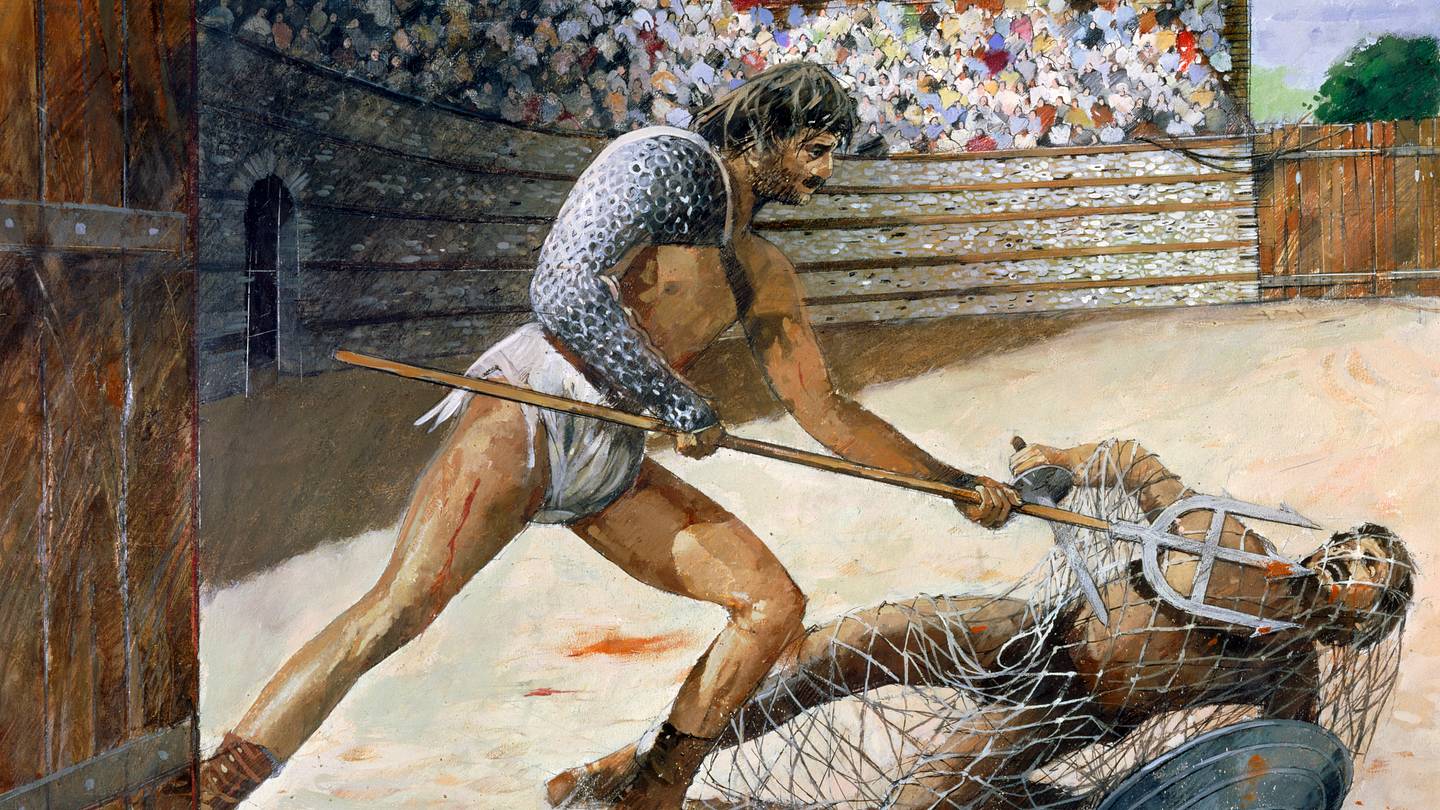
The Hunger Games franchise is currently in the midst of a massive revival, with two prequel books released in the last six years and the latest movie adaptation coming to theaters on November 20. With author Suzanne Collins expanding what we know about the world of Panem, her Classical inspirations are becoming increasingly obvious.Collins has discussed the origins of The Hunger Games on multiple occasions, explaining that she was channel surfing when the coexistence of reality television and genuine war footage sparked her imagination. She began to write a book based on just war theory, merging the idea of reality TV and fights to the death. To create the overarching plot and style of the Games, she borrowed from the Greek myth of Theseus and the Minotaur and the Roman tradition of gladiatorial combat.You don’t have to be a Classics expert to see the connections between The Hunger Games and Greek and Roman death battles. But you might be surprised to learn just how deep the connections go. From the names of major Capitol residents to the terminology used by the people of Panem, Greek and Roman history are everywhere in The Hunger Games franchise, highlighting the worst elements of these cultures and how they can be appropriated by authoritarian regimes.PanemPlutarchTributeMentorArenaCoriolanusTesseraeAvoxCornucopiaSenecaPanemapomares/GettyImagesPerhaps the most well-known example of Roman culture infiltrating The Hunger Games franchise appears in its setting. The series takes place in the country Panem, which comes from the Latin word for bread. As Collins has acknowledged, “Bread crops up a lot in The Hunger Games.” Peeta is a baker, and his gift of bread kept Katniss alive long enough to spark the rebellion. Both inside the arena and beyond, the Capitol uses food as a weapon, keeping the Tributes and districts hungry so that they don’t have the energy to fight back.However, the giving and withholding of bread isn’t the only thing at play here. In Mockingjay, Plutarch references the idea of “panem et circenses” (bread and circuses), a phrase coined by the Roman writer Juvenal in his work Satires. “They shed their sense of responsibility long ago, when they lost their votes, and the bribes; the mob that used to grant power, high office, the legions, everything, curtails its desires, and reveals its anxiety for two things only: bread and circuses.” Juvenal, Satire XThe same mentality that Juvenal lamented in Rome is present in Panem, and especially in the Capitol. The citizens have so much food that they choose to vomit just to continue eating. They receive annual entertainment through the deaths of children and the celebration of the Victors, emphasizing Juvenal’s claim that “Even those who have no wish to kill enjoy the power to do so.” Ultimately, though, a population that is lulled into apathy by bread and circuses is easily roused when their food and entertainment are taken away.PlutarchPlutarch, Greek philosopher | Timacoch/GettyImagesThe character Plutarch Heavensbee is directly inspired by the writer Plutarch, a Greek aristocrat who became a prominent Roman citizen and one of the most important sources for Classical historians. He wrote hundreds of works, including approximately fifty surviving biographies of Greek and Roman figures, published under his Parallel Lives series. While his writings often included gossip and may not have reflected the true history they purported to explore, they nonetheless provide insight into the mindset of 1st century Romans and influenced public perceptions of these figures for millennia.Suzanne Collins was well aware of this when she began working on The Hunger Games, as her father would read her passages from Plutarch’s biographies when she was young. She explained that Plutarch Heavensbee was given his name because he is “one of the few characters who has a sense of the arc of history.” As a Capitol aristocrat, Heavensbee had access to a top-tier education, and while he never knew a world without the Hunger Games, he had more understanding of the world before it than nearly any other character. Furthermore, his role as both a gamemaker and head of propaganda for the rebellion put him in a position to create stories and shape minds and hearts, just as his namesake did thousands of years earlier.TributeTheseus and the Minotaur | Man_Half-tube/GettyImagesThe concept of each District providing a boy and girl as Tributes to the Capitol plays on both Greek mythology and Roman political systems. The process comes from the myth of Theseus. After the Cretan king's son died, he went to war against Athens, forcing them to send seven young men and women to Crete on a regular basis, where they would be sent into a labyrinth to be killed and eaten by a minotaur. This only stopped when the Athenian prince Theseus volunteered to go to Crete and defeat the monster.In Collins’s words, Katniss serves as “a futuristic Theseus,” volunteering for certain death in order to protect innocents. But the specific word “Tribute” has its own history. The word comes from the Latin Tributum, which was originally a form of taxation collected for military purposes. As the empire spread, however, citizens were exempt from paying Tributum, and it instead became a price that conquered peoples paid as a sign of submission. Given this context, the Tributes in The Hunger Games serve as literal taxes paid by the districts after their defeat in the Dark Days.MentorThe Odyssey (Homer) | JannHuizenga/GettyImagesWhen Katniss and Peeta make their way to the Capitol, Effie warns them that Haymitch, as their Mentor, is “your lifeline to the world… the difference between your life and your death.” While the concept of a mentor is ancient, appearing in thousands of stories, it has an interesting connection to Greek mythology that might have influenced its use in The Hunger Games.While the word appears to derive from Ancient Greek roots meaning “mind” and “thought,” it first appeared in the form of a name in The Odyssey. Mentor was a man in Ithaca who advised Telemachus during his father’s absence, although he was often actually the goddess Athena in disguise. In addition to providing advice, Athena advocated for Odysseus before the gods, guided allies to him, and provided both Odysseus and Telemachus with the information and resources they needed to survive. Given this context, the fact that mentors in The Hunger Games would advocate for their tributes to the sponsors, send them supplies, and guide them in how to act feels deliberate, with Haymitch’s actions being just as vital to Katniss’s survival as Athena’s were for Odysseus.ArenaRoman gladiators fighting in coliseum | Grafissimo/GettyImagesThe choice of the word “arena” for the setting of the Games is yet again a way to connect the world of Panem with its historical inspirations, as the term is heavily associated with Roman gladiatorial matches. Although The Ballad of Songbirds and Snakes showed the early games taking place in the Capitol Arena, which was described as “a now-dilapidated amphitheater that had been used for sports and entertainment events before the war,” the historical distinction between the word “arena” and words like “amphitheater” (a place to watch spectacles from both sides) or “stadium” (which comes from a measure of distance) provides additional context.The word arena comes from the Latin harēna, which initially meant “sand.” It became synonymous with the location of gladiatorial matches and other violent entertainment because the amphitheaters would be covered in sand to absorb the blood. By the 1st century CE, the word “arena” began appearing in reference to conflict itself as well as the location it was set in. The Capitol kept the word “arena” long after the Games stopped being held at the Capitol Arena, because even in a seemingly natural ecosystem, it retains its Roman origins as a place that combines violence and spectacle for mass consumption.CoriolanusGnaeus (or Gaius) Marcius Coriolanus, 5th century BC Roman general | Design Pics Editorial/GettyImagesSuzanne Collins tends to be very deliberate with her name choices, and Coriolanus Snow is no exception to that. While his last name was intended to evoke “coldness and purity,” his first name comes from Gnaeus Marcius Coriolanus, a Roman general from the 5th century BC. He won the name “Coriolanus” after a dramatic victory in Corioli, but he was later exiled after refusing to grant Roman citizens access to grain without completing military service or relinquishing their political power.After being cast out of Rome, Coriolanus gathered support for a rebellion against Rome, only stopping after an appeal from his mother, wife, and children. There is some debate about his ultimate fate, but he is believed to have been either executed or assassinated. While many historians doubt whether Coriolanus actually existed, he functioned as a case study in the dangers of valuing military service and patrician birth over the well-being of the common people. It isn’t difficult to see the connection between Panem’s tyrant and his historical namesake, especially with the additional context provided in The Ballad of Songbirds and Snakes. Both used hunger and violence as weapons against their own people, and both learned the consequences of that decision.TesseraeOld coin | mohamed rouggani/GettyImagesLike his historical counterpart, Coriolanus Snow believed that food was not a human right. Instead, the children of poor families could sign up for tesserae, which provided a year’s supply of grain and oil in exchange for an additional entry into the Reaping. They could enter once for each member of their family, but their Reaping entries were cumulative, turning the odds drastically against them as time went by. While this might seem like an explicitly fictional concept, it comes from a real Roman practice.Originally, a tessera was a single tile within a mosaic, which was common in both Greek and Roman artwork. This meaning was referenced in The Ballad of Songbirds and Snakes, when Tigris made buttons from the tiles in their bathroom. Over time, the word tessera came to mean nearly any token or small object, including gambling dice. The most important version here is the Tesserae Frumentariae, tokens which entitled the holder to disbursements of grain or oil. But while the Romans would give these Tesserae based on citizenship or position, the government of Panem used them as bargaining chips, forcing the poor to put their own children in greater danger, in exchange for the food they needed to survive.AvoxDeath Of Pausanias | Print Collector/GettyImagesThe concept of an Avox was invented for the world of The Hunger Games, but its linguistic composition is once again rooted in ancient history. Avox is a hybrid word, combining the Greek prefix a- (not or without) and the Latin word vox (voice). This is fitting, as the Avoxes were people who had their tongues removed as punishment for treason. In contrast to the popular phrase “Vox populi, vox Dei,” which claimed that “the voice of the people is the voice of God,” the Capitol saw the voice of the people as an inherent threat that had to be eliminated.If bread is used as a weapon in Panem, speech is a tool that is carefully regulated. The characters frequently worried that they were being spied on, and the jabberjays were explicitly created for that purpose. Like the character Echo, in Greek mythology, they had no voices of their own, only able to repeat the things they heard. Similarly, President Snow attempted to control what Katniss and Peeta said to limit their power. Amongst all of this, the Avoxes were constantly present, showcasing the Capitol’s ability to silence those who didn’t fall in line. However, the mockingjay was a powerful symbol precisely because its speech could not be tamed by the Capitol. This was especially clear when Pollux, an Avox, served as a cameraman for the rebellion, reclaiming his voice despite his physical limitations.CornucopiaIllustration of Cornucopia | Bettmann/GettyImagesThe central image of every Hunger Games since the first Quarter Quell is the Cornucopia, a golden horn filled with weapons and supplies, drawing the Tributes together to prompt a bloodbath. It’s a twisted version of the Classical symbol, which used the Latin cornu copiae to mean "horn of plenty.” As Haymitch noted in Sunrise on the Reaping, the version in Panem functioned as “A horn of plenty for the few. Desperation for many. Destruction for all.” Even by becoming a Victor, which guaranteed enough food to survive without fear, the tributes could never escape the oppressive system.While many of the other concepts and symbols in Panem come directly from antiquity, the cornucopia is the most twisted from its original meaning. Greek mythology depicted the cornucopia as the horn of a divine goat named Amalthea, who fed Zeus while he was being hidden from his filicidal father. The horn was capable of providing endless nourishment, a concept which was embraced by the Romans, who associated it with gods like Pax (peace) and Abundantia (abundance). In The Hunger Games, it is the setting for both the bloodbath and the final kills in the 74th Games, reminding the districts that the Capitol’s abundance is only available to them if they fight to the death for it.SenecaThe Bust Of Seneca | Heritage Images/GettyImagesThe Head Gamemaker from the 74th Hunger Games provides one of the most direct translations from Roman history into the world of Panem. Seneca Crane was inspired by Lucius Annaeus Seneca the Younger, a philosopher and politician during the early Roman Empire. After being threatened with death under two emperors, one of whom exiled him, Seneca returned to Rome triumphant, serving as a tutor and advisor for the future emperor, Nero. But while he was a competent statesman, managing the empire during Nero’s early years in power, he was eventually implicated in an assassination attempt against the emperor and ordered to commit suicide. He complied, cutting open his veins and consuming a potion made from hemlock, one of the very poisons that inspired The Hunger Games’s revolutionary Nighlock berries.Like his namesake, Seneca Crane seemed to be thriving under the reign of an autocratic ruler until rebels that had nothing to do with him put him in the line of fire. Notably, both of the Head Gamemakers in The Hunger Games trilogy were named after Roman writers. While Plutarch wrote biographies of Greek and Roman historical figures, Seneca wrote tragic plays in which Greek mythic heroes caused violent deaths, and lovers turned on one another. It’s little surprise that the character named after him would believe that Katniss and Peeta could be turned against each other so easily. However, both the historical figure and the fictional one learned how easily a paranoid dictator can transform from an ally to a deadly adversary.Read More:
10 Words and Names in the ‘Hunger Games’ Franchise Drawn From Ancient Greece and Rome
Full Article
Original Source
Read the full article at Mentalfloss →KhanList aggregates and links to publicly available news content. We do not host full articles from third-party sources. Always verify important information with original sources.