
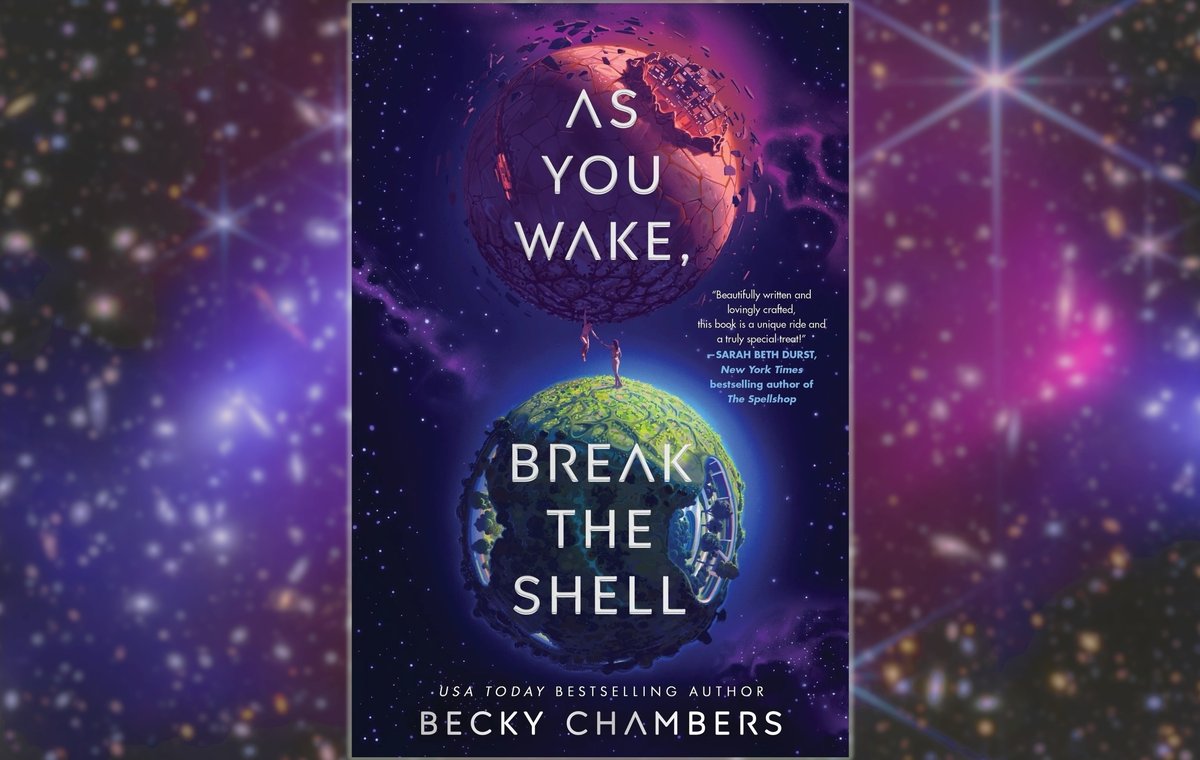
One of science fiction’s oldest themes is its insistence that the future isn’t inevitable. Few contemporary authors embody that idea more than Becky Chambers, whose stories imagine alternative futures—not through grand revolutions or galaxy-spanning battles but through ordinary people trying to care for one another.As a defining voice of the “hopepunk” genre, Chambers has built a reputation for science fiction that prizes empathy as much as imagination. Her latest novel, As You Wake, Break the Shell, brings us to the hostile, unpredictable world of Fortune, where acid rain falls and billowing volcanoes shroud the horizon. The story follows a reclusive botanist and a spacefaring pilot across alternating timelines as they search for connection and purpose, attempting to navigate a life where Fortune has never favored the bold.We caught up with Chambers to discuss a toxic planet’s world-building, scientific accuracy in storytelling and the motivational merits of unrelenting spite.On supporting science journalismIf you're enjoying this article, consider supporting our award-winning journalism by subscribing. By purchasing a subscription you are helping to ensure the future of impactful stories about the discoveries and ideas shaping our world today.[An edited transcript of the interview follows.]This story spends a lot of time on a colony planet with a poisonous atmosphere. What does designing an ecosystem teach you about designing a civilization?Everything. It’s really important for me to start with what the environmental conditions are because that’s going to affect everything from what we’re eating, what we’re building houses out of, what kind of clothes we have—and all of those things, in turn, affect culture. There is so much about our values, our personalities, that are actually molded by the physical environments we exist in, both natural and constructed.Starting from [the questions] “what do we have” and “what do we not have” is really important for me. Suppose someone’s eating a sandwich. What’s in the sandwich? It’s a throwaway line that seems like it doesn’t matter, but it’s actually really important to say whether or not there’s lettuce in this sandwich, because that does communicate a lot of information about how this world works.For this book, I had a really big table of crops [to reference], what are we growing, how are we growing it, what’s available and what’s not?Those are details I spend a lot of time sussing out before I really get into the thick of drafting the story.What specific ideas inspired the scientific foundation for this story?Botany is the big one. I have always had an appreciation for plants but not any actual sort of technical knowledge about what it is that I’m looking at. So I did a lot of research for this book into how plants work, and specifically into seeds, which is a topic I have become fascinated by the more I learn about it. Seeds are a big part of this book, as are plants and the way they communicate with each other.How does scientific accuracy influence your storytelling? Do you often find yourself molding the plot to fit the science, or vice versa?I look at science as partially a foundation but more of a tool that I use to color the world that I’m in. I want it to feel tangible and possible, but I’m very willing to take some liberties here and there for the sake of getting the feeling across.I tend to think of what I’m doing as more like impressionism than photorealism. If you think of something like Monet’s Water Lilies, for example, it doesn’t look like a real pond, right? But it feels like a real pond. And I often use a similar approach with my work. I am not necessarily painting you a picture of the cosmos as it actually exists, but what I’m trying to communicate is the sense of wonder and awe that I feel when I’m experiencing those things in the real world. So it’s a matter of getting the emotional quality of discovery across, and sometimes that does mean taking shortcuts.With As You Wake Break the Shell, I kept it within the realm of “with sufficient technology, this could be possible.” Is it probable? Probably not. There are a lot of things that I gloss over because they’re not things that everyday people outside of science would know about or understand. We know [in the reality of the story] that there are giant space-dwelling creatures out there. We don’t need to know how it is that they evolved or what kind of world it is that they came from. Those are questions that interest me as a person who is into real science, but they don’t serve the story.This book has a knack for taking the unknown and making it feel familiar while making the familiar feel unknown, simply by showing it from a new perspective—for instance, that of an enormous, cargo-toting space behemoth. How do you get into the headspace of examining humanity from the outside?It’s a highly technical process that involves me sitting in my armchair and just staring at the ceiling and thinking about what it would be like to have a body other than mine, and just sort of deconstructing everything that makes me down to the raw components and trying to figure out what it is that’s necessary and what’s not.I take a lot of inspiration from the natural world. I have a really keen interest in invertebrate life and in deep-sea life, and I have a real interest in animal intelligence that exists in nonmammalian creatures.What would it mean to communicate through color? What would it mean to communicate through pheromones? What does the world feel like if you don’t have a sense of sight like we do? I just love taking any one of those traits and then expanding it to make something that we would recognize as a person, regardless of whether they physically look like us or not. How does that make you think about yourself? How does that make you think about existence?As You Wake, Break the Shell is a love story as much as a space story. What did pairing those genres let you explore that you couldn’t do with either one on their own?It allowed me the freedom to not segment any of the things I was thinking of into separate boxes. This was a really personal book for me in that I’m writing about everything I care about in this one. I’m writing about the natural world, I’m writing about society, and I am also writing about love, romantic love, and these are all things that are extremely important to me in my everyday life.We have a bazillion stories about “and then they lived happily ever after,” but I actually want to see what that looks like because it’s never that simple.I feel that the most interesting parts of a relationship are what happens “after,” and so that was what drove a large part of my decision to have [the book] be a split timeline, where it’s very clear from the jump that they’re going to be together a long time and we’re going to see all these different stages in what makes them them, because I do think that that’s an area that is underexplored.You’ve said before that you write the stories that you need to hear. What did you need to hear from this book?I wanted to see a relationship that matched my own. Queer representation in media is better than ever in a lot of ways, and yet it’s still very rare to see anybody over their 20s.By the time we started getting more stories about coming of age or people falling in love when they’re young, I was already too old for those stories. I was feeling a real frustration in not finding love stories that spoke to me where I am now in my life. It was one of those things of, “I guess I’ll just have to write it myself.”Your work has been described as “wholesome,” “thoughtful” and “heartwarming.” How much of your inspiration and motivation actually comes from spite?[Maniacal cackling] So much! I’m so happy you asked this question because so many people come at it from, like, “How do you maintain hope? How do you maintain the sense of coziness?” And the answer is that I am so pissed off all the time about everything. And honestly, so much of it does come from a place of looking at so many of the directions we are headed in the real world, so many of the decisions we are making about technology, about the environment, about how we organize ourselves as a society, feeling the crushing, overwhelming despair that I know we all feel and then just flipping that off and saying, “I’m sorry, I don’t accept that this is all there is and that it has to be like this.”
Love blooms on a hostile colony world in As You Wake, Break the Shell
Full Article
Original Source
Read the full article at Scientificamerican →KhanList aggregates and links to publicly available news content. We do not host full articles from third-party sources. Always verify important information with original sources.