
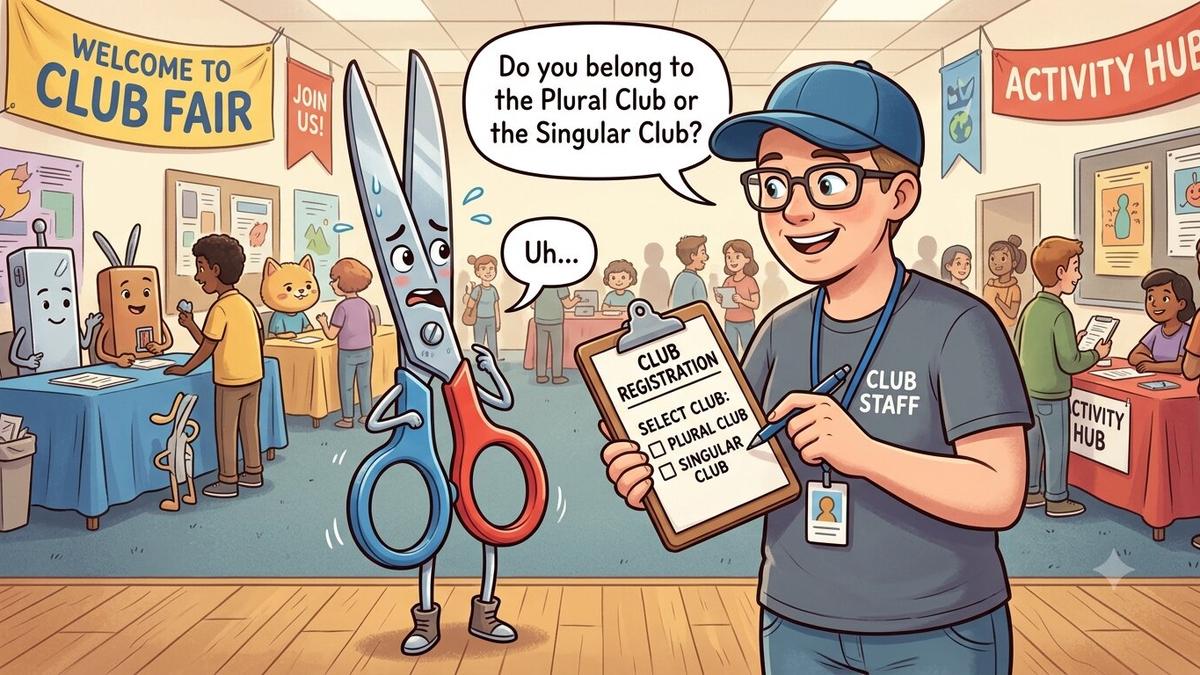
Anceline went shopping to prepare for a camping trip. She made a list of everything she needed: clothes, a pair of trousers, a pair of scissors, shoes, goods, camping equipment, furniture, luggage, bread, and so on. She also noted down some information about the camping trip and the names of some people who could give her advice.At the first shop, she bought some clothes and a pair of trousers. She then asked the shopkeeper, “How much are these trousers?” The shopkeeper replied, “They are 1,500 rupees.”Next, Anceline bought a pair of scissors. “How much are these scissors?” she asked. “They are 300 rupees,” came the reply.At the camping shop, Anceline asked for some camping equipment. The salesman gave her some advice and a lot of information about the equipment. She thanked him and said, “Your advice is very useful, and this information is exactly what I needed.”On her way home, she heard some surprising news. There was heavy traffic on the main road. She finally reached home, but her luggage was so heavy that she could hardly carry it upstairs.When she opened her bag, she discovered that she had forgotten to buy the goods her mother had asked for. To make matters worse, her younger brother reminded her, “You still have your homework to finish!”Anceline looked at her shopping list and sighed. “I need some advice,” she said. “But first, I need some rest!” The word ‘scissors’ may be used to refer to a single object, but it is grammatically plural. | Photo Credit: WIKIMEDIA COMMONS Plural only please!The story contains several nouns that are normally used only in the plural form. These include clothes, goods, trousers, and scissors. We normally say some clothes, the goods, a pair of trousers, and a pair of scissors.Although trousers and scissors refer to a single item, they are grammatically plural. Therefore, we say These trousers are expensive These scissors are sharp rather than This trouser is expensive This scissor is sharp The expressions a pair of trousers and a pair of scissors allow us to refer to one complete item. The word ‘furniture’ is uncountable, and can be used in the ‘singular’ format. Words that are uncountableThe story also contains several nouns that are normally uncountable and used only in the singular form. These include equipment, furniture, luggage, advice, information, traffic, homework, and news. We do not normally form their plurals by adding -s. Thus, we say: some equipment, not some equipments some furniture, not some furnitures some luggage, not some luggages some advice, not some advices. Similarly, we say some information, heavy traffic, some homework, and some news.When we want to count these things, we use suitable expressions such as a piece of equipment an item of furniture a piece of luggage a piece of advice a piece of information a piece of news The word news, though it ends in -s and looks like a plural noun, is grammatically singular. We say, The news is surprising, not The news are surprising. Thus, news is a useful example of a noun whose appearance can be misleading.Many words in English look plural but are used as singular nouns and therefore take a singular verb. Here are some examples of words that end in -s but take a singular verb: mathematics, physics, economics, politics (when referring to the subject or field), linguistics, ethics (when referring to an academic subject or system of principles), and athletics. The news is shocking. Mathematics is my favourite subject. Economics is an important subject. The word bread in the story is also usually used as an uncountable noun when we are talking about bread in general. We say some bread or a loaf of bread, rather than some breads. However, ‘breads’ can be used when referring to different types or varieties of bread, so it is not as restricted as words such as advice or information.Similarly, rest is normally uncountable when it means relaxation, as in I need some rest. The plural rests is possible in other meanings or specialised contexts.Here are simple sentences using each phrase: My teacher gave me one piece of advice before the examination. The website provides two pieces of information about the course. We bought one piece of furniture for the living room. I need a pair of scissors to cut this paper. He bought a pair of trousers for the interview. Some nouns are uncountable and singular, but can become countable when we change the meaning. Here are examples: experience, work, business, light Experience is important. / I had several interesting experiences. Work is tiring. / The museum displays several works of art. Business is good. / Several businesses opened. Light travels fast. / There are several lights in the room. Goods: singular or pluralThe word goods is always plural. It takes plural verbs (like are or have) and does not have a standard singular form when meaning items or merchandise.Examples: Have the goods arrived? Where are the goods kept?Chennai, September 7: Police recovered a large quantity of stolen goods from an abandoned warehouse on the outskirts of the city on Sunday. The goods, including electronic items, household products and packaged food, were reportedly stolen from several shops last week.You cannot say “a goods”. To talk about one single product, use words like item, product, or merchandise.Let’s remember that the English language has rules, but it also has an astonishing number of exceptions. Exposure to the language through listening and reading can help learners master the language.(Dr Albert P’Rayan is an ELT resource person and education columnist. Send your feedback to englishmatters2024@gmail.com)ActivityRead the news report below. It contains 8 errors. Identify them and rewrite the paragraph correctly.The college administration released several informations about the upcoming cultural festival yesterday. The principal also gave an advice to students on how to participate responsibly. According to the organisers, new equipments have been purchased for the events, while additional furnitures are being arranged in the auditorium. Students who attended last year’s festival said they had received useful feedbacks from the audience. Meanwhile, the organising committee has conducted several researches to improve this year’s programme. The volunteers were also given some important advices about crowd management and were asked to complete their homeworks before the final rehearsal.
Looks plural, acts singular
Full Article
Original Source
Read the full article at Thehindu →KhanList aggregates and links to publicly available news content. We do not host full articles from third-party sources. Always verify important information with original sources.