
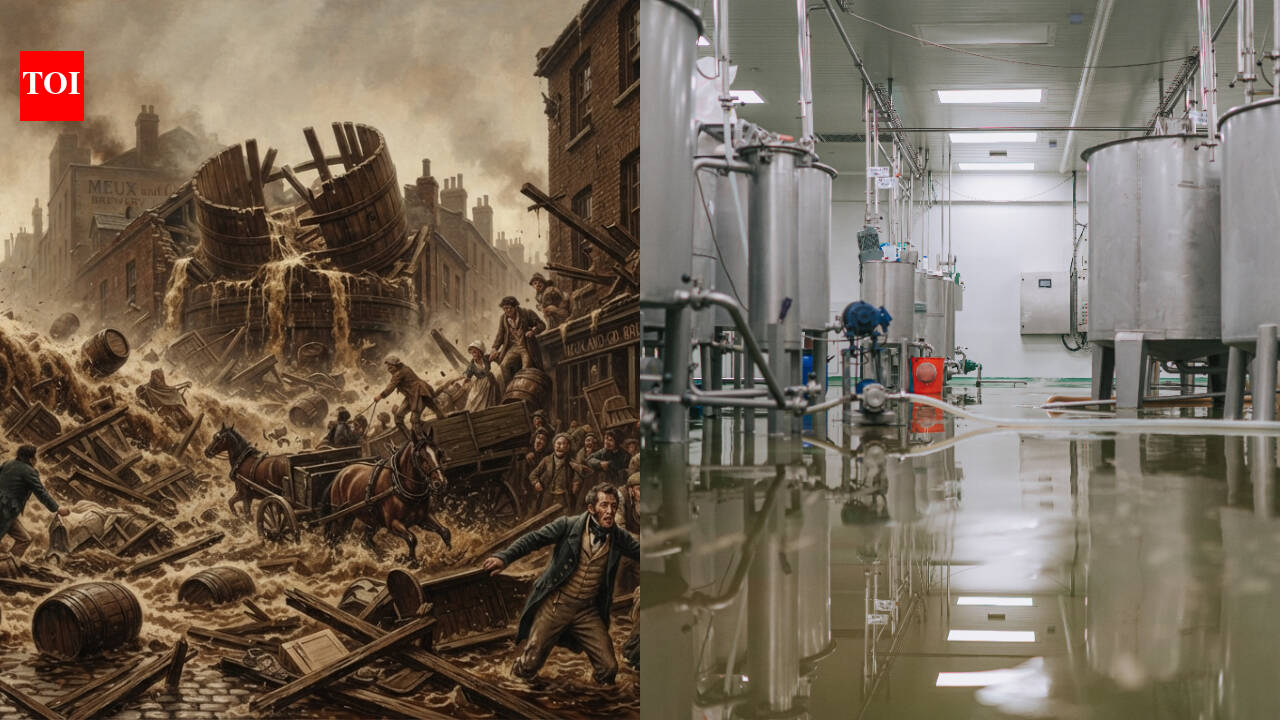
Residents collected and drank spilled beer, while the stench of fermentation lingered for months.Picture a normal Monday afternoon that goes sideways, with streets flooded not with rain or sewage but with thousands of gallons of beer. Sounds interesting? On October 17, 1814, the residents of a poor London neighborhood fought a deadly flood of dark porter when an enormous brewery vat ruptured, sending a torrent of beer into their homes and narrow streets. What appeared at first to be an amazing industrial accident was to become one of Britain's oddest tragedies, claiming eight lives and leaving an entire neighborhood in ruins.When disaster came out of a breweryThe event was held at the Horse Shoe Brewery, owned by Meux and Company, in the St Giles district of London, close to Tottenham Court Road. Historic UK says that by 1810 the brewery had installed a huge wooden fermentation vat. The structure was some 22 feet high, bound together with heavy iron hoops, and could hold more than 3,500 barrels of porter, a dark beer somewhat like modern stout.It was an old brewery, turning out huge quantities of porter for the swelling London drinker population. The towering storage vessels were the heart of its operations, but their size also made them a serious hazard when structural elements failed.One October afternoon one of the iron hoops on a large vat snapped. The damage did not, at first, represent an emergency. But the pressure in the huge container built up until the weakened structure eventually gave way.Beer Tsunami triggered by chain reactionAs History explains, brewery clerk George Crick had seen the broken iron hoop earlier that afternoon. Such incidents were not unknown to brewery workers and the damage was not seen as an immediate threat.Then, just about 5.30pm, the huge vat exploded. Things went dramatic and its contents ripped through the surrounding structures, damaging nearby beer containers and beginning additional ruptures.In all, the force sent some 320,000 gallons of fermenting porter gushing from the brewery. The pressure blew out part of the brick wall of the brewery, sending the liquid gushing into the surrounding streets, the Historic UK report adds.St Giles Rookery, with its dense population, was especially vulnerable. Its narrow streets and crowded tenements and shabbily kept buildings afforded little shelter from the sudden deluge.Within minutes a torrent of beer and debris rushed down George Street and New Street flooding basement apartments and inundating nearby houses.Eight lives lost in the deadly floodIt was an extraordinary incident and the human toll was deeply tragic. One of the worst hit properties was a house where Mary Banfield and her four-year-old daughter Hannah were having tea. Their home was swept away in a sudden flood and both were killed, says Historic UK.In the next room, an Irish family was having a wake for a two-year-old boy who had died. The collapsing structure and the rushing beer trapped the mourners inside, killing five people, including the child’s mother, Anne Saville. It was the collapse of the brewery wall which killed teenage worker Eleanor Cooper near the Tavistock Arms public house.The history books tell us that the destruction was most severe on the women and children who lived in the neighbourhood’s crowded and vulnerable housing.Rescuers waded waist-deep in beer, broken timber and fallen masonry searching for survivors. Three brewery employees were rescued and another person was pulled alive out of the rubble.A curious aftermath. A controversial verdict.The disaster also brought disturbing scenes once the flooding receded. Historic records from the UK say people gathered up the spilled beer in containers and others were reported to have drunk it straight off the floor. The smell of fermenting beer hung about the neighborhood for months.An inquiry was held after the tragedy, but the brewery was not held legally responsible. The incident was eventually ruled an Act of God, meaning the deaths were accidental and not the result of an offense.History has it that the brewery got parliamentary relief from the excise duties paid on the lost beer, saving them an even bigger financial whack.A moment that changed the way we brewEventually the Horse Shoe Brewery disappeared, the premises being demolished in 1922. Part of the site of the former building is now the London Dominion Theater.But the disaster of 1814 was to have a lasting effect on brewing history. The extraordinary failure demonstrated the perils of large wooden fermentation vessels and helped spur the gradual transition to more robust lined concrete storage tanks.More than two centuries later, London’s Beer Flood is a sobering reminder that even an everyday industrial product can become a deadly force when engineering and safety fail.Image Courtesy: Google Gemini and istock
London's 1814 Beer Flood: Brewery disaster killed eight in bizarre tragedy
Full Article
Original Source
Read the full article at Timesofindia →KhanList aggregates and links to publicly available news content. We do not host full articles from third-party sources. Always verify important information with original sources.