
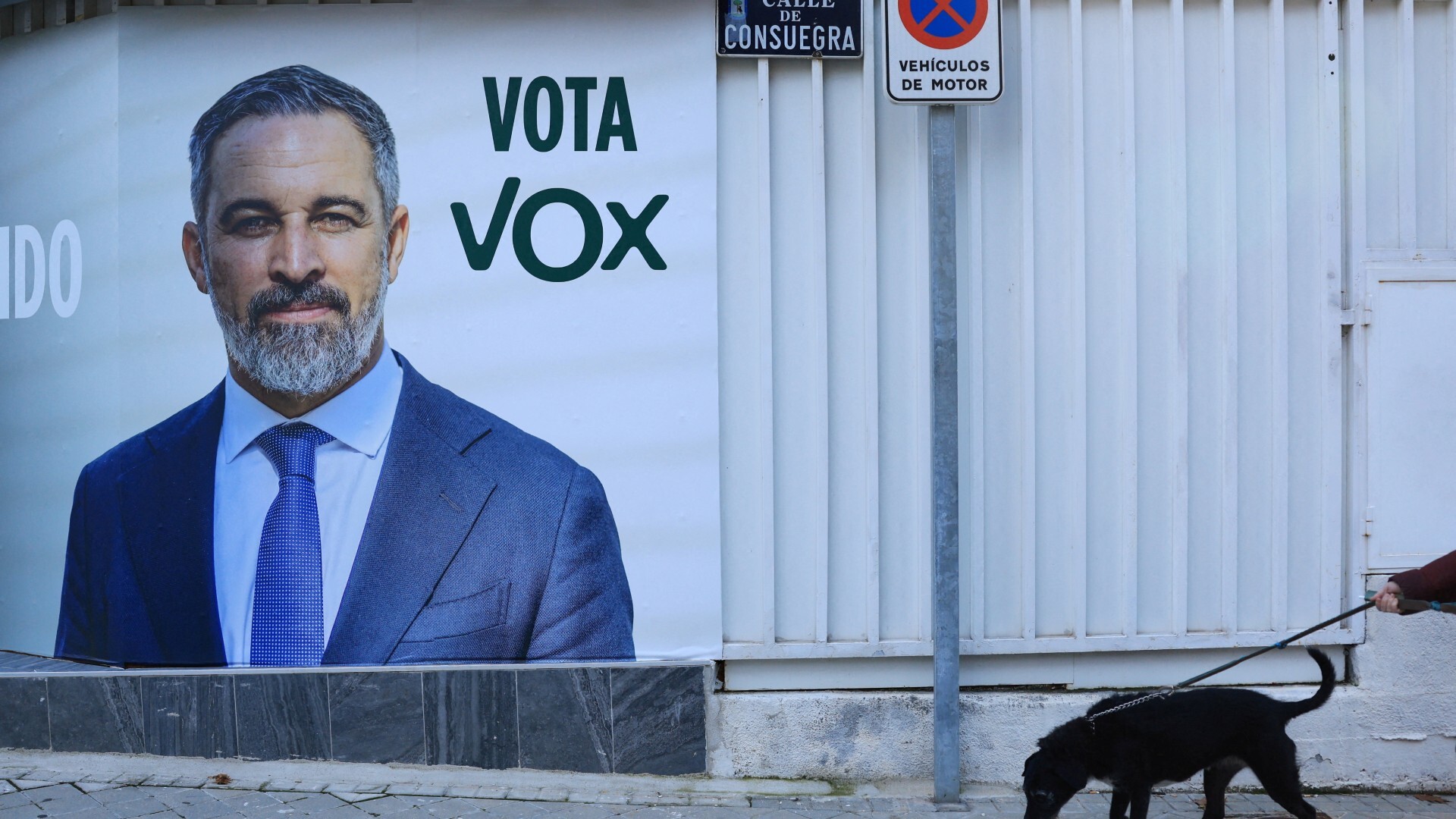
“The Israeli government has all our support, affection and understanding,” Santiago Abascal, leader of Spain’s far-right Vox party, said during a trip to Israel in December 2023. While Abascal visited Israel in a show of support and to seek political backing from Prime Minister Benjamin Netanyahu, Israeli forces had killed more than 16,248 Palestinians in Gaza, according to figures cited by the UN humanitarian office, OCHA. About 70 percent were women and children. Spain votes on Sunday, with polls predicting that Vox will almost double its parliamentary representation from 33 seats to 61. That would help the centre-right People’s Party (PP), which polls project will win 129 seats, assemble a coalition comfortably above the 176-seat majority needed to unseat Prime Minister Pedro Sanchez’s centre-left government. The election could also change Spain’s foreign policy, including its relationship with US President Donald Trump, its tense relations with Morocco and its deteriorating ties with Israel over the genocide in Gaza and ongoing apartheid policies in the occupied West Bank. New MEE newsletter: Jerusalem Dispatch Sign up to get the latest insights and analysis on Israel-Palestine, alongside Turkey Unpacked and other MEE newsletters Domestic issues, including the cost of living, affordable housing, wages and immigration, have dominated the campaign since Sanchez called the snap election on 5 October. Those concerns have driven support for Vox and the PP more than any shift in public attitudes towards foreign policy. According to a June survey by Pew Research Center, around 66 percent of Spaniards on the self-identified political right viewed Israel unfavourably, compared with 79 percent in the centre and 96 percent on the left. “The historical and traditional stance held by all Spanish governments [towards Palestine] since the transition to democracy in the 1970s enjoyed a broad consensus across the political spectrum - among conservatives, socialists, left-wing parties, and nationalists alike - and commanded widespread public support,” said Isaiah Barrenada Bajo, an international relations professor at Complutense University of Madrid. Spanish Prime Minister Pedro Sanchez speaks during a press conference after attending a special summit of European Union leaders in January (AFP) Under former PP prime minister Jose Maria Aznar, who governed Spain from 1996 to 2004 and took the country into the Iraq war, “a shift occurred toward a neoconservative, more Atlanticist, and pro-Israel orientation,” Barrenada told Middle East Eye. “This perspective has persisted within one faction of the PP to this day; it is especially prominent within the far-right party Vox - considered the most pro-Israel party in the European Parliament - upon which the PP might well depend to secure a governing majority,” he added. Israel’s diaspora affairs minister, Amichai Chikli, called Abascal “a personal friend” and “one of Israel’s greatest supporters in Europe” during a podcast in April this year. Abascal has also promised to reverse Spain’s recognition of a Palestinian state. 'One of the darkest episodes of this century' Spain formally recognised the State of Palestine on 28 May 2024, alongside Ireland and Norway. Sanchez announced the decision in parliament six days earlier, summing up his reasons in three words: “Peace, justice and coherence.” Sanchez has arguably been one of Europe’s strongest voices in demanding accountability for Israel’s crimes in Palestine. Alongside recognising the genocide in Gaza, Sanchez said the bombing campaign against the besieged strip would become “one of the darkest episodes of this century”. He said he wanted Spaniards to be able to say they had stood “on the right side of history”. Spain has also supported South Africa’s genocide case against Israel at the International Court of Justice. “The recognition of the State of Palestine - though long overdue, having been demanded by parliament and civil society for over a decade - was welcomed by the majority of the population, regardless of whether they supported the current government or identified with the opposition,” Barrenada said. 'Historically, the Spanish right has been much firmer in responding to Morocco’s blackmail, hostility and pressure than the Socialist Party' Taleb Alisalem, political analyst Relations with Israel, meanwhile, have hit rock bottom since 2023. Both countries have withdrawn their ambassadors. Spain has sanctioned some Israeli settlers, banned imports from Israeli colonial outposts in the West Bank, introduced an arms embargo and condemned Trump’s plan to ethnically cleanse Gaza. When more than 60,000 Moroccan migrants crossed into the Spanish territory of Ceuta in August, many in Spain blamed Rabat and Tel Aviv for orchestrating the crisis. Israeli leaders relished the crisis, during which more than 100 Moroccans drowned attempting the dangerous crossing. In September, Aznar, a staunch supporter of Israel, linked the Ceuta crisis to Spain’s deteriorating relationship with Israel. He suggested it resulted from "[alienating] the friendship of relevant allies, those allies one should be able to count on in crises". He called for the "normalisation of diplomatic relations with Israel as soon as possible". The migration crisis emboldened the Spanish far right, which sought to portray Sanchez as weak on border security and unwilling to confront Morocco over its weaponisation of migrants. “Historically, the Spanish right has been much firmer in responding to Morocco’s blackmail, hostility and pressure than the Socialist Party, which has consistently demonstrated an attitude of submission towards Rabat,” Taleb Alisalem, a Sahrawi writer and political analyst based in Madrid, told MEE. “However, I personally do not believe that the People’s Party will go as far as reversing Pedro Sanchez’s decision to support Morocco’s autonomy plan for Western Sahara.” Vox's unconditional support for Israel Sanchez’s 2022 decision to back Morocco’s autonomy plan for Western Sahara proved controversial because it offers the territory limited self-rule under Moroccan sovereignty, while the Polisario Front seeks a referendum allowing the Sahrawi people to choose independence. The move also triggered a rupture in relations with energy-rich Algeria. “Could there be a rapprochement with Algeria? Certainly. Mainly because of energy interests. Algeria is a major gas producer with substantial reserves and supplies a significant proportion of the natural gas consumed in Spain. I believe a right-wing government would seek to rebuild and strengthen relations with Algiers,” Alisalem said. Israel revels in Spain's migrant crisis while embarrassing ally Morocco Read More » “But Morocco also has considerable means of exerting pressure, extending far beyond its relationship with the Socialist Party. Rabat could also put pressure on the PP and even Vox, including through its close relationship with Israel.” Latin America offers a recent precedent for how a change from a left-wing to a right-wing government can dramatically shift foreign policy towards Israel and the US. In August, Colombia’s newly elected far-right government, led by Abelardo de la Espriella, recognised Moroccan sovereignty over Western Sahara and Israeli sovereignty over the occupied Syrian Golan Heights. It also announced plans to move its embassy to west Jerusalem. Moussa Bourekba, a research fellow at the Barcelona Centre for International Affairs and author of Escalation within Continuity: Spain’s Foreign Policy towards Israel and Palestine after October 7th, told MEE that Spain was unlikely to undergo such a dramatic shift. During an election debate on Thursday, PP leader Alberto Nunez Feijoo described events in Gaza as “a massacre” and “unacceptable”. “Vox clearly has a sense of unconditional support to Israel,” Bourekba said, adding that “PP could not openly go against the move of recognition of Palestine, because that would mean going against what the Spaniards believe and think”. “My argument here is that the very same way that leftist parties within the current coalition government led by Sanchez have been very influential in pushing him to raise the tone against Israel, to adopt sanctions, and to show solidarity with Palestine, we could expect Vox to act in a similar manner with PP, but in the opposite direction.”
As Spain’s right eyes power, what would change for Israel, Morocco and Algeria?
Full Article
Original Source
Read the full article at Middleeasteye →KhanList aggregates and links to publicly available news content. We do not host full articles from third-party sources. Always verify important information with original sources.