
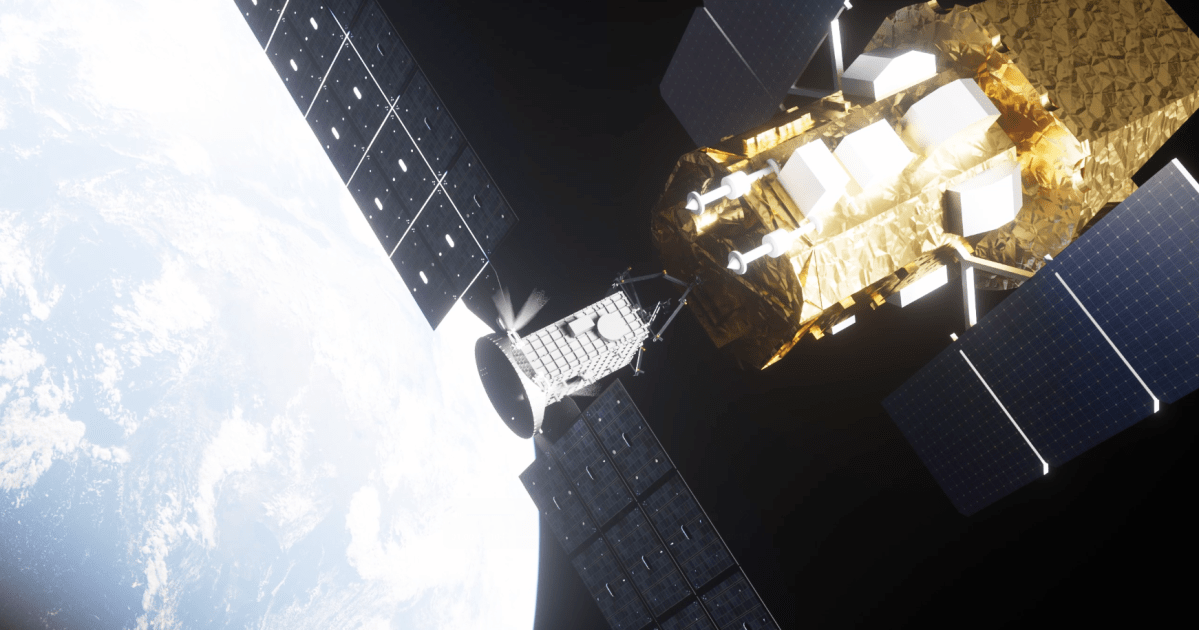
After an attitude-control failure sent it spinning, LINK will proceed with rendezvous and proximity operations at Swift — just not the orbit-boosting maneuver the mission was built to perform. | Published: August 24, 2026 Katalyst Space's LINK spacecraft (left) closes in on NASA's Neil Gehrels Swift Observatory (right) in this artist's concept. LINK was built to dock with Swift and raise its orbit, but an attitude-control failure has limited the spacecraft to a rendezvous with the telescope, without the boost. Credit: NASA NASA announced Aug. 19 that the Katalyst Space LINK spacecraft built to boost the aging Neil Gehrels Swift Observatory will still rendezvous with the telescope but won’t raise its orbit, after an attitude-control failure sidelined LINK during on-orbit commissioning. The Swift Boost Mission was a quick-turnaround rescue attempt designed to save the Swift observatory from an early demise. Thanks to increased atmospheric drag from the effects of solar maximum, NASA predicts the space telescope will reenter Earth’s atmosphere later this year, cutting short the extended run of a spacecraft that has delivered a number of breakthroughs in understanding gamma-ray bursts — the highest-energy explosions in the universe. NASA contracted Katalyst Space Technologies, a startup based in Flagstaff, Arizona, in September 2025 to attempt the rescue, giving the company less than a year to go from concept to execution. Katalyst designed and built the LINK spacecraft for the express purpose of rendezvousing with Swift in orbit, docking with the telescope, and boosting it to a higher altitude for a few more years of science. LINK launched July 3 on a Northrop Grumman Pegasus XL rocket but quickly ran into trouble, losing control of two of its three reaction wheels over the last weekend of July. Reaction wheels are spinning flywheels that use angular momentum to let a spacecraft point itself precisely without burning propellant. Three of them, angled correctly, can hold a spacecraft steady on every axis; NASA’s Nancy Grace Roman Space Telescope, set to launch Aug. 30, carries six for redundancy. LINK carries only the minimum three, and losing two sent it tumbling at nearly nine degrees per second, compromising communications with ground controllers. Katalyst spent the following weeks firing LINK’s electric propulsion thrusters to slow the spin, eventually taming it to about 1.47 degrees per second by early August — but for a while, it was an open question whether the mission could continue at all. RELATED: Is NASA’s Swift Boost Mission spinning away?Katalyst uploaded a flight-software fix Aug. 11 that reestablished LINK’s attitude control. But at that point, the timeline was even tighter. Swift had decayed to an orbital height of 216 miles (347 kilometers), just 31 miles (50 km) shy of the point where an orbit-raising mission would become much more difficult. Then came the Aug. 19 announcement from NASA that the spacecraft would still attempt rendezvous and proximity operations — closing in on and flying near Swift to test the maneuvers any future servicing mission would need — but would make no attempt to boost the telescope’s orbit. Without that boost, Swift is still expected to meet a fiery end before the end of the year. Neither NASA nor Katalyst has said how LINK’s mission will end — whether the spacecraft will dock with Swift and remain there through the telescope’s final days or drift off on its own. The Swift Boost Mission was framed from the start as a long shot, and NASA’s messaging hasn’t shifted now that it’s fallen short. “This is not the outcome we were working toward, but it does not change why this mission was worth attempting,” said NASA Administrator Jared Isaacman in the Aug. 19 announcement. “We knew this was a high-risk, high-reward mission — a first-of-its kind attempt, developed on an unprecedented timeline driven by the Sun’s activity,” said Shawn Domagal-Goldman, director of NASA’s Astrophysics Division. “We were all hoping for more science from Swift. But we knew the takeaways from this mission would be worthwhile either way, and we have gained so much through the series of accomplishments up to this point.” The agency plans to lean on its other missions to help cover the gap in gamma-ray burst monitoring once the 21-year-old Swift telescope is lost, as well as file away whatever lessons LINK’s rendezvous can teach us about robotic servicing for missions that follow. Brooks Mendenhall is a staff writer for Astronomy and is based in Chattanooga, Tennessee.
LINK to meet with Swift, but won’t boost
Full Article
Original Source
Read the full article at Astronomy →KhanList aggregates and links to publicly available news content. We do not host full articles from third-party sources. Always verify important information with original sources.