
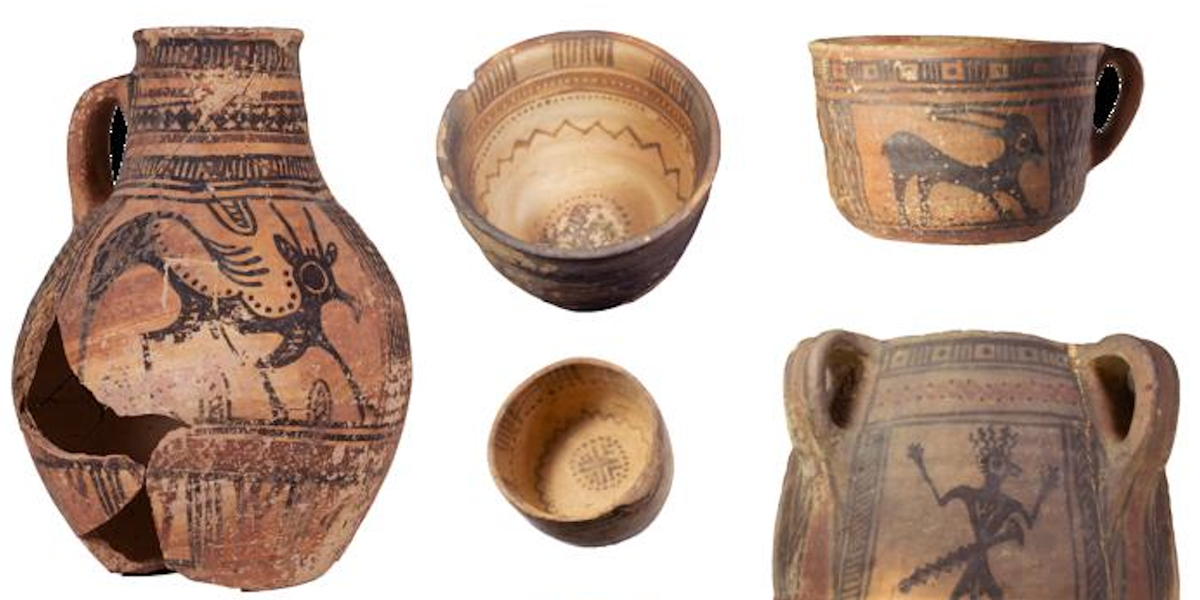
3 min readHere’s what you’ll learn when you read this story:Researchers believe that pottery crafted at the Oasis of Qurayyah in Northwestern Arabia represents some of the world’s earliest brand-making. While the makers didn’t stamp marks on the ceramics, their distinct style made the pottery widely sought-after and copied. Exports of the Qurayyah Painted Ware helped it live for centuries. Forget Roman sword makers stamping their mark on steel 2,000 years ago. Researchers now believe brand-making may have started in the Bronze Age more than 3,200 years ago, at the Oasis of Qurayyah in Northwestern Arabia.Known as the Qurayyah Painted Ware, this pottery—which featured distinctive animals and human rituals—not only created a local following, but turned into an export business that had other craftspeople looking to copy its style. “Oasis-dwellers were resourceful and inventive enough to create their own ceramic repertoire: to cherish at home and eventually export abroad,” Marta Luciani, professor in the University of Vienna’s Department of Prehistoric and Historical Archaeology, said in a statement.A team of researchers published a study in the journal PLOS One claiming they’ve proven that the Bronze Age oasis in the Arabian desert created true “brands.” The team stated that they investigated branding not through the analysis of added marks or packaging, but through the development of commodities manufactured with cultural-specific production modes and unmistakable visual properties.“Our analyses reveal that this bichrome painted pottery—locally invented in the late Middle Bronze Age—developed over centuries into a location-based, technologically consistent, and aesthetically distinctive corpus,” the team wrote in the study. They added that becoming a widespread export further contributed to the pottery becoming an early example of brand creation in ceramic production.Pamela Fragnoli, head of the Ceramic Lab at the Austrian Archaeological Institute of the Austrian Academy of Science, said that the team examined stratified material, vessel-shaping technology, and petrographic analysis of ceramic sections, and then cross-checked those with the vessels’ composition to find that the first set of Qurayyah Painted Ware was produced 3,600 years ago.“Our most striking discovery was ascertaining that painted pottery production continued by constantly evolving,” said co-author Doralice Klanscek, a Ph.D. candidate at the University of Vienna. Four centuries after its invention, the craftspeople producing Qurayyah Painted Ware were manufacturing a “flourishing repertoire of painted animals and human rituals.”The team identified several hallmarks of branding in their effort to assess the pottery, according to the statement: visual identity, material consistency, technological continuity, centralized production, export circulation, local imitation, intentional commercial scope, and cultural reputation. According to their analysis, Qurayyah Painted Ware achieved them all.“Our discovery sheds lights on how even in the arid environment of desert oases, where essential resources such as clay, water, and fuel were scarce, local communities already in the Bronze Age were far from marginal but participated in wider networks of technological know-how shared with neighboring regions, such as the Southern Levant and Syria,” Luciani said.The Qurayyah Painted Ware—which was once called Midianite Pottery, before the pottery’s Oasis of Qurayyah origin became known—traveled tens (if not hundreds) of miles south to North Arabia and north to sites like Tell el-Kheleifeh as an export product.Qurayyah’s potting traditions remained based in the oasis for thousands of years, into the final Iron Age, and became an exampleof the way that branding implications stretch beyond archaeology and into the long-term relationship between humans, natural resources, and economic mechanisms of the “producer-consumer relationships across time and space.”Tim Newcomb is a journalist based in the Pacific Northwest. He covers stadiums, sneakers, gear, infrastructure, and more for a variety of publications, including Popular Mechanics. His favorite interviews have included sit-downs with Roger Federer in Switzerland, Kobe Bryant in Los Angeles, and Tinker Hatfield in Portland.
Scientists May Have Found Evidence of the World’s First-Ever Brand.
Full Article
Original Source
Read the full article at Popularmechanics →KhanList aggregates and links to publicly available news content. We do not host full articles from third-party sources. Always verify important information with original sources.