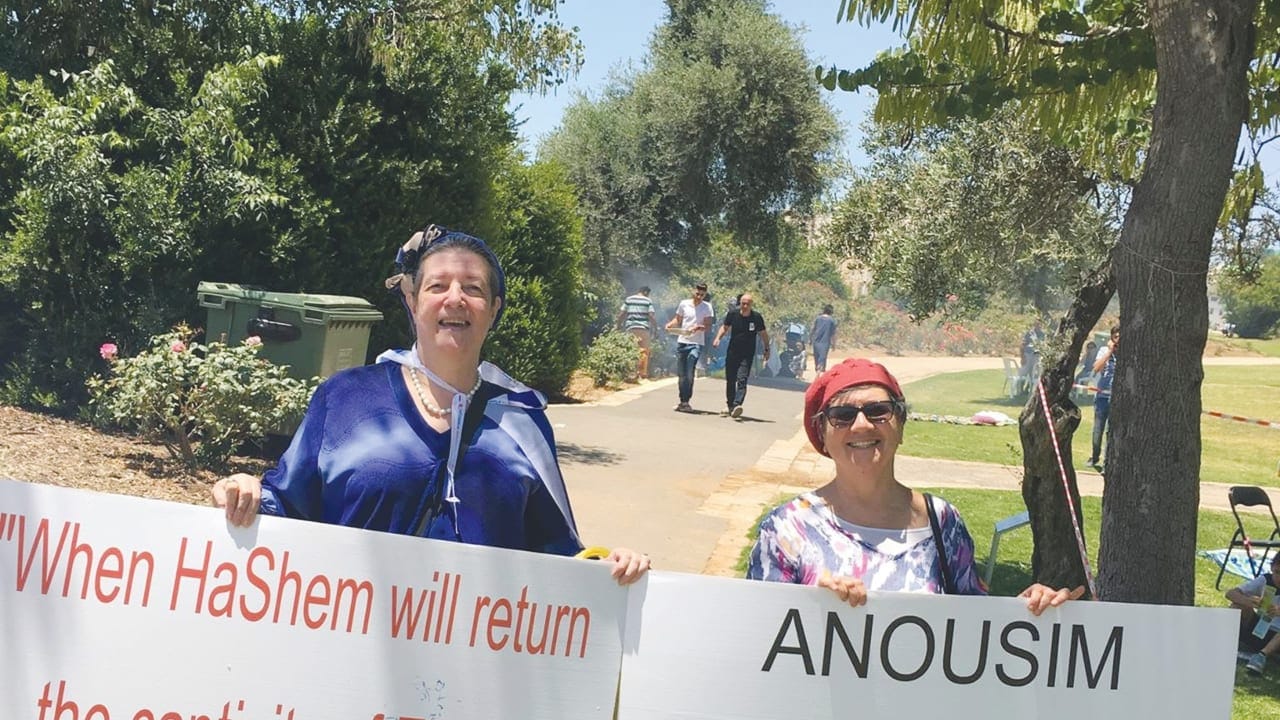
ByRIVKAH LAMBERT ADLERJULY 18, 2026 23:59For nearly a century, a little-known communal decree has effectively blocked tens of thousands of Jewish converts and descendants of Spain and Portugal’s forced converts from making aliyah through normal channels. Israel’s Nascent Sanhedrin court just challenged the legitimacy of that prohibition, potentially reopening the door for a population that has long sought to return both to Judaism and to Israel.The controversy centers on a takanah (communal decree) enacted in 1927 by the Syrian Jewish community in Buenos Aires. The decree barred converts from joining the community, a policy later adopted by the city’s Ashkenazi community and, over time, by every recognized Jewish community throughout Latin America.Yaffah Batya daCosta, founder and CEO of Ezra L’Anousim (bneianousim.org), explains why such a communal decree was enacted in the first place.“The decree against converts joining an established Jewish community was allegedly created to prevent Jewish men from marrying non-Jewish women whose sincerity about being a Jew was in question, such as in cases where they were already in a relationship with a Jewish man. That would have been enough to reject those potential converts in those days. “But why a blanket decree against ALL converts – even sincere ones?'The Inquisition Tribunal' as painted by Francisco de Goya (credit: Wikimedia Commons)“One has to understand the history to get to the root cause. The Spanish and Portuguese Jews had been forcibly converted to Roman Catholicism if they stayed in those countries after expulsion decrees. In 1497 in Portugal, they were not even permitted to leave, despite an expulsion edict. The Inquisition sought to punish heretics – those who had converted and were secretly observing Jewish law, custom, and tradition in private. “When the Spanish and Portuguese conversos went to the New World, essentially Latin America today, the Inquisition followed them there. The Catholic Church persecuted the secret Jews for 400 years. The last auto-da-fé (burning at the stake) was in 1830 in Mexico City.Potential converts murdered by Catholic Church“Even more, in Spain and Portugal in the 13th and 14th centuries, potential gentile converts, along with the rabbis teaching them, were murdered by the Catholic Church. In Latin American countries, which were all Roman Catholic, a gentile wanting to be a Jew would obviously have been a Catholic or a coveted potential convert to Catholicism.“So in 1927, in my opinion, the rabbis decided not to put their own lives, and the lives of the Jews in their congregations, at risk by barring conversion altogether,” she explains.While originally intended to address the unique circumstances of its era, critics argue that the decree has had unintended consequences for the Bnei Anusim – the descendants of Jews in Spain and Portugal who were forced to convert to Christianity but who secretly maintained elements of Jewish practice for generations.Beginning about three decades ago, growing numbers of these descendants began seeking to openly and publicly reclaim their Jewish identity through formal conversion. They quickly encountered an unexpected obstacle: recognized Jewish communities across Latin America generally would not sponsor or accept them because of the longstanding takanah.Unable to join established communities, many created independent congregations. However, those communities are generally not recognized by Israeli authorities for the purposes of aliyah.The issue has also intersected with Israeli immigration policy. Roughly a decade ago, lawmakers explored establishing a Knesset caucus to address the status of the Bnei Anusim. The matter was referred to the Diaspora Affairs Ministry, which reportedly convened a committee that, after two years of study, recommended assistance for the communities. Those recommendations were never implemented.At approximately the same time, the Interior Ministry adopted a policy recognizing conversions performed within “recognized and active” Jewish communities for immigration purposes under the Law of Return. While that policy applies broadly to converts, it effectively excludes many Bnei Anusim in Latin America because the communal ban prevents them from becoming members of the very communities whose recognition Israel requires.DaCosta describes the situation as a bureaucratic paradox.“There are young men and women in Latin America who have undergone conversion, identify as religious Zionists, and dream of serving in the IDF or performing National Service,” daCosta says. “Yet, because they belong to what Israel classifies as ‘emerging communities’ rather than recognized ones, they cannot make aliyah.”The long road to aliyahA limited pathway does exist. Several nonprofit organizations have brought small numbers of converted Bnei Anusim to Israel, where they study in yeshivot before undergoing an additional conversion through Israel’s official Chief Rabbinate conversion framework. Only afterward can they pursue aliyah.DaCosta says this process is expensive and resource-intensive, making it inaccessible to most candidates, despite what she describes as significant demand.She also argues that public awareness of the issue remains low. The history of the Inquisition, crypto-Judaism, and the descendants of secret Jews is seldom emphasized in contemporary Jewish education, leaving many Israelis and Diaspora Jews unaware that communities across Latin America continue to seek formal reintegration into the Jewish people.That could soon change.The Nascent Sanhedrin, a contemporary body that seeks to revive the historic 71-member Jewish high court but which holds no official legal authority within the State of Israel, has been studying the issue. On July 6, they issued a ruling calling on the Chief Rabbinate and the Interior Ministry to accept these converts from Latin America as a group. The ruling states:“There are several communities of converts in South America who have undergone Orthodox conversion according to its rules and are fully observing the Torah and commandments. Jewish communities throughout the world, as well as the Chief Rabbinate and the Interior Ministry, must accept these communities, permit them to come in congregation, and immigrate to the Land.”DaCosta explains that what they are asking for is the same right to come to Israel that has previously been granted to the Bnei Menashe communities from India and the Ethiopians from Africa. She estimates that if this ruling were accepted by the Chief Rabbinate and the Interior Ministry, 10,000-15,000 Orthodox converts from across Latin America would be eligible to come soon, with approximately 10 times that number of extended family members coming later.DaCosta is further convinced that once this pathway to aliyah is established, the initial group would be followed by many more Bnei Anusim who have stopped pursuing conversion and aliyah due to the dismal prospects of recognition by the established Jewish communities in Latin America and Israel. On this point, the ruling states:“At the same time, consideration should be given to sending conversion courts from Israel to these countries for the purpose of converting according to the Halacha of those interested. An examination of conversion courts already operating in these countries will also be conducted to see if they are indeed operating according to the Halacha, and if so, the State of Israel will validate the conversions of these courts.”Those involved in the discussions argue that the communal decree conflicts with the Torah’s repeated commandment to love and protect the ger (convert), which appears 36 times in the Torah. The appendix to the ruling by the Nascent Sanhedrin includes over 2,500 words in English, quoting sources beyond the Hebrew scriptures, including the Talmud, Maimonides, and 19th-century Sephardi rabbi and kabbalist the Ben Ish Chai.Although any ruling issued by the Nascent Sanhedrin would not carry legal force under Israeli law, daCosta believes it could have significant moral influence, potentially encouraging Jewish communities and Israeli authorities to reconsider longstanding policies affecting thousands of descendants of the Bnei Anusim across Latin America – policies that add Jewish injustice to Catholic injustice.If her hopes are realized, she says, it will mark the first significant challenge in nearly 100 years to policies that have prevented thousands of secret Jews from fully rejoining the Jewish people, and, ultimately, from coming home to Israel.■Follow us on Google
Latin American Jewish converts caught between communal bans and Israel’s Law of Return
Full Article
📰 Original Source
Read full article at Jpost →KhanList aggregates and links to publicly available news content. We do not host full articles from third-party sources. Always verify important information with original sources.