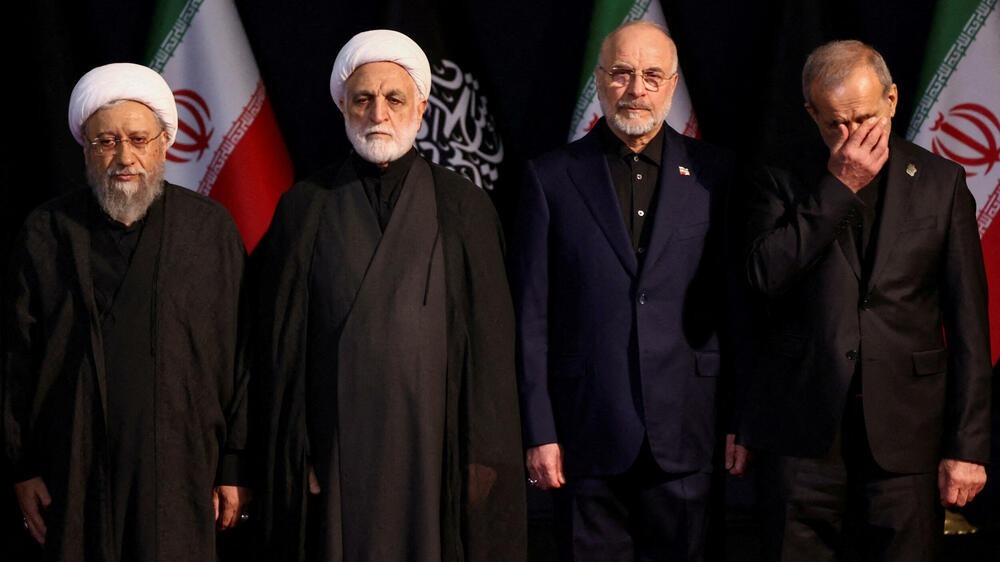
Hardline factions in Iran have accused senior leaders of staging a soft coup after the US agreement. The charge has sharpened internal divisions as Mojtaba Khamenei remains out of public view.Senior Iranian officials at a funeral ceremony in Tehran. (File photo: Reuters)Iran's political establishment is witnessing an intensifying power struggle, with hardline factions accusing the country's visible leadership of orchestrating a "soft coup" after reaching an agreement with the United States, even as Supreme Leader Mojtaba Khamenei remains out of public view, according to a report by CNN.The tensions spilled into the open during the funeral of former Supreme Leader Ali Khamenei in Tehran last week. As President Masoud Pezeshkian walked alongside Khamenei's coffin, sections of the mourners directed chants of "death to the compromiser", instead of paying tribute to the late leader.Foreign Minister Abbas Araghchi, who played a key role in negotiating the ceasefire and sanctions relief agreement with the Trump administration, also came under attack. According to reports, he was forced to leave the funeral after being pelted with stones by mourners accusing him of being a "traitorous sellout."The hostility underscores a narrative gaining momentum among Iran's most hardline groups. They alleged that senior officials who negotiated with Washington are attempting to sideline the country's revolutionary leadership while Mojtaba Khamenei, who succeeded his father, has remained largely absent from public appearances amid security concerns. Some critics have also speculated that his prolonged absence could be linked to health issues, though no official confirmation has been provided.Hardliners argue that, instead of retaliating for Ali Khamenei's killing in Israeli airstrikes carried out with US coordination earlier this year, the government effectively surrendered by signing an agreement that they claim contradicts Mojtaba Khamenei's directives. While officials continue to govern and negotiate in his name, the new supreme leader has neither addressed the nation nor publicly asserted his authority. In Mojtaba Khamenei's absence, Parliament Speaker Mohammad Bagher Ghalibaf, President Pezeshkian and Foreign Minister Araghchi have emerged as the public faces of Iran's post-war administration. Their growing prominence has fueled allegations from radical factions that they are attempting to consolidate power by bypassing parliament, ignoring the supreme leader's instructions during negotiations and suppressing nightly demonstrations organised by hardline supporters.Days before the funeral, outspoken conservative lawmaker Mahmoud Nabavian amplified those accusations in a post on X, asking, "Warning to the people of Iran: Is a coup on the way??" Following the funeral, he declared that supporters would "raise the banner of vengeance" for Khamenei's death while resisting what he described as an unfolding coup.Arash Azizi, a US-based Iran expert and author of What Iranians Want, told CNN that Mojtaba Khamenei's continued absence has left hardliners without direct access to the new supreme leader. As a result, they have increasingly portrayed Ghalibaf and Pezeshkian as the architects of a political takeover.HARDLINERS RENEW CONFRONTATION CALLSThe week-long funeral ceremonies became a platform for Iran's most uncompromising factions to press for military retaliation against the United States and reject any diplomatic engagement with Washington.That demand appeared to gather momentum after a fragile ceasefire deteriorated this week. The Revolutionary Guards launched attacks on shipping in the Strait of Hormuz, prompting retaliatory US strikes and renewed calls from hardliners to abandon the truce altogether.Even before hostilities resumed, prominent figures within the hardline camp had publicly threatened members of the government over the agreement with Washington.At one public gathering, Mohammad Ali Bakhshi, a regime-aligned religious singer, warned President Pezeshkian: "Mr President, if the leader's conditions are not fulfilled, then it will be us, the blade and your throat. We will bring hell upon you".Although the remarks drew criticism, there have been no reports of legal action against Bakhshi.Ghalibaf has also come under sustained criticism despite his long association with the Revolutionary Guards and his influential role during the conflict. Hardliners accuse him of expanding the authority of the Supreme Council for National Security at the expense of both parliament and the supreme leader."They are trying to elevate the role of the Supreme Council for National Security while diminishing the role of the supreme leader and parliament," hardline MP Kamran Ghazanfari said in a video statement earlier this month, describing the process as a gradual political coup.EFFORTS TO MARGINALISE RADICAL FACTIONSThe internal battle has also played out within the Iranian Parliament.On Tuesday, Nabavian was removed from the National Security Commission along with another lawmaker who opposed the agreement with the US.Nabavian had previously served on Iran's negotiating team before becoming one of the deal's fiercest critics. He allegedly attempted to derail the agreement by leaking its contents before it was signed and accused negotiators of violating the supreme leader's red lines.Nabavian and his allies are closely associated with Jebhe-ye Paydari (Endurance Front), an ultraconservative political faction that portrays itself as the defender of the ideals of the 1979 Islamic Revolution.According to analysts, Iran's current leadership is increasingly seeking to curb the influence of these groups."We're seeing Ghalibaf exerting influence to sideline these hardline elements. They are too costly for the system and they're bringing their rivalries out in the open, especially as the situation in Iran becomes unstable," Hamidreza Azizi, a visiting fellow at the German Institute for International and Security Affairs, told CNN.Although the faction is relatively small, it retains influence within parliament, the state broadcaster IRIB and other institutions. One of its leading figures, former national security chief Saeed Jalili, secured more than 13 million votes in the 2024 presidential election, finishing second.US President Donald Trump has repeatedly described Iran as "seriously fractured", arguing that internal divisions have complicated efforts to reach an agreement. However, analysts say that despite the visible tensions between the country's governing leadership and hardline factions, the broader establishment remains united on key strategic objectives, including securing sanctions relief and maintaining Tehran's control over the Strait of Hormuz.At the same time, Mojtaba Khamenei's continued absence from public life, his conditional backing of the ceasefire, the expanding role of the Revolutionary Guards and the large turnout at his father's funeral have emboldened radical voices demanding a tougher military response against both the United States and Israel.Reflecting that sentiment, former Iranian foreign minister Manouchehr Mottaki said during a televised interview on Wednesday that Iran should target a US military base in the region and capture American troops, saying, "It would be enough if we take 100 soldiers and bring them back to Iran".- EndsPublished By: Sahil SinhaPublished On: Jul 19, 2026 07:46 IST
Death to the compromiser: Iran hardliners turn on leadership over US deal
Full Article
📰 Original Source
Read full article at Indiatoday →KhanList aggregates and links to publicly available news content. We do not host full articles from third-party sources. Always verify important information with original sources.