
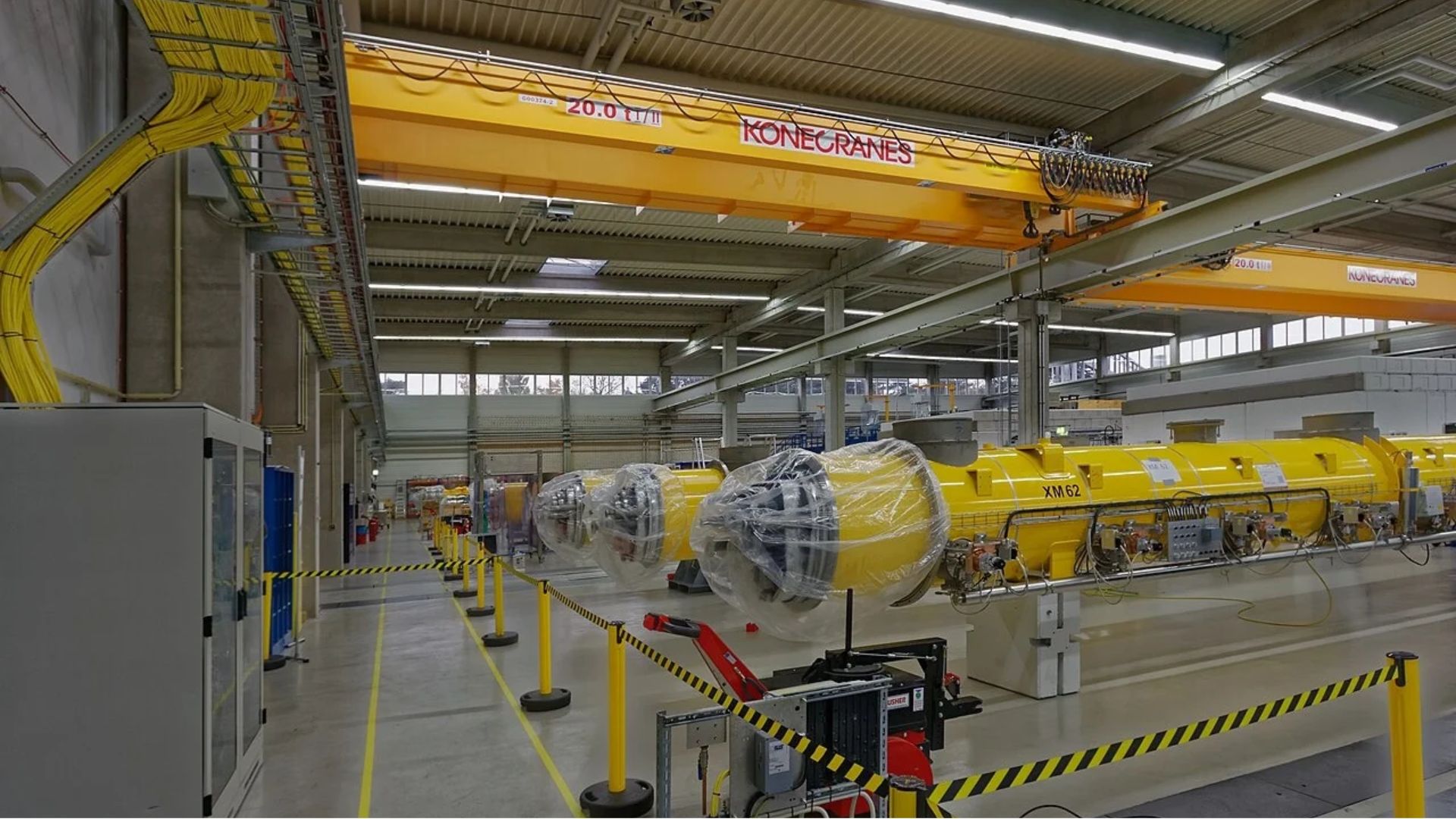
Researchers at DESY and European XFEL have broken their own world record by reliably generating and transporting X-ray laser flashes with a wavelength of about 0.04 nanometers. The team reported producing 800 flashes per second and sending them along a roughly 0.6-mile beamline at the European XFEL free-electron laser facility. The flashes reached a photon energy of 30,000 electronvolts after several years of work to improve the accelerator’s electron beam. Their wavelength is much shorter than the typical distance between neighboring atoms in a solid, which could help scientists make out finer details in dense materials and follow how those materials change under extreme pressure. Getting the X-rays down the beamline Producing the flashes was only part of the test. The researchers also had to steer the X-rays along the beamline, where the optics redirect the light before it reaches an experiment. The team retained nearly 60% of the X-ray light after it passed through those optics. That figure shows how much light remained available after transport, even at the shorter wavelength. The distinction matters because the wavelength sets a limit on the scale of features that X-rays can resolve. An experiment also needs enough light at the sample to produce a usable signal, making transport through the beamline part of the performance test. “The recent advance increases the span of wavelengths that European XFEL can provide to users and is unique among the world’s FEL facilities,” says Anders Madsen, a coauthor of the study and leading scientist at the facility’s Materials Imaging and Dynamics instrument. Years of accelerator tests paid off The team spent several years using simulations to study how the electron beam behaved inside the accelerator and testing changes on the machine itself. Improving the quality of that beam was central to producing the shorter-wavelength X-rays reliably. “A key enabling factor for this world record in X-ray laser science was the high electron beam quality, achieved through extensive beam dynamics studies and accelerator optimization,” says DESY scientist Ye Chen, who led the accelerator work with Frank Brinker. The facility is also developing superconducting undulators, devices that use magnetic fields to make electrons follow a zigzag path and emit X-rays. That effort is expected to support further work at shorter wavelengths over the next few years. A closer look at materials under pressure The shorter wavelength could help researchers distinguish closely spaced features in solids. The rapid succession of flashes also offers a way to sample fast changes at different points in an experiment. Together, those capabilities could help scientists see how the structure of a dense material changes while it is being compressed. In a compression experiment, for example, a series of measurements could show when a change in the material’s structure begins and how it progresses as the pressure rises. Potential applications include experiments on catalysts, functional materials and quantum materials. European XFEL is coordinating work on detectors, optics, beam diagnostics and experimental equipment alongside its accelerator upgrades. The goal is to make the record-setting flashes routinely available so that research teams can use them in their own experiments. The study was published in the Optica journal. Get the latest in engineering, tech, space & science - delivered daily to your inbox.Atharva is a full-time content writer with a post-graduate degree in media & amp; entertainment and a graduate degree in electronics & telecommunications. He has written in the sports and technology domains respectively. In his leisure time, Atharva loves learning about digital marketing and watching soccer matches. His main goal behind joining Interesting Engineering is to learn more about how the recent technological advancements are helping human beings on both societal and individual levels in their daily lives.
Laser sets world record with flashes reaching wavelength of 0.04 nanometers
Full Article
Original Source
Read the full article at Interestingengineering →KhanList aggregates and links to publicly available news content. We do not host full articles from third-party sources. Always verify important information with original sources.