
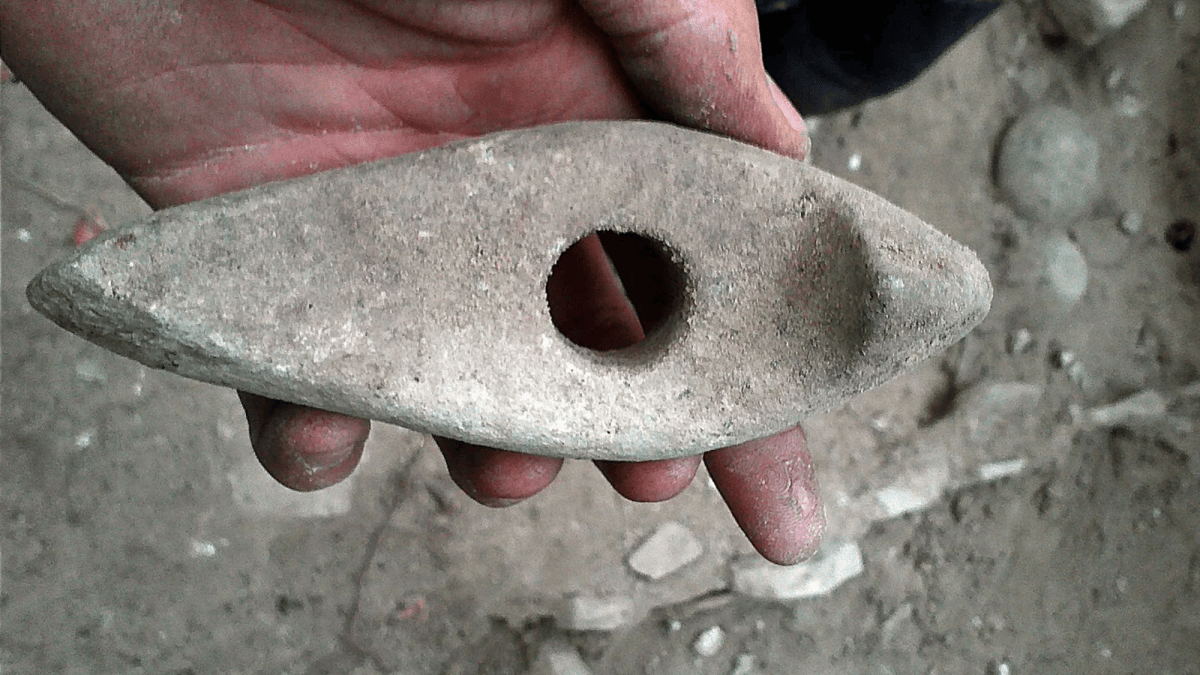
A double axe of the North German/South Scandinavian type. Found in a passage grave in Wangels, Eastern Holstein, excavated by the Institute of Prehistoric and Protohistoric Archaeology of Kiel University. Image: © Sebastian Schultrich Today, the Rhine River stands as a physical border between parts of France and Germany, and a cultural boundary between Western and Central Europe. This physical and cultural separation seems to have existed for a very long time. Archaeological evidence on either side of the river as early as the late fourth millennia BCE reveals differences. Archaeologists have determined that the river is a sort of barrier during this time—but new research challenges this conclusion. Sebastian Schultrich, an archaeologist at Kiel University in Germany, looked at late Neolithic coarse pottery, double axes, and collective graves from either side of the Rhine and found significant cross-boundary ties in the late 4th and early 3rd millennia BCE. His findings, described in a study recently published in the archaeological journal Germania, suggest that populations in Western, Central, and Northern Europe were more connected than previously assumed. “The combination of pottery, burial rituals and tools reveals new insights into life 5,000 years ago,” Schultrich said in a statement. The pottery in question, called coarse ware, is simple and plain—so much so that archaeologists have seen it as culturally insignificant. The roughly-shaped artifacts have emerged in many regions of Europe. It became widespread in modern-day central and northern France as well as the western Alpine region starting in the mid-4th millennium BCE. Afterward, it also became prominent in modern-day western and northern Germany and Denmark. Finds from the excavation carried out by the Kiel Institute of Prehistoric and Protohistoric Archaeology in Brodersby-Schönhagen, Rendsburg-Eckernförde district. In addition to flint artefacts, a shard of ‘coarse ware’ pottery was found (c. 3000–2800 BCE). Image: © Sebastian Schultrich. “There are indications that a convergence of pottery styles across such great distances occurred gradually and unconsciously. This is an indicator of high mobility within a region where there were no distinct barriers between groups, or where the boundaries were fluid,” said Schultrich. Double stone axes—prestigious axes with two cutting edges and a shaft hole—were also widespread in this period. Archaeologists have discovered them from France through Central Europe to Scandinavia and Poland. While the dates of the French double stone axes has been a subject of contention, it’s currently clear that they, along with the Central and Northern European versions, hail from the the 4th and early 3rd millennia BCE. Unlike coarse ware, the double axe design seems to have been intentionally widespread, showing that a shared concept existed on either side of the river. The same regions are also home to different versions of large-scale group burials, including passage graves or gallery graves. But they all were the final resting place of dozens to hundreds of individuals, were used over many generations, and were the locations of ritual acts and gatherings. This is more evidence of a shared idea, even though its regional manifestation differed. The remains of a Neolithic gallery grave on Île Coalen, Brittany (France). Although the design of these graves varied from region to region, they shared fundamental characteristics across many parts of Europe. Image: © Sebastian Schultrich. “It was not a uniform cultural complex,” Schultrich explained. “What we see here is a network characterised by fundamental narratives, yet one that simultaneously allowed scope for strong regional peculiarities. This is an early example of a complex, differentiated form of society in which identity combined both supra-regional and local elements.” By drawing prehistoric connections across the Rhine, Schultrich revealed ties across late Neolithic Europe that clearly overcame the watery boundary. 2026 Popular Science Home of the Future Awards 39 products that will improve your everyday life.
Fancy axes and simple pottery show how interconnected Europe was 5,000 years ago
Full Article
Original Source
Read the full article at Popsci →KhanList aggregates and links to publicly available news content. We do not host full articles from third-party sources. Always verify important information with original sources.