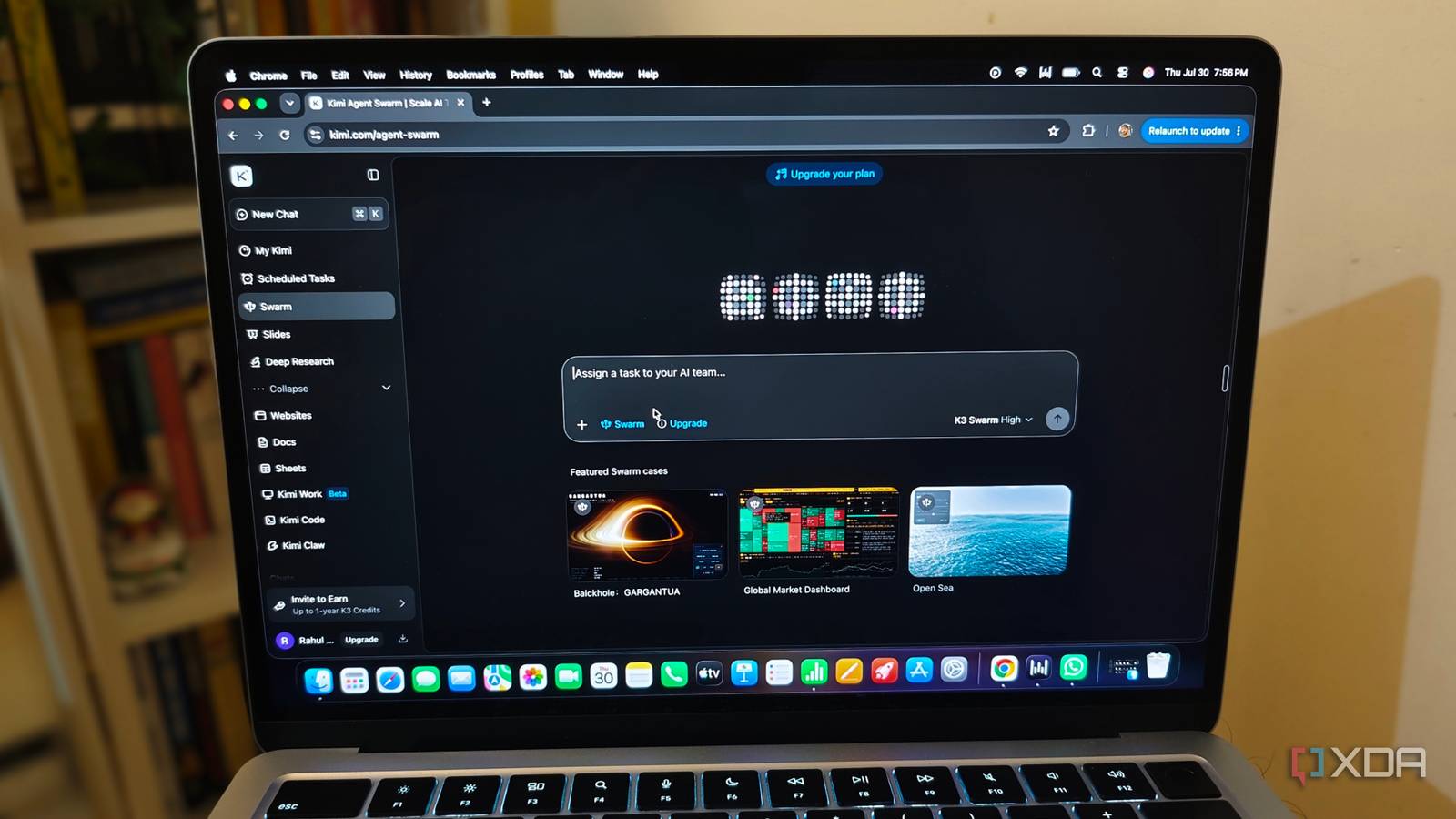
Published Aug 6, 2026, 8:30 AM EDT Anurag is an experienced journalist and author who’s been covering tech for the past 5 years, with a focus on Windows, Android, and Apple. He’s written for sites like Android Police, Neowin, Dexerto, and MakeTechEasier. Anurag’s always pumped about tech and loves getting his hands on the latest gadgets. When he's not procrastinating, you’ll probably find him catching the newest movies in theaters or scrolling through Twitter from his bed. Frontier AI labs have made significant progress in the technology, all thanks to the billions of dollars investors are pouring into it. Most of these AI labs, including OpenAI and Anthropic, release only closed-source models, such as GPT and Claude. We are not seeing the same level of innovation in the open-weight world because the companies operating in this space simply do not have the same resources. For the longest time, open-weight models came nowhere close to their closed-source counterparts, but that changed recently with Kimi K3. Moonshot somehow managed to deliver an open-weight model that can go head-to-head with Anthropic’s Fable 5 and even OpenAI’s GPT-5.6 Sol. It's a ray of hope for the open-weight ecosystem and another reminder of how scary good local AI is getting. Almost all of Kimi K3 is now on Hugging Face You get the model, not its recipe Moonshot released Kimi K3’s complete 2.8-trillion-parameter model on Hugging Face rather than a smaller version based on it. The download is roughly 1.56TB and is split across 96 files, which should be enough to quash most self-hosting dreams. Moonshot has already compressed the model using lower-precision MXFP4 weights, so this is not a case where further optimization will suddenly make it fit on a gaming PC. K3 uses a Mixture-of-Experts architecture, which means it calls on only a small part of the model for each request. It has 896 experts but uses only 16 of them at a time, activating around 104 billion of its 2.8 trillion parameters. This reduces the processing power required to generate a response, but the complete model must still remain accessible. You cannot treat it like a regular 104-billion-parameter model. For comparison, Qwen3.5 and Llama 4 Maverick each contain around 400 billion parameters, making K3 roughly seven times larger. Google’s largest Gemma 4 model has only 31 billion parameters, while its smaller versions can run on laptops and even smartphones. The largest Qwen and Llama models already require serious hardware, but K3 belongs in an entirely different category. It's technically available for anyone to download, but in reality, it's built for data centers and well-funded AI labs. The custom Kimi K3 License gives you rights to download and deploy the model, modify and fine-tune it, and create derivative models. You can even redistribute it or use it in commercial products. However, there are some restrictions if you are a model-as-a-service generating more than $20 million in revenue, including a separate agreement with Moonshot and an obligation to display Kimi's logo on your platform. Moonshot published K3’s architecture, technical report, inference tools, and some of the infrastructure used to build it, including MoonEP and FlashKDA. However, it did not release the complete training dataset or all the information required to recreate the model from scratch. That’s why K3 does not qualify as fully open source under the Open Source Initiative’s definition. Kimi K3 can go against any model out there Even Fable 5 Kimi K3 is not just impressive in the open-weight world but also compared to any AI model out there. That includes your frontier models, such as Fable 5 GPT, Soul, Gemini, and anything else. Kimi GPT-5.6, Soul, and Fable 5 build different things, but the outputs haven't been very different. In fact, Kimi K3 does a lot better job at UI than any of these models. Moonshot’s own testing shows K3 scoring 77.8 on ProgramBench, narrowly ahead of Fable 5 at 76.8 and GPT-5.6 Sol at 77.6. It also leads on BrowseComp with 91.2, compared with 88 for Fable and 90.4 for Sol. K3 scores 57 on the Artificial Analysis Intelligence Index, compared with 59 for GPT-5.6 Sol and 60 for Fable 5. A two- or three-point gap does not make these models interchangeable, but it places K3 much closer to the frontier than previous open-weight releases. K3 is also cheaper than GPT-5.6 Sol and Fable 5. It costs $3 per million input tokens, while GPT-5.6 Sol costs $5 and Fable 5 goes up to $10. K3 costs $15 per million output tokens, while GPT-5.6 Sol charges twice that at $30, and Fable 5 takes things to an absurd $50. Self-hosting it is a distant dream, though Consumer hardware still cannot handle it “If not friend, then why friend-shaped?” That is how I would describe Kimi K3. It’s a fantastic model that can hold its own against almost anything else available today, and its weights are publicly available. Everything you need to deploy it on your own hardware is available on Hugging Face. The only problem is that you need a small data center and an investment of more than $500,000 to get it running locally. I am a self-hosting enthusiast, but even I am not willing to go that far. However, devs have already found ways to make K3 run on consumer hardware. A project called WASTE managed to run the complete model on a MacBook Pro with 64GB of memory. It reduced the model to a 982GB container, kept the parts used in memory at all times, and streamed the required experts from the SSD. The setup required only about 29GB of memory for a 4,000-token context. The word “run” is doing some heavy lifting here. K3 generated only about 0.32-0.34 tokens per second, which means a moderately long response could take 15-20 minutes. The model needs to read roughly 17GB of expert data from storage for every token it generates, so the SSD becomes the bottleneck. The more realistic route will probably involve smaller models distilled from K3 rather than squeezing the complete 2.8-trillion-parameter version into a laptop. Local AI will only get better Given the pace of innovation over the past few years, it is fair to say that local AI will get much better. Models such as Gemma 4 already make it possible to run AI on most consumer devices, while Alibaba and Meta offer smaller models that perform equally well.
Kimi K3's open weights just dropped, and it's another reason local AI is getting scary good
Full Article
Original Source
Read the full article at Xda-developers →KhanList aggregates and links to publicly available news content. We do not host full articles from third-party sources. Always verify important information with original sources.