
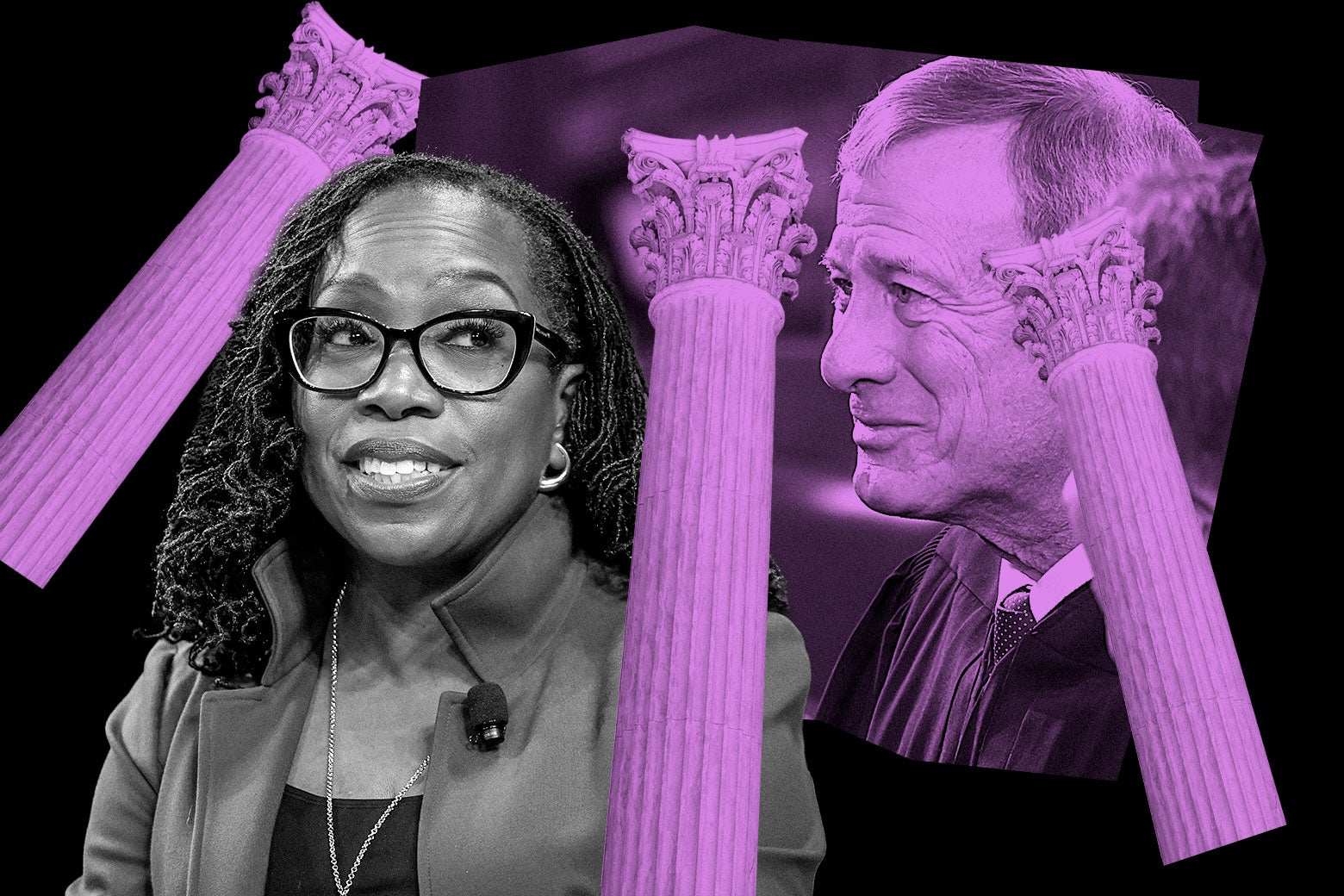
Jurisprudence No lower court could stomach the executive order’s illegality. Photo illustration by Slate. Photos by Win McNamee/Getty Images, Tasos Katopodis/Getty Images for the Atlantic, and Molly Hutson/Unsplash. Sign up for Executive Dysfunction, a weekly newsletter that highlights one under-the-radar story about how Trump is changing the law—or how the law is pushing back—and keeps you posted on the latest from Slate’s Jurisprudence team. On Monday, the Supreme Court allowed the Trump administration to begin implementing Donald Trump’s mail-in-ballot executive order, which seeks to nationalize an election procedure that the Constitution has assigned to the states by ordering the United States Postal Service to refuse to mail certain ballots. Even though nearly all midterm primaries have already happened and the general election is only months away, the court bought the government’s argument that it’s simply too early to consider a lawsuit about the order’s legality. As Justice Ketanji Brown Jackson pointed out in her dissent, Monday’s decision is another piece in this court’s deteriorating democratic docket, letting Trump sow chaos over voting rights across an electorate increasingly dissatisfied with his governance. In March, President Trump issued an executive order called “Ensuring Citizenship Verification and Integrity in Federal Elections,” which sought to give the White House and the executive branch control over mail-in ballots. The order creates a three-part behemoth of new voting measures. First, it directs the Department of Homeland Security to create citizenship lists of people in every state who the federal government believes are eligible to vote. Second, the order directs the attorney general to “prioritize” prosecutions against local election officials who violate election law by allowing people to vote who shouldn’t have. Finally, the order launches a process for the USPS to issue a rule about new special barcodes on mail-in ballots; through that rule, the USPS is directed to refuse to mail ballots that don’t contain this brand-new barcode. Given that the Constitution gives the president no authority over election processing, no lower court could stomach the EO’s illegality. After a group of 23 states sued, multiple federal courts issued injunctions blocking its implementation. But then Trump’s government went to the Supreme Court, as it often does. At no point did the government attempt to argue that the EO is legal. Instead, they only argued that the states lacked legal standing to bring the lawsuit to begin with. The Republican appointees sided with the government, reasoning that the executive order technically only required other federal agencies to take action, rather than the states. Therefore the states did not meet the injury required to bring their case at this time. But throughout the opinion, the court made no claims as to whether the court would rule in favor of the administration once the legal issues are squarely before the court. And to make matters more confusing, a separate court still has a separate injunction blocking parts of the EO in a case brought by the League of Women Voters. There’s a more twisted point that’s worth zeroing in on, and that’s the relationship between Trump’s mail ballot–suppression efforts and the Supreme Court’s horrid election law jurisprudence of the past few years. Jackson flags this exact relationship in her dissent, as the court’s new ruling Monday “lets another shoe drop in the Kafkaesque nightmare that our precedents have been steadily creating for certain plaintiffs.” The nightmare works primarily by manipulating timing. As state and federal governments began taking increasingly controversial election actions over the past decade, such as gerrymandering or throwing out lawful ballots, voters and civil rights groups have filed more suits. But the Supreme Court has developed two new limitations on how a lower court is able to rule on these election issues. Understanding both these limitations together is key to seeing just how much of a democratic crisis this court is enabling. First, in a case from a couple of terms ago called Trump v. CASA, the court held that lower district courts do not have the authority in most instances to issue what are called nationwide injunctions. A nationwide or universal injunction just means an order requiring the government to stop implementing an unlawful rule against the entire country. Instead, after CASA, the court can usually only prevent a losing government from enforcing its unlawful rule against the specific parties that filed the lawsuit. But after hamstringing what types of remedies a court can order, the Supreme Court also restricted when any orders can come down with its second restriction. This is the controversial Purcell principle, which says that courts are not permitted to change voting rules close to Election Day. This restriction holds true even if the government’s own delay is the reason the lawsuit had to come so late. Purcell creates an absurd situation in which a plaintiff can challenge an election rule in court, the court can agree the rule is illegal, but then no one is allowed to remedy the illegality because it’s too close to an election. Now pile onto Purcell Monday’s mailing order. In its unsigned opinion, in which the three liberal justices dissented, the majority says that it is simply too early to challenge the forthcoming USPS rule because, well, who could possibly know what that rule might say? It characterizes the lower court as engaging in “a string of speculation” about what the federal agencies might do when, and how that speculation illustrates that the state’s claims aren’t ripe for review. The majority goes so far as to say that the lower court “had to speculate” about whether the USPS would even issue a final rule whatsoever. This charge is especially absurd given that the USPS had already issued the final rule days before the Supreme Court’s order, publishing the 95-page final rule last Friday. To recap: Purcell punishes a plaintiff in voting cases for being too late to court. But Monday’s order says that a plaintiff, like the states that sued, can also come to court too early. See the issue? The court’s precedents are creating an invisible tightrope which very few plaintiffs can cross successfully. And even if the plaintiffs eventually succeed in challenging the EO, thanks to the CASA decision, only voters in the blue states that sued will likely get any protection. What makes this tightrope even harder to navigate is the fact that these legal developments don’t happen at the predictable cadence Americans might want from their election procedures. It’s the government itself that controls when it releases drafts and final versions of all these rules and regulations. The government can therefore strategically delay or speed up parts of the process, as it’s doing here, based on what it needs to argue to the judge in front of it and when. Jackson rightly describes this “Catch-Me-If-You-Can approach” to legal strategy as what it is: a cynical gotcha game designed to dodge legal accountability for as long as possible. And all in support of an effort to sow chaos before a midterm election that the president believes will rebuke his authority. Jurisprudence Supreme Court Voting Voting Rights Judiciary Ketanji Brown Jackson
Ketanji Brown Jackson’s Clear-Eyed Solo Dissent Explains the Supreme Court’s Voting Assault
Full Article
Original Source
Read the full article at Slate →KhanList aggregates and links to publicly available news content. We do not host full articles from third-party sources. Always verify important information with original sources.