
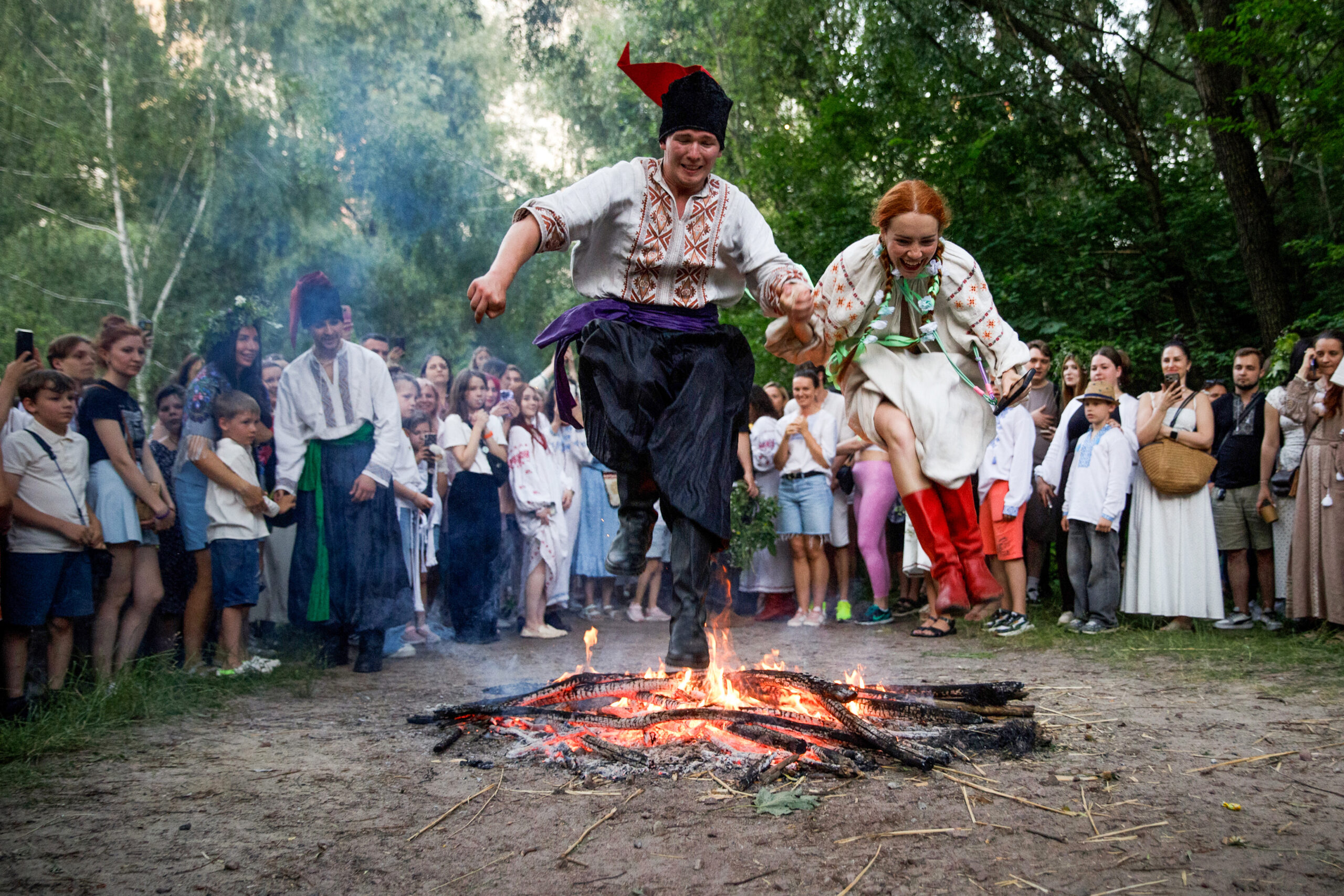
As Kyiv’s midnight curfew approached, a crowd gathered outside the Naked Room gallery in the city’s Golden Gate district. Guests lingered in the bitter cold, smoking cigarettes and embracing friends before making their way home through darkened streets. It was the height of Ukraine’s winter blackouts. Russian missile and drone attacks had left much of the capital without electricity, while ice covered the sidewalks. Yet the mood was anything but defeatist. This well-attended evening marked the closing of Naked Room’s original location as the gallery prepared to move to a larger space. It was a fitting metaphor for Kyiv’s own cultural trajectory. The guest list included members of Ukraine’s government, founders of defense tech companies, and young artists whose careers have developed almost entirely under the shadow of Russia’s full-scale invasion. They danced to a soundtrack that moved effortlessly between Ukrainian and American music before dispersing into the freezing night. This snapshot from early 2026 offers a window on the remarkable cultural renaissance that is currently underway in wartime Ukraine. Rather than extinguishing artistic life, Russia’s full-scale invasion has accelerated a flowering of creativity, intellectual exchange, and civic purpose. As a new generation of artists, entrepreneurs, soldiers, and public officials re-imagines the country’s identity, they are reshaping not only Ukraine’s future but also its place in the world’s cultural landscape. Stay updated As the world watches the Russian invasion of Ukraine unfold, UkraineAlert delivers the best Atlantic Council expert insight and analysis on Ukraine twice a week directly to your inbox. “Ukraine is lucky in a sense as it was able to preserve its independence. The current generation finds itself in a unique position because for the first time, the world is now listening to Ukraine’s version of events and not Russia’s,” comments Kharkiv-born photographer Sasha Maslov, who has taken portraits of Ukrainian President Volodymyr Zelenskyy and exhibited his photography internationally. “Culture plays a huge role in Ukraine’s current struggle.” For centuries, Ukrainian culture was filtered through imperial narratives that minimized or appropriated its distinctiveness. Even after independence in 1991, institutions, language politics, and cultural assumptions inherited from the Soviet era continued to shape public life. This legacy also helped define modern international perceptions of Ukrainian culture, with debates still playing out in museums such as the Metropolitan Museum of Art and MoMa over whether certain artists should be considered Ukrainian or Russian. Historic change is now well underway. Since 2022, the full-scale Russian invasion has accelerated a generational shift in cultural identity that had already begun in the aftermath of Ukraine’s Revolution of Dignity eight years earlier. Many younger Ukrainians no longer define themselves primarily in opposition to the Soviet past. Instead, they are creating a new national identity with a sense of self-confidence that requires no external validation. Few organizations illustrate this spirit more clearly than Nahirna22, a Kyiv-based collective of Generation Z artists. Formerly located in the city’s Soviet-era Automation Center, the collective attracted international attention after Russian drone strikes hit its facilities twice in 2025, killing one person. Following the first attack, members raised funds, rebuilt their space, and reopened. After the second strike, they did it again. “What truly moved and convinced us to keep going was the incredible response from our community,” says Martha Nyrkova, Nahirna22’s manager. “When the second strike hit, it was a heavy psychological blow, but it didn’t break our resolve. If anything, it solidified the understanding that our persistence is a form of resistance.” She believes her generation occupies a fundamentally different place in Ukrainian history than their predecessors. “Previous generations of Ukrainian artists often had to fight for the very right to exist as distinctly Ukrainian,” she comments. “Our generation’s voice is different. We don’t have to prove we are Ukrainian. We simply are.” Eurasia Center events Periods of war and profound national upheaval have often given rise to extraordinary cultural movements. From the Dutch Golden Age to Paris’s Montparnasse in the early twentieth century, history offers numerous examples of military, political, and economic transformation leading to lasting artistic innovation. Ukraine’s fight for survival against Russia’s ongoing invasion is now generating a remarkable concentration of creative energy. Since the outbreak of hostilities four years ago, the number of Ukrainian books being translated into English has more than doubled. This year, Ukraine’s Ministry of Culture is supporting the publication of over one hundred translated Ukrainian works across thirty-three countries. Around the world, audiences encounter Ukraine not only in the form of battlefield updates and geopolitical analysis, but also through the country’s filmmakers, architects, fashion designers, musicians, photographers, writers, and visual artists. Ukrainian artist Waone, whose surrealist murals have become fixtures of Kyiv’s street art scene, recently designed a Hermès storefront installation at Kansai International Airport in Japan. Ukrainian Fashion label Gunia Project has collaborated with international luxury houses while reinterpreting traditional Carpathian craftsmanship for global audiences. Meanwhile, Kyiv-based brand Bevza has become a regular presence at New York Fashion Week. Ukrainian documentary film makers are also reaching global audiences, with “20 Days in Mariupol” becoming the country’s first Academy Award winner and introducing millions to the human reality of Russia’s invasion. “For me, culture is inseparable from resilience,” says artist Marta Syrko, who depicts Ukrainian military veterans as Renaissance figures in her photography-based art. “A society cannot exist as a distinct community without its own language, art, visual traditions, and shared memory. They form the foundation of identity, and identity gives people the ability to define themselves rather than be defined by someone else.” In August, Ukraine’s cultural renaissance was on display at the annual Bouquet Kyiv Stage festival, which took place in the stunning surroundings of Kyiv’s ancient Saint Sophia Cathedral complex. “Bouquet Kyiv Stage reflects who we are at a particular moment in time, expressed through the language of art,” Bouquet organizer Irina Budanska explains. “Since the beginning of Russia’s full-scale invasion, each edition of the festival has evolved alongside us.” Since 2022, Ukraine’s remarkable military prowess has captured the world’s attention. But another transformation is unfolding alongside it. Galleries are expanding. Festivals continue. Ukrainian writers are reaching new audiences. Ukrainian designers, photographers, musicians, and filmmakers are introducing the country to the world on their own terms. If the world remembers this period of Eastern European history solely in terms of battles and politics, it will overlook one of the war’s most enduring legacies. Amid missile strikes, blackouts, and uncertainty, Ukraine is experiencing a cultural renaissance that is undoing centuries of imperial oppression. Davis Richardson is the founder and CEO of America-Ukraine Strategic Partners (AUSP) and the founder of Paradox Public Relations. Further reading The views expressed in UkraineAlert are solely those of the authors and do not necessarily reflect the views of the Atlantic Council, its staff, or its supporters. The Eurasia Center’s mission is to enhance transatlantic cooperation in promoting stability, democratic values, and prosperity in Eurasia, from Eastern Europe and Turkey in the West to the Caucasus, Russia, and Central Asia in the East. Follow us on social media and support our work Image: June 23, 2026, Kyiv, Ukraine: Participants jump over a Kupala bonfire during the large-scale Kupaila na Yvana celebration held according to authentic Ukrainian traditions at the Mamayeva Sloboda Cossack settlement in Kyiv, Ukraine, on June 23, 2026 (Credit Image: © Marianna Kotyk/Ukrinform via ZUMA Press Wire)
A cultural renaissance is reshaping national identity in wartime Ukraine
Full Article
Original Source
Read the full article at Atlanticcouncil →KhanList aggregates and links to publicly available news content. We do not host full articles from third-party sources. Always verify important information with original sources.