
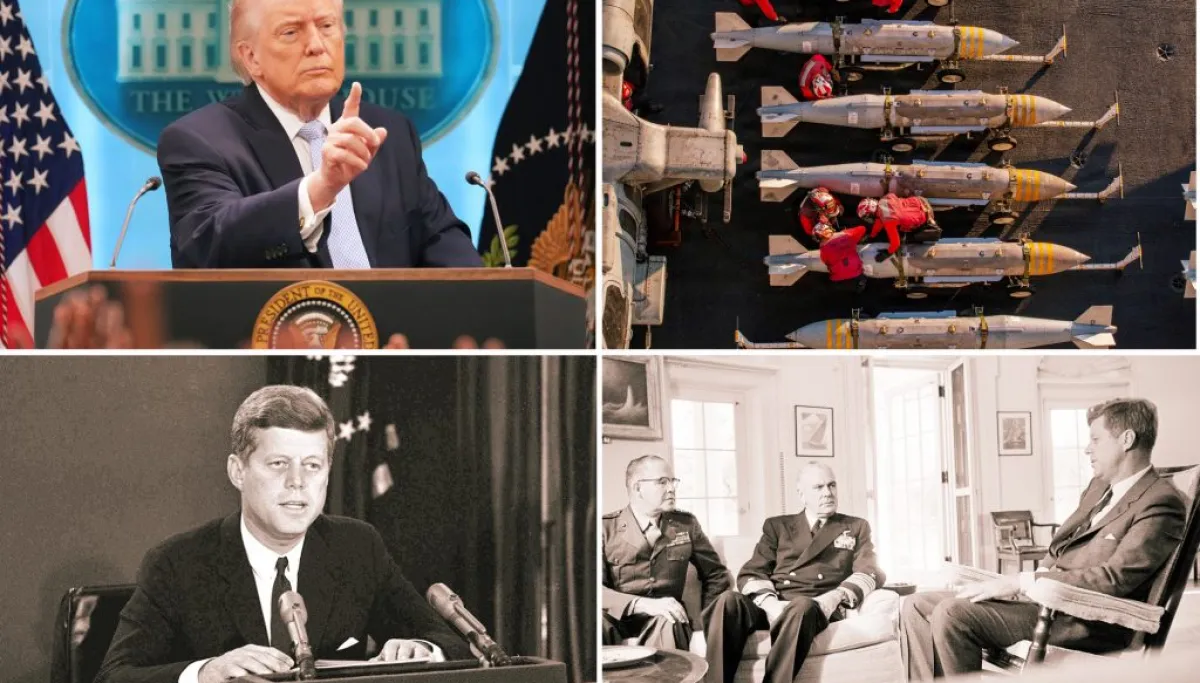
Vice President JD Vance offered a blunt explanation for the Republican midterm defeat last week: “The reason we lost is the war.”President Donald Trump called that assessment “largely true” but defended attacking Iran because Tehran could not be allowed to acquire nuclear weapons.An ABC News voter poll found 34% of House voters considered the war crucial, compared with 49% citing the cost of living and 55% citing government corruption. The war and gasoline prices are connected, and voters have paid for both. Eight months after Operation Epic Fury began on Feb. 28, Washington has explained what American forces were attacking. It has been less clear about the political outcome those attacks were meant to produce. That distinction matters with another round of strikes possible.On Oct. 22, 1962, President John F. Kennedy addressed the nation about Soviet missiles in Cuba. He identified the threat, explained America’s response, and defined the conditions for resolving the crisis. His objective was the withdrawal or elimination of Soviet offensive missiles from the Western Hemisphere. Americans understood what he wanted and why it mattered.Trump’s Feb. 28 statement was different. He cited Iran’s nuclear ambitions, support for terrorist groups, repression of protesters, and the 1979 hostage crisis. He also encouraged Iranians to take over their government. These grievances explained Washington’s opposition to Tehran, but left the desired political outcome uncertain.The Pentagon, however, articulated specific military objectives: destroy Iran’s missile and drone capabilities, navy, and defense industrial base. On April 8, Joint Chiefs of Staff Chairman Dan Caine said those objectives had been achieved after 38 days. The administration could legitimately claim major operational success. But Trump’s invitation to Iranians to replace their rulers suggested something beyond capability degradation.Was regime change an objective, an anticipated consequence, or merely an opportunity?Degradation destroys capabilities. Submission requires the surviving government to accept Washington’s demands. Regime change replaces the political order with one capable of governing. The first occurred on a substantial scale. Neither of the latter two followed. Each demands a different strategy and measure of success.American and Israeli strikes killed Ayatollah Ali Khamenei and other senior leaders, disrupting Iranian command and control. Yet the Islamic Republic survived under Mojtaba Khamenei. The Islamic Revolutionary Guard Corps retained the capacity to resist, threaten shipping through the Strait of Hormuz and impose costs on American forces.An October Wall Street Journal investigation identified 274 damaged structures at 24 installations hosting U.S. forces. Officials estimated at least $5 billion in damage, potentially reaching $15 billion. More than 20 American service members died in war-related activity. Iran’s weakened military could still retaliate, and leadership decapitation did not dismantle the institutions sustaining the regime.The nuclear issue reveals a parallel gap. Damaged enrichment facilities are not the same as verified elimination of enriched uranium, scientific expertise, or the ability to rebuild. Without reliable access to remaining material and enforceable inspections, Washington cannot establish that Iran’s nuclear pathway has permanently closed. Military success did not settle the nuclear question.The Islamabad agreement signed in June contemplated at least $300 billion in reconstruction and development assistance, alongside sanctions relief and nuclear restrictions. Washington was prepared to negotiate incentives with the political system it had attacked. The framework unraveled, leaving the central question unresolved: What concessions could the surviving regime actually deliver?Accommodation might have been the original plan, a prepared contingency or an adjustment after expectations failed. The public record cannot establish which. But anticipating an adversary’s survival is different from discovering after the fighting that survival is the central political fact.Senior military leadership bears professional responsibility here. Civilian authorities establish political objectives. Commanders must explain whether operations can achieve them. Their duty includes challenging assumptions about succession, institutional cohesion, and retaliation, even when their assessments complicate a president’s preferred course. An executable plan is not necessarily a sufficient strategy.Did senior officers tell the commander in chief what he needed to hear, or what they believed he wanted to hear? Did they explain that Tehran might regard survival itself as victory, regardless of Washington’s battlefield scorecard? Did they distinguish military degradation from political submission? Those questions concern professional candor, not the competence of the forces executing the campaign.Kennedy understood the distinction. When Gen. Curtis LeMay advocated strikes during the Cuban missile crisis, Kennedy considered Moscow’s response, including in Berlin. He recognized that destroying missiles could provoke consequences beyond Cuba. His administration also negotiated a settlement, including the secret removal of American Jupiter missiles from Turkey.What senior officers advised before Epic Fury remains partly classified. Public reporting suggests differing assessments, including warnings about shortages and risks. From outside, Washington’s shifting demands and negotiations sometimes resembled improvisation. Perhaps planners anticipated this outcome. Perhaps they assumed overwhelming force would yield concessions as quickly as a commercial bargain. Authoritarian leaders defending their survival rarely respond to that logic.Another military campaign is possible, with a Democratic Congress arriving in 2027. Before launching it, Washington should explain where power resides in Iran, who can make binding commitments, what concessions would end the fighting, and whether the United States can accept the government that remains.TRUMP SAYS RETURN TO FULL-SCALE WAR WITH IRAN ‘HIGHLY UNLIKELY’ AS PEACE TALKS PICK UPTrump should do what Kennedy did: address the country and state the political objective. Is it no nuclear weapons, no enrichment, submission, or regime change? What will Washington accept, and what limits will it observe? Clear answers will not erase casualties or gasoline prices, but they will let Americans judge the purpose of further sacrifice.Operation Epic Fury demonstrated America’s ability to destroy leadership and military infrastructure. It did not demonstrate that destruction could produce a lasting political settlement. The question before any leadership decapitation is not merely whether American forces can remove a leader. It is whether the country has a strategy for dealing with the government that survives.
Kennedy told the country what it needed to know. Washington never has on Iran
Full Article
Original Source
Read the full article at Washingtonexaminer →KhanList aggregates and links to publicly available news content. We do not host full articles from third-party sources. Always verify important information with original sources.