
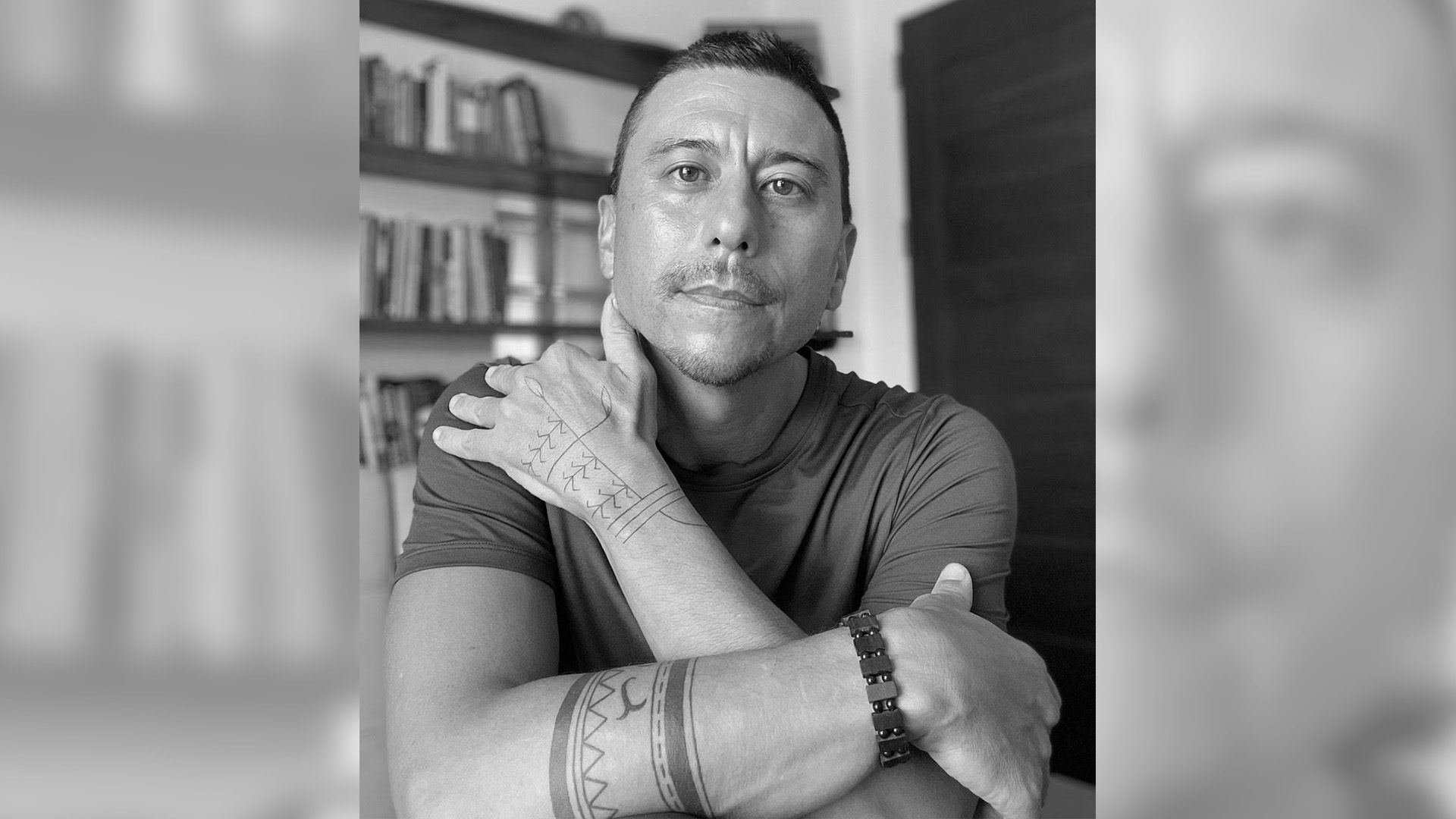
While Batanes has long captivated Filipinos with its rolling hills, stone villages, and dramatic coastlines, it’s also an ancestral homeland etched with generations of Ivatan memories — stories that author Dorian Merina has dedicated his life to preserving. Merina has devoted years documenting indigenous oral poetry and safeguarding traditions that have been passed down through Ivatan communities in this northernmost province, separated from the rest of the country by the Balintang Channel. An Ivatan himself, Merina’s critically acclaimed book, Di Achichúk, earned the 2020 Gintong Aklat Award and is considered one of the most celebrated literary works to emerge from Batanes in recent years. Di Achichúk: Poems and Images from Batanes serves as a portrait of Ivatan life, weaving together the islands’ geography, history, language, and lived experiences into a collection of poems. “I am seeking to share and reflect daily and communal life in Batanes. An important aspect of this is recognizing that, as Ivatans, we are inseparable from the land and our history,” Merina told Rappler. “We do not regard our place, whether it is our particular village or community, as merely a setting, or a background. The land, the ocean, even a specific hillside, mountain ridge or lagoon, is intricately linked to our memories and experiences.” Those became even more significant after a group of Chinese scholars revived territorial claims over Batanes. During an academic symposium held on June 30, 2026, at Jinan University in Guangzhou, China, scholars from institutions including the Chinese Academy of Social Sciences and Nanjing University argued that the Batanes and Babuyan island groups are a “natural geographical extension” of Taiwan. Because Beijing claims sovereignty over Taiwan, they contended that Batanes should also be considered part of China. Among their arguments was that post-World War II treaties requiring Japan to return occupied territories to China should have included Batanes. They also claimed that the 1898 Treaty of Paris placed the islands outside the territory ceded to the Philippines. The claims ignored the centuries-long relationship between the Ivatan people and their homeland, said Merina. “Our families have lived here for many generations,” said Merina, who lives in Savidug, Sabtang, where he helps document and preserve the Ivatan oral poetry tradition known as Laji. “Our language has evolved in this landscape. These are important distinctions because this understanding automatically engenders a deeper relationship with Batanes and a responsibility to protect its well-being.” “For many generations, outsiders have tried to redefine, conquer or reshape Batanes. Today, powerful political forces in our region continue this impulse.” The assertions drew condemnation from Philippine historians, legal experts, and government agencies, all of whom stressed that Batanes has long been recognized as an integral and sovereign part of the Philippines under international law. The National Historical Commission of the Philippines rejected the scholars’ arguments, pointing to more than a century of historical and scientific evidence. It noted that Spain formally incorporated Batanes into the Philippine colony in 1783, that British explorer William Dampier found no evidence of Chinese governance when he visited the islands in 1687, and that oceanographic studies show Batanes sits on the continental shelf extending from Northern Luzon rather than Taiwan. For Merina, however, defending Batanes begins with ensuring that future generations of Ivatans continue to tell their own stories, going beyond historical documents and political statements. He believes literature and language remain among the strongest forms of cultural resistance, allowing communities to preserve their history and identity. “Over and over we, as Ivatans, have had to assert our identity and protect our community,” he said. “Sometimes that comes by strengthening our solidarity with other tribal people in the region or throughout the Philippines. The more we can tell our own stories, preserve our histories and foster our own literature and language, the more we maintain the ability to continue to resist these attempts to take away our autonomy.” Merina also organized community libraries, storytelling sessions, and poetry performances across Batanes to encourage younger Ivatans to reconnect with their language and heritage before these traditions fade. For him, preserving culture is a personal responsibility owed to both ancestors and future generations. “This is to provide context and knowledge, and to provoke emotional connection to our tribal history. This is my aim today: to ensure that our place as Ivatans is not erased; but remains strong and resilient for many generations to come,” he said. Ultimately, Merina hopes Di Achichúk will encourage readers outside Batanes to see the islands for what they are, beyond their breathtaking scenery or geopolitical stance. He hopes they come to understand the lives, histories, and traditions that have shaped the people who call the islands home. “This is where literature and stories can make a difference,” Merina said. “Literature encourages us to learn from each other and understand how events, circumstances, and historical influences are all deeply related. A vacant landscape is much easier to destroy. But a land filled with plants, animals, people and cultural memory is rich in value, and much more resistant to threats.” – Rappler.com
Keeper of Ivatan memory: Dorian Merina sees Batanes beyond the postcard view
Full Article
Original Source
Read the full article at Rappler →KhanList aggregates and links to publicly available news content. We do not host full articles from third-party sources. Always verify important information with original sources.