
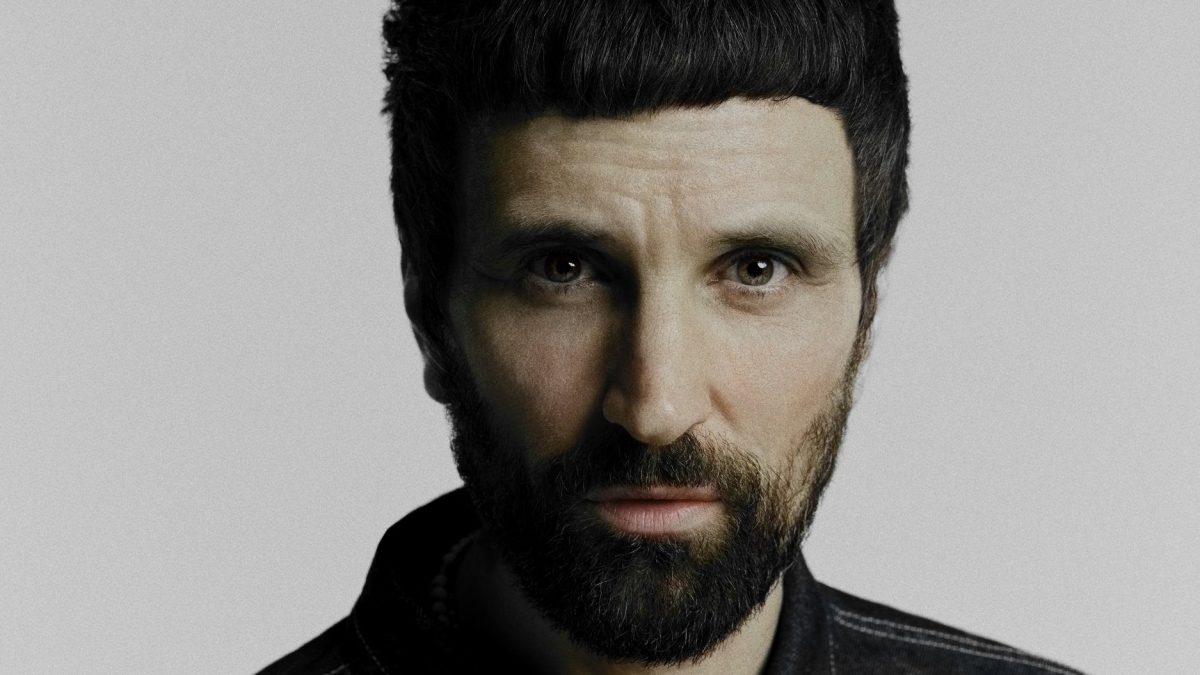
Some singers make for unlikely frontmen; Serge Pizzorno is not one of them. When he bounded onto the stage at Glasgow’s TRNSMT festival in June for Kasabian’s first UK show of the year, he looked every inch the rock star: the irrepressible energy, the palpable synergy with the crowd, the ludicrous fur coat straight from the Cruella de Vil collection. There is nothing to suggest he ever harboured doubts about taking on the role from original singer Tom Meighan, about walking the long few yards from stage left into the spotlight. Pizzorno had always had an unusually high profile for a guitarist. Kasabian broke through in 2004, with a self-titled debut that paired Oasis’ swagger with Primal Scream’s penchant for neo-psychedelic exploration – something symbolised on stage when Meighan, who had the look of the no-nonsense everyman about him, would stand alongside Pizzorno, who presented as a sort of cosmic pirate with his wiry frame, jet-black beard and flamboyant wardrobe. In addition to being at least as recognisable as Meighan, Pizzorno was also the band’s primary songwriter, making his transition to frontman the obvious next step in 2020, when Meighan was sacked after pleading guilty to domestic assault. In truth, Pizzorno says on a Zoom call from his native Leicester, it was a daunting prospect, one he took on chiefly because the only other feasible option was the band splitting up. “There’s just no way it could have ended like that,” he reflects, “so you jump out of the plane, and you pray the parachute pulls. When you step into that space, it’s overwhelming, because you’re dealing with so much energy; your own energy, and the energy of thousands of people in the audience, because essentially, that’s all we are, man. We’re just waves of energy, our consciousness all moulding into one.” Spiritual detours of this nature occur regularly in conversation with Pizzorno. Kasabian are about to release their third album since he became singer, after 2022’s techno-inflected The Alchemist’s Euphoria and 2024’s Happenings, a partially successful attempt to make a psychedelic pop record in the style of The Beatles’ Sgt Pepper’s Lonely Hearts Club Band or The Rollings Stones’ Their Satanic Majesties Request. This latest album is called Act III, as in the third chapter of this new, post-Meighan outfit, as if to express that these records are all of a piece, all a part of the band’s reconfiguration as a vehicle for Pizzorno’s mad-scientist musical whims. Pizzorno says stepping onto stage as frontman can be ‘overwhelming’ (Photo: Katja Ogrin/Redferns) He appears to have poured a little of everything into this latest concoction. Like Charli XCX, he understands the confluence between music, film and fashion, with Alfred Hitchcock a thematic influence and the album’s artwork based on the minimalism of a Chanel shopping bag. It’s an album that touches upon every era of Kasabian, from the soulful groove of “Superpowers” and the disco strut of “Silver Apple Eyes” to the breezy, straightforward indie rock of “Great Pretender”. It also introduces new sounds, with hip-hop beats influenced by Pizzorno’s love of Nas and Wu-Tang Clan. “Between records, I collect things,” he explains. “I don’t write on tour, but what I will do is watch plenty of movies, listen to plenty of music, visit plenty of art galleries. By the time I’m back in the studio, it’s pure expression, with no second guessing. Some of these songs, I think, are beautifully Hockney-esque; they capture the detail by following the rules of great songwriting, in terms of structure and melody and lyrics. Others are just a raw expression of how I’m feeling. Abstract, like Jackson Pollock.” After nine albums and more than 20 years, Pizzorno still knows that a certain crowd will always write Kasabian off as lad rock, no matter how many genres he flirts with or avant-garde influences he cites; in the past, he has nodded to everybody from the Situationists to the radical Chilean filmmaker Alejandro Jodorowsky. “I mean, our most successful album is literally called West Ryder Pauper Lunatic Asylum,” he smiles wearily, referencing the 2009 LP that spawned massive singles like “Fire”, “Underdog” and “Vlad the Impaler”. “You’d think eventually, people would go, ‘actually, this might deserve a deeper look. Maybe we can’t just fold these guys off as a lad band.’ It makes no sense to me, but I think every artist will say they’re misunderstood on some level. You just keep your mouth shut and let the work speak for itself. If anything, it’s given us licence to be even more weird and wonderful.” Sure enough, Pizzorno has cast his lyrical net wider than ever this time around. Act III is not an overtly political record, but his alarm at both online grifters and the custodians of big tech provides a thematic throughline. “‘Hippie Sunshine’ is about Silicon Valley, and the fact that tech billionaires are going out and dabbling with DMT and acid – these are the same people taking decisions that shape the world,” he explains of what is, on the surface, one of the record’s poppiest and most upbeat tracks. “They’re behind the algorithms that are determining how society is moving, and they’re mad partying – I find that incredible.” The album’s artwork is based on the minimalism of a Chanel shopping bag “The Guru and the Crypto Time Machine”, meanwhile, might be Act III’s most unhinged track, a chaotic exercise in psych-rap that wouldn’t be out of place on a Gorillaz album. “Influencers are the modern gurus,” says Pizzorno, “and it’s interesting to see these kind of hench characters talking about wellness and personal improvement, and then in the next breath charging you £10 a month if you want to keep listening to them. It’s fascinating. I’m not saying I have the answers. I’m just holding a mirror up to what I see going on.” Still, it’s something that has bled into his thinking about his personal life. Act III contains paeans to both his wife, Amy (“Soulmate”), and to his two teenage sons (“Nothing Better Than This”), who he calls his “best achievement.” “It’s a mad time to be raising boys,” he says. “It’s not easy. Me and my wife have done our best to raise beautiful boys, who are going to go into the world and carry themselves in the way men and boys should. Having them was a huge, defining moment in my life. Being in a band and grinding for success, you can get lost in that world. Starting a family kept me grounded, I think. That, and staying in Leicester.” Pizzorno continues to work primarily from his home studio; songwriting, he says, is still the thing that gets him up in the morning – “my favourite part about being in the band”. Accordingly, he’s dubious about the way in which streaming services are affecting the decisions artists take, and equal parts appalled and amused by the advance of music made by artificial intelligence. “It’s been reduced to a numbers game, with streaming; it’s all about churning out tunes for the sake of the commercial side of things, and becoming bigger. I think you’re going to end up with two camps: the audience that’s happy with that, and the one that values something bespoke, that’s really been worked on and laboured over. I know I’d rather have the leather shoe than the plastic trainer. Give me something that’s been made in the Italian hills, stitched by somebody who’s been doing it for 40 years.” ‘Music has been something deeply human since the days we were sitting around fires banging drums and chanting’ (Photo: Luke Brennan/Getty Images) AI, he feels, is anathema to the songwriter. “The fact that AI-generated music even exists is the logical conclusion to the way streaming services have gone. The fact that music is now referred to as content by people who stand to make money from it – I find that so offensive, to talk that way about something so sacred, so beautiful. “You can literally study how music changes people’s brainwaves. Music has been something deeply human since the days we were sitting around fires banging drums and chanting. There’s certain songs I can put on that I know will change my mood instantly. Music transcends, and takes us somewhere new and different. I don’t know how a computer is supposed to replicate that.” The communal experience of live music, he adds, is another thing that can’t be approximated by technology. In December, Kasabian will undertake their latest arena tour, having last month played their biggest-ever headline show at London’s Finsbury Park – a testament to the staying power of what is now a multi-generational fanbase. Fronting the band has been a genuinely transformative process for Pizzorno, and not just as a musician; he’s traded debauchery for discipline in order to keep up with the rigours of performance, and now does as many interviews with Runner’s World as Rolling Stone. “I’m a man of extremes,” he reflects, “and I’ve lived the extremes at both ends. I’m in my mid-forties now, and there was a moment where I realised I could leave the casino with a few chips left. I’m fitter than I’ve ever been now, and I wake up in the morning excited about what’s next – more exploration, more adventure. Something good came out of the hurt and the pain.” ‘Act III’ is out now. Kasabian play five UK shows from 11 December
Kasabian’s Serge Pizzorno: ‘It’s a mad time to be raising boys’
Full Article
Original Source
Read the full article at Inews →KhanList aggregates and links to publicly available news content. We do not host full articles from third-party sources. Always verify important information with original sources.