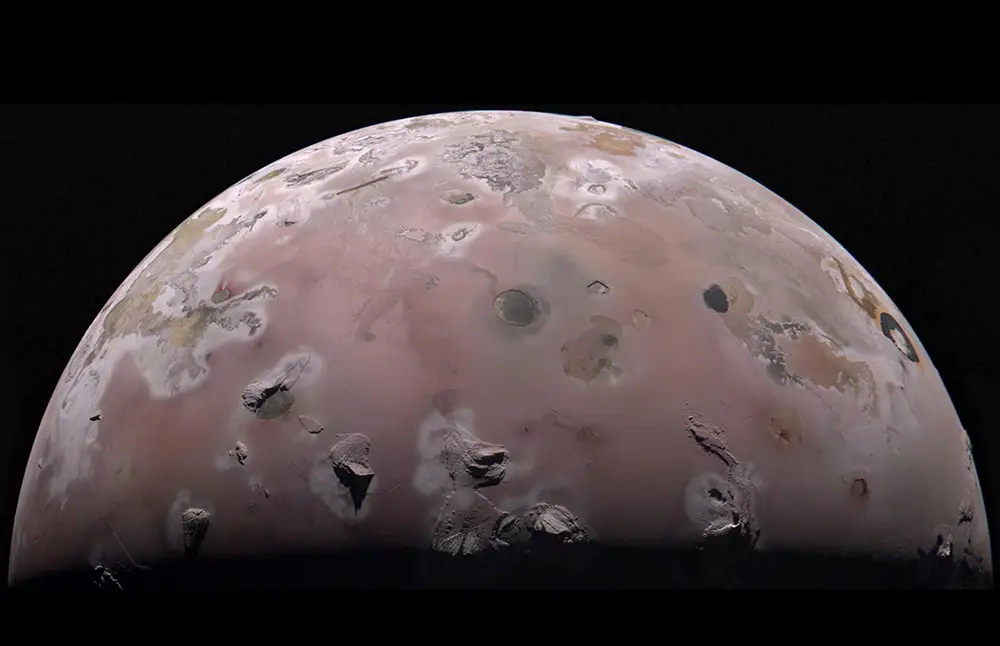
Ash from countless volcanic eruptions on Io have likely built up its porous surface. The north polar region of Jupiter’s volcanic moon Io was captured by NASA’s Juno during the spacecraft’s 57th close pass of the gas giant on Dec. 30, 2023. Data from that flyby and one on Feb. 3, 2024, is helping scientists understand Io’s interior. Image data: NASA / JPL-Caltech / SwRI / MSSS; Image processing by Gerald Eichstädt When NASA extended the Juno mission at Jupiter to permit close flybys of Ganymede, Europa, and Io, it provided unusual opportunities to point Juno’s six microwave radio antennas at the rocky and icy. Nobody has ever launched a spacecraft with such a microwave radiometer to study the crust of a rocky world. When Juno pointed those instruments at Io during two flybys in 2023 and 2024, they measured its fiery internal heat and confirmed a bizarrely fluffy surface. Juno’s antennas were designed to receive microwaves in six different frequencies (spanning 0.6 to 22 gigahertz, corresponding to wavelengths from about 50 centimeters down to about 1 cm). That range allows Juno to “see” Jupiter’s atmosphere at six different depths. In a paper published in the Journal of Geophysical Research, Shannon Brown and coworkers laid out what the microwave radiometer saw when it pointed at Io. Just like it does at Jupiter, Juno detected microwave radiation from different depths within Io. Because Io is made of rock and not gas, the microwave emission came from much shallower depths, within the upper few tens of meters (down to about 100 feet). One thing the radiometer detected makes for a good sanity check: The surface is a lot hotter under sunlight than in darkness. That may sound obvious, but it’s an encouraging sign that an instrument designed for a gas planet is producing meaningful data on an entirely different sort of world. The finding also confirms previous work that suggested that whatever substance covers Io’s surface, it has low thermal inertia, meaning it heats up fast during the day and cools off quickly after sunset. That, in turn, means that it’s not likely solid rock, but rather something dustier, or maybe more porous. This map represents data captured by the Microwave Radiometer instrument aboard NASA’s Juno, indicating heat rising from just beneath the surface of Jupiter’s moon Io. The colors illustrate a distinct temperature gradient across the moon, with the most extreme, localized heat output in red.NASA / JPL-Caltech / SwRI / USGS The radiometer also measured the truly huge amount of heat that’s flowing out of Io at all times. Io’s global heat flow is between 1 and 3 watts per square meter, 20 to 30 times Earth’s heat flow and in line with previous estimates. Because of the multiple wavelengths, Juno could actually measure how the temperature increases with depth. At the shallowest depths, the temperature is constant (except for daily solar heating and cooling, which averages out over time) down to depths of about 2 meters. That suggests there’s an insulating layer over the heat source that lurks beneath. Probably the most surprising result from these unusual observations relates to the density of Io’s uppermost surface. The radio emission Juno measured from Io is consistent with a density of 0.7 to 1.1 times that of water. Solid silicate rock is more than three times denser than that, so the “rock” covering Io’s surface has to be incredibly porous, as though it were made of snow. Io’s surface may be a type of rock called scoria, made by the fall of volcanic ash and full of holes. More significant than the specific results from Juno’s two flybys past Io is the fact that the observation technique worked so well there. Intriguingly, Juno saw hints of variation in heat flow across Io’s surface, but the two encounters aren’t enough to make a map. Perhaps a future mission to Io could carry a microwave radiometer to map where it’s hottest and how its pockmarked surface was built from countless volcanic eruptions.
Jupiter’s Moon Io is Surprisingly Fluffy
Full Article
Original Source
Read the full article at Skyandtelescope →KhanList aggregates and links to publicly available news content. We do not host full articles from third-party sources. Always verify important information with original sources.