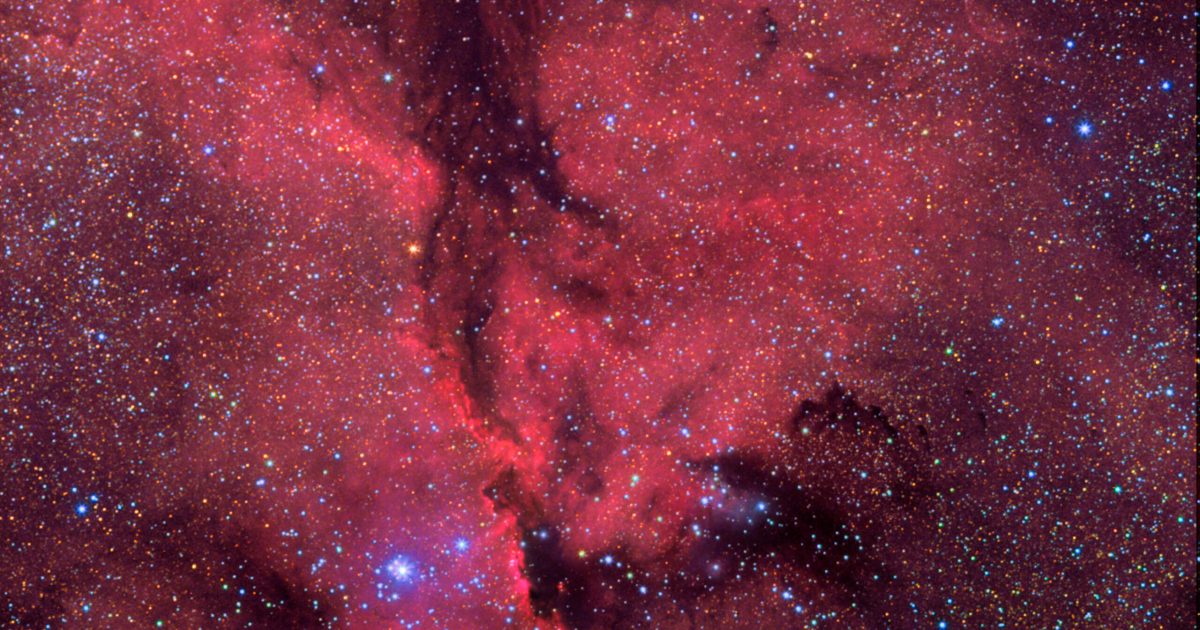
This small, often-overlooked constellation contains several observing treasures worth your while | Published: July 29, 2026 NGC 6188 is a combination emission/reflection nebula. Even a 4-inch scope will reveal a faint haze measuring 20' by 12' that interacts with open cluster NGC 6193. Larger scopes will reveal a dark region separating the eastern and western halves. Credit: Gerald Rhemann The constellation ARA (pronounced AIR-uh) the Altar was one of the “original” constellations of the Greeks. It appeared in Phaenomena, a 3rd-century-b.c. work by the Greek poet Aratus. He based it on a work written a century earlier by Eudoxus of Cnidus. The constellation’s position is easy to locate directly beneath the tail of Scorpius. Making an altar out of the stars is more difficult. Ara is visible May through July in the Northern Hemisphere, the time Scorpius hangs directly in the south. Its center lies at right ascension 17h18m and declination –56°30′. Ranking 63rd in size out of the 88 constellations, Ara covers 237.06 square degrees (0.575 percent) of the sky. And while its size is nearer to the bottom than the top of that category, it fares somewhat better (34th) in terms of overall brightness. The best date to see Ara is June 10, when it stands opposite the Sun in the sky and reaches its highest point at local midnight. Your location will make a difference, however: The constellation is completely visible from latitudes south of 22° north and completely invisible from latitudes north of 45° north. Although this star pattern isn’t huge or bright, it offers some worthy treats for observers. Among them are open and globular clusters, an emission nebula, and a couple nice galaxies. So, consider heading south if necessary to reach the Altar and all the underobserved deep-sky objects it holds. Good luck! Observe the Deep Sky in Ara Explore Ara Tap to discover deep-sky objects Explore more of the night sky with our other interactive deep-sky tours: Underappreciated Serpens What’s lurking in Lynx? Spend some time in Auriga Wander the Queen’s starry court Discover deep-sky gems in Ophiuchus Michael Bakich has spent his life immersed in astronomy, earning two degrees in the field, authoring seven books, and joining Astronomy magazine in 2003. When not writing or leading tours to eclipses and historical astronomy sites worldwide, he enjoys woodworking, science-fiction movies, and collecting rare 19th-century astronomy books from his home in Tucson.
Observe the deep sky in Ara
Full Article
Original Source
Read the full article at Astronomy →KhanList aggregates and links to publicly available news content. We do not host full articles from third-party sources. Always verify important information with original sources.