
Never before had humanity been so close to its destruction. It was January 2025: the hands of the clock stood at 89 seconds to midnight. Juan Manuel Santos was looking at the Doomsday Clock in Washington, D.C. The former Colombian president — who governed between 2010 and 2018 – had been invited by the Bulletin of the Atomic Scientists to participate in the annual session of this unsettling assessment of the dangers threatening the planet.For almost 80 years, the clock has offered a symbolic calculation, warning us how close we are to total annihilation. The closer the hands get to midnight, the less time remains until the end of the world.The Doomsday Clock, created in 1947, has been adjusted in response to wars, tensions between world powers, the proliferation of nuclear weapons and, more recently, climate change and new technologies. Not without criticism for spreading alarmism, the clock is a metaphor for fear, but also for humanity’s capacity to avert its own destruction. In January 2026, a year after Santos’ visit, the clock moved four seconds closer to midnight: it’s now 85 seconds away. Juan Manuel Santos is 75 years old. And he has a strong belief that seems to have survived the disappointments of the last decade: all conflicts have a solution. This isn’t a naive statement, given that it comes from someone who spent a good part of his life involved in war. As minister of defense for three years (2006-2009) during the administration of president Álvaro Uribe (2002-2010) — his current nemesis — Santos led some of the most decisive operations against the Revolutionary Armed Forces of Colombia (FARC). As president of Colombia, he negotiated with the men he had fought against: those he had once wanted to kill and who had wanted to kill him, too. After leaving office, he has dedicated much of his time to defending that peace agreement with FARC, which has been questioned since its signing in 2016. It’s still awaiting full implementation, after neither the administrations of Iván Duque (2018-2022) nor Gustavo Petro (2022-2026) showed any real interest in doing so.Today, the kind of politics that has been consolidated — one that uses brute force as the primary instrument of power — has changed the landscape that once made the Colombian peace agreement possible. Santos notes how, during the Cold War, Ronald Reagan and Mikhail Gorbachev were able to sit down and negotiate agreements to reduce the nuclear threat. Today, however, to expect such a willingness seems entirely unrealistic. Santos believes that the problem isn’t a lack of solutions, but rather the absence of leaders willing to find them: “A true leader is someone who thinks long-term, someone who makes decisions — even if they’re unpopular — knowing that they’re the right decisions for the long run. It takes perseverance, as well as a certain amount of courage, to go against the grain. I went to war so that I could make peace.”·On November 24, it will be 10 years since Santos and Rodrigo Londoño — alias Timochenko, the top leader of the insurgency — signed the peace agreement for the second time. The first agreement (signed on September 26) was shattered at the polls just days later, after citizens rejected it in a referendum. Santos has always considered that holding the referendum was a mistake. In December 2016, the Colombian president received the Nobel Peace Prize in Oslo for getting the FARC — Latin America’s oldest guerrilla group — to lay down their arms and sign a peace treaty, which ended the FARC’s conflict with the state after more than 50 years of war.To mark that 10th anniversary, Santos received EL PAÍS four times between April and September of this year. The conversations — each lasting about an hour and a half — took place in his office at the Compaz Foundation, which he created after leaving the presidency. Today, he also chairs The Elders, the organization founded by Nelson Mandela that brings together former international leaders. Politicians and other figures from Colombian public life come and go from his office before and after the interviews. Santos retains his eagerness to talk and sets few limits on the topics of conversation. He only becomes more reserved when the conversation delves too deeply into the day-to-day politics of his country. His manner of speaking hasn’t changed much since his presidency, nor has his inclination to explain each of his decisions in detail. What has changed is the world he speaks about. Ten years ago, Colombia occupied a central place on the international agenda; it was a beacon of hope, and Santos was on the verge of becoming one of the central figures in its history. However, today — with his legacy inextricably linked to that agreement — he reflects on a decade in which the conditions that made peace possible seem increasingly difficult to replicate. The man who brought an end to one of the longest wars in the Americas now speaks of a world that seems to have regained its taste for conflict.— Do you think the Colombian peace agreement would be possible in today’s world?— In the last 15 years, the only peace negotiation that the U.N. has been involved in is the Colombian agreement. This is the issue on which the UN Security Council has unanimously adopted the most positive resolutions. Today, that would be impossible.The negotiations required major international support. The United States, Cuba, Venezuela and other powers — each with very different interests — ended up backing the same objective. One of the most delicate moves was securing Hugo Chávez’s cooperation. As defense minister, Santos had been locked in a bitter feud with the then Venezuelan president, who maintained close ties to the FARC and provided safe haven to its leaders on Venezuelan soil. It was precisely for that reason that Santos concluded Chávez was indispensable to achieving peace. The challenge was to turn someone who had been part of the problem into part of the solution.“Chávez and I needed each other. He was absolutely fundamental and he was also someone I had really fought with. So, I had to build a bridge,” he recalls.The reconciliation began in 2010, at Quinta de San Pedro Alejandrino, a hacienda in the Colombian port city of Santa Marta. That’s where the two presidents mended their strained relations. Juan Manuel Santos then began asking Chávez to use his close ties with the guerrillas to facilitate dialogue. “He didn’t contradict me. In fact, he used [his connections]. Almost implicitly, he was telling me: ‘Yes, I have very good contacts with them, I can help.’ And he did help.” Thus, Venezuelan cooperation became an important element of the secret talks that preceded the negotiations in Havana, Cuba. The former enemy had ended up becoming an ally in achieving the most important objective of the Santos presidency.·Santos wasn’t always a man of peace. Or, rather, for a long time, he didn’t understand that peace required renouncing the use of force. As minister of defense, he transformed Colombia’s intelligence services, modified his country’s military strategy, and strengthened cooperation with the United States and the United Kingdom. His objective went beyond weakening the guerrillas: he was convinced that the use of force would lead the FARC commanders to realize that their survival and future depended more on an agreement, rather than on continuing the war. “We had to get through to them, and we began to do so.”Today, he recalls that the first commander to fall after that change in strategy was Tomás Medina Caracas (alias Negro Acacio), who controlled drug and arms trafficking in eastern Colombia. Many others followed, like Raúl Reyes, who was killed during a Colombian military operation on Ecuadorian territory. When Santos was president — “I was elected because I had been the minister of defense,” he acknowledges — Jorge Briceño Suárez (alias Mono Joyjoy) and Alfonso Cano (the top guerrilla leader at the time) were killed just as the peace process was beginning. That was one of the most decisive actions taken by Santos. According to his interpretation of events, the war allowed for a shift in the balance of power, making negotiation an attractive option for the state’s enemies: “The person who hit the FARC the hardest in its entire history — and the commanders themselves say so — was me, both as minister of defense and as president.” In reality, however, the story is more unsettling than a string of military successes. Colombia’s security policy has long been riddled with serious human rights violations, especially during Uribe’s presidency. For instance, there was the so-called “false positives” scandal — the murders of civilians, who were presented as guerrillas killed in combat. Santos, who was serving as minister of defense when the scandal broke, apologized. And he has always distanced himself from those events, which still haunt Uribe. He insists that he spearheaded a doctrinal shift to strengthen respect for human rights and rebuild trust with communities. And he maintains that he learned something that ultimately proved to be essential: legitimacy can be just as important as military superiority.The first two interviews with EL PAÍS for this report took place before Abelardo de la Espriella won the presidential elections back in June. The third took place the day after his electoral victory. And, finally, the last was conducted after De la Espriella had been sworn in as the new president of Colombia.A few days before that fourth conversation, De la Espriella celebrated a military operation. It concluded with him posing alongside the bodies of the criminals, which were wrapped in sheets on the ground.— What did you think when you saw the sitting president walking around and displaying corpses?— It saddened me greatly because the way we won the war — in the sense of bringing the FARC to the negotiating table — was precisely by doing the opposite: respecting the dignity of the guerrillas. The legitimacy of a state and its military forces is their greatest asset. If you lose that legitimacy, you lose respect. You can’t do what your enemies do. The state must be above that. I think that it’s very sad and counterproductive.”Santos then recalls the operation launched against Alfonso Cano, which took place shortly after the peace process began: “I gave instructions to the brigade commander in charge of the operation: ‘Try to capture him, not kill him.’ I even thought that the impact of Cano’s capture — like that of Abimael Guzmán [the Shining Path leader, now deceased, who was arrested and imprisoned in Peru back in 1992] — could be very positive for peace. I knew it would be very difficult to capture him and that he wouldn’t give up. And what happened, happened. But it’s not true what they say, that he was murdered in cold blood. He was hiding; it was nighttime. He ran out and a soldier shouted [at him to identify himself], but he didn’t respond, so he was killed.”·Santos has never hidden the fact that his approach to politics is highly calculated. “I love poker,” he admits with a smile, referring to one of the most frequent criticisms leveled against him: his willingness to take political gambles. “I like to take risks, but risks to win, not risks to lose,” he clarifies, when he recalls why he made the decision that ultimately defined not only his presidency, but also his entire career.Peace was the riskiest gamble of his time in politics. And it wasn’t an improvisation or a sudden conversion. “I had this idea of peace in my head,” he says, with a gesture suggesting it had been a long time coming. For decades, he had built up experiences that led him to believe that Colombia could never reach its full potential while trapped in a war.Long before becoming president, Santos had understood that goodwill alone wasn’t enough to achieve peace. It was necessary to learn how to negotiate. His approach to the country’s internal conflict was driven by both intellectual curiosity and an obsession with methodology. Years earlier, he had been a student of Roger Fisher, a Harvard professor and one of the world’s leading experts in conflict resolution. Santos consulted Fisher when he became interested in the reconciliation experiences of other countries. And it was his former professor who put him in touch with Adam Kahane, a Canadian expert who had participated in dialogue initiatives during the South African transition from apartheid to democracy in the early 1990s.Santos invited him to Colombia in 1996. Kahane — who was also working on other international conflicts at the time — accepted, but on one condition: that Santos bring together people from truly opposing sides. The former president began calling guerrilla leaders, representatives of paramilitary groups, members of the government, opposition figures, business leaders and rural organizations. A dialogue, as well as scenario planning, emerged from that effort. The initiative — known as Destino Colombia (“Destination Colombia”) — sought something that seemed impossible in a country riddled with violence: that, together, the protagonists of the conflict could imagine a different future. The negotiation of an agreement still wasn’t in the works, but the parties were at least learning to listen to one another. They recognized that there could be another destiny besides war.Santos has also learned from other peace and reconciliation processes. He especially remembers a conversation with Nelson Mandela in South Africa. He was impressed to see how victims and perpetrators met in public forums to discuss the crimes of apartheid. Mandela explained the meaning of that exercise and warned Santos that Colombia could never truly take off until it resolved its armed conflict.That conversation marked him deeply. Decades later, Santos still invokes Mandela to defend a seemingly simple idea: negotiation requires recognizing the adversary, listening to their concerns and accepting that no one has a monopoly on the truth. But his interest didn’t stop at the moral teachings of great leaders. When the time came to negotiate with the FARC, he also turned to William Ury, a disciple of Fisher and another of Harvard’s leading figures in negotiation theory. And he surrounded himself with specialists who had participated in the peace processes in Northern Ireland (Jonathan Powell), the Middle East (Shlomo Ben Ami) and Central America (Joaquín Villalobos), among others. The Colombian peace process had something of a laboratory feel to it: a combination of military experience, political intuition and negotiation techniques, honed over decades. “They were my advisers — not the team’s advisers. They were immensely helpful in difficult times. Everything they told me made sense and was very useful,” Santos recalls. He frequently met with them to discuss how the talks were going: “They were a dream team.”At one point, when he was still hesitant about the risks he was willing to take, former Israeli minister Shlomo Ben-Ami posed the following question to him: “I know you’re facing this dilemma, but consider this: Stand in front of your grave, look back, and ask yourself this question: ‘If I take the risk of making peace and succeed… how many lives will I have saved?’ If you do not [take the risk], will you go to your grave with a clear conscience?” Santos concludes: “That argument was very powerful in finally convincing me to do what I had to do.”·On September 24, 2015, Santos and Rodrigo Londoño met face to face for the first time. In public, Cuba’s Raúl Castro took each of their hands and clasped them together for a handshake. When they met, Santos admits, there was a special connection. He recounts that, during the meeting, he was calm: “I’m very level-headed. I wasn’t nervous, and I wanted to put him at ease.”The FARC leader confessed that he was sick, that he had dengue fever. “That meeting impressed me a lot, because I saw that he was willing and sincere. We talked about the difficulties that he was going to have with his own people and I, with mine.” The then-president told him: “Listen, you and I have been trying to kill each other for 35 years. Now, let’s commit to getting in the same boat, rowing in the same direction and not stopping until we reach our destination.”When asked if he thinks that this is what has happened, Santos replies: “Yes, I have to admit that he’s kept rowing. From back then — when I met him — all the way until now, he’s grown as a human being, I admire him even more.”The Final Agreement, signed in 2016, ended the conflict with the FARC. Thousands of combatants laid down their weapons and began their reintegration into civilian life. However, the signing didn’t end all the violence in the country, nor did it resolve the problems that had fueled the conflict.Santos distinguishes between the end of the war and the violence that still permeates many parts of Colombia today. For the former president, the current violence is caused by gangs vying for territory. The state has left gaps in security by failing to fulfill the security and rural development commitments outlined in the agreement. — Was this the peace you envisioned? — With the FARC, yes. As for the country, no. 2017 and 2018 were the most peaceful years we’ve experienced in 100 years, but that peace was reversed. That vacuum [left by the demobilized guerrillas] was left to chance. And criminal gangs began to fill it. The violence in Colombia today is similar to what the entire continent is experiencing. I never imagined this would happen, but it has occurred precisely because of the non-implementation of the agreement. There’s still time if we manage to gain control of the territory. The state must be present. Implementing the peace agreement is the best security policy for this government — not [Trump’s] Shield of the Americas.”·Santos speaks of moderation as if it’s a political cause that needs rescuing. “I’m not willing to fuel divisions or aggression under any circumstances; I believe that makes democracy unviable. I believe in finding the best of both the left and the right and putting it to work.”— Being a moderate now is somewhat like being a rebel…— The decline of democracies around the world is due to the loss of that moderation. If that’s being a rebel, then I’m a rebel.This statement aptly expresses his diagnosis of an era in which, according to him, confrontation offers greater electoral benefits than negotiation. “The effect of social media in fueling aggressive language has solidified the notion that, politically, we’re more polarized than before. The more hateful the speech, the more traction it gets.” Throughout his life, Santos has been a tough, competitive politician, convinced of his decisions. He hasn’t always shied away from confrontation. And although he acknowledges his mistakes, he shows great reluctance to question his presidency.— Did you ever think you were making a mistake?— Many times. You never have the absolute truth. Constant doubt is necessary to fuel perseverance. It helps you stay on track. ·Santos frequently recalls that, when he began exploring negotiations with the FARC, he encountered opposition even among close associates. Some warned him that it could destroy his career and hand his enemies a political victory. The outcome wasn’t what some had imagined, either. The signing of the agreement didn’t produce immediate reconciliation, nor did it end the disputes or transform his adversaries into allies. The peace agreement, however, did alter Colombian political life. The former president believes that one of its less-appreciated effects was helping to remove the stigma that had been carried by segments of the left for decades, as they were frequently associated with the armed insurgency. “The stigma attached to the left was lifted, and it gradually established itself as a legitimate movement, back when it was said that leftist movements were the political arms of the FARC,” the former president notes.Santos now observes this process through a global lens. The cooperation between the United States, Cuba and Venezuela that helped forge the agreement seems difficult to replicate in a fragmented world. Multilateral institutions face new tensions. And, once again, the foreign policy of the major powers is marked by strategic competition. The former president reflects on some of the current global conflicts. Regarding the possibility of the war between Russia and Ukraine coming to an end, he refers to the Colombian experience: “Every negotiated [end to a] conflict has to consider where the line is drawn between justice and peace. There can be no peace if Russia keeps everything it wants, nor if Ukraine refuses to compromise. There always has to be a sacrifice on both sides.” For Santos, in a world where “force prevails over law” — specifically regarding the case of Venezuela and the transition after the January 3 operation that led to Nicolás Maduro’s arrest — he argues that “a true democracy cannot be imposed from the outside; otherwise, it won’t be a lasting democracy.” For decades, the Colombian war seemed impossible to end. Many tried to negotiate and failed. Santos could also have failed. He lost the referendum, won the Nobel Peace Prize, signed the peace agreement and spent the following years defending it. His victory was incomplete and the consequences of the agreement are still being debated. But thousands of former combatants laid down their arms. A seemingly endless war came to an end. And, 10 years later, Santos is still rowing that imaginary boat with Timochenko. He knows the journey was much longer than expected, that some abandoned their commitment, and that others never wanted to get on board in the first place. The Doomsday Clock keeps ticking. Juan Manuel Santos watches its hands with the concern of someone who knows the consequences of violence, and the conviction of someone who once succeeded in bringing it to an end. “I believe in the law of the pendulum; I believe people will realize that what’s happening, in the long run, could be fatal. It’s simply a matter of sitting down and talking.”Sign up for our weekly newsletter to get more English-language news coverage from EL PAÍS USA Edition.
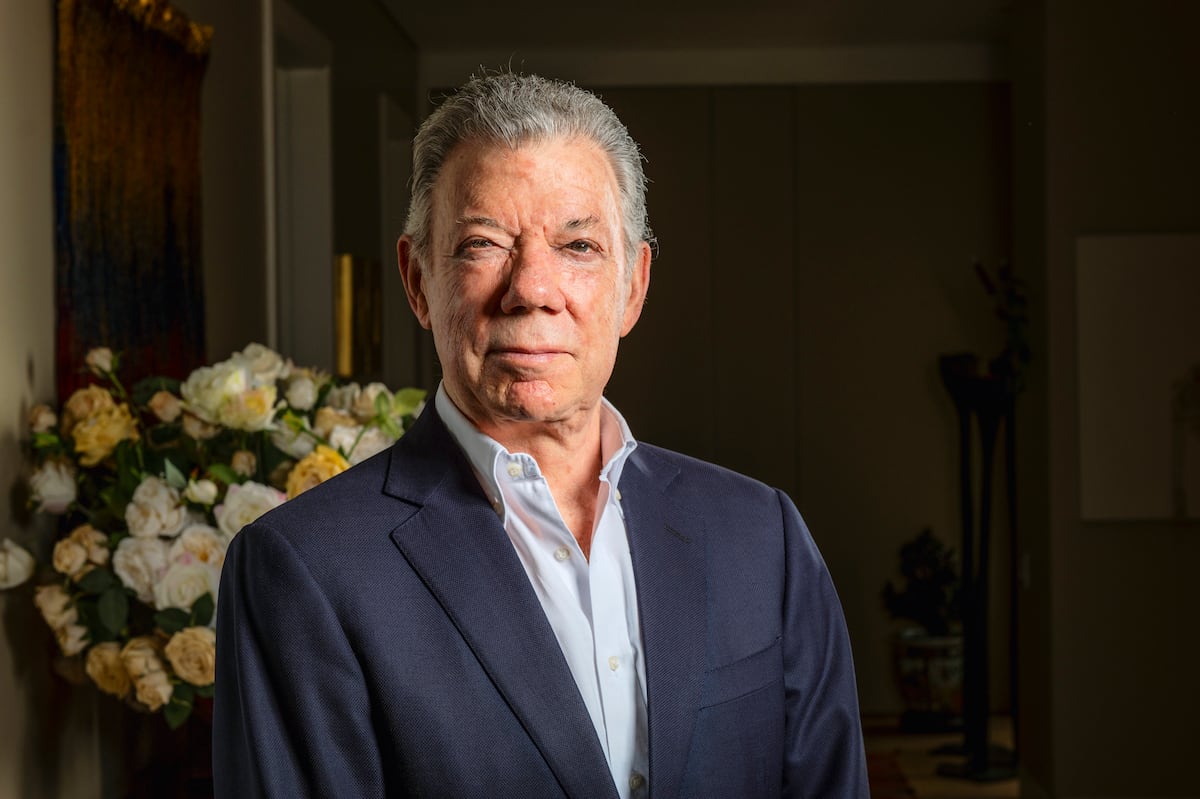
Juan Manuel Santos, former president of Colombia: A man of peace in times of war
Full Article
Original Source
Read the full article at English →KhanList aggregates and links to publicly available news content. We do not host full articles from third-party sources. Always verify important information with original sources.