
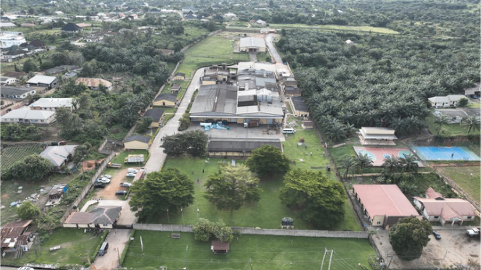
JohnVents Group is transforming Nigeria’s cocoa wealth through local processing, consumer products and supply-chain investments, writes Sunday Ehigiator, who recently visited the company’s factories across Ondo State. The first thing that caught my attention wasn’t a factory chimney, tons of cocoa beans, or the hum of industrial machinery. It was the sound of drums and footsteps hopping in rhythmic sync. At Akure Airport, in Ondo State, our arrival from Lagos was greeted by a troupe of cultural dancers whose energetic performance offered a distinctly Nigerian welcome to a journey that would challenge my understanding of what local manufacturing could look like when ambition meets investment. There we were: journalists from different media houses, influencers, entertainers and other guests, brought together for a three-day tour of JohnVents Group’s manufacturing facilities. Among the familiar faces were popular skit maker Layi Wasabi; influencer Eniola; Nollywood Actors Odunlade Adekola and Stanley Eze, who also serves as a JohnVents ambassador. We had come to see factories. What awaited us was a much larger story about farmers, sustainability, industrialisation, international finance, consumer products and the struggle to retain more of the value generated by Nigeria’s agricultural wealth. Yet, as the convoy pulled away from the airport, I did not know just how much ground we would cover, how many products we would encounter or how dramatically the experience would shift my perspective on a Nigerian agribusiness whose ambitions now stretch across continents. Our first major destination was JohnVents Premium Cocoa Products Industry Limited (PCPIL), in Ile-Oluji, where a tightly coordinated security escort accompanied our movement. The reception party, led by the company’s founder and the Group Managing Director of Capitalsage Holdings, John Alamu, and members of his management team, welcomed us into an industrial environment whose significance became clearer during every passing hour. Behind the security arrangements, corporate introductions and carefully planned itinerary lay an intriguing question: how does a business that began by helping farmers find inputs and markets evolve into a group processing agricultural commodities, manufacturing consumer goods and exporting to more than 30 countries? The answer, I would discover, was written not only in the company’s factories but also in its decisions about what Nigeria should do with the resources it already possesses. The journey begins with a farmer. To understand JohnVents, one must travel back to 2014, long before the factories, international financing agreements and expanding consumer brands. Alamu was then working in monitoring and evaluation at the International Institute of Tropical Agriculture (IITA). His experience exposed him to a recurring problem confronting smallholder farmers: many could produce crops but lacked access to agricultural inputs, finance and dependable buyers. Rather than remain an observer, he began supporting farmers informally, helping them obtain inputs and connect their harvests to markets. The business was incorporated in 2016, initially operating through agricultural trading and aggregation. Looking back, Alamu identifies the move from trading commodities to processing them as one of the defining decisions in the company’s evolution. “Trading connects farmers to markets, but processing allows us to retain more value locally,” he explained. In 2021, JohnVents acquired an 18,000-metric-tonne cocoa processing facility in Akure. Within six months, the factory had processed 5,000 metric tonnes of cocoa, marking the company’s transition from moving agricultural commodities to transforming them into industrial ingredients. Two years later, it acquired PCPIL in Ile-Oluji, an established cocoa-processing facility with an installed annual capacity of 30,000 metric tonnes. The acquisition was more than an expansion of production capacity. It represented an attempt to revive an existing industrial asset, restore manufacturing activity and create opportunities around a facility that had been operating below its installed capacity. “We wanted more of the cocoa grown here to become products that Nigerians can buy and enjoy here,” Alamu said of the company’s subsequent move into consumer manufacturing. That ambition became more visible with the establishment of JohnVents Foods in 2023, bringing cocoa powders, chocolate drinks, cereals and confectionery products into the company’s growing portfolio. From its beginnings in farmer support, JohnVents had begun assembling the components of a vertically integrated agribusiness: sourcing, processing, manufacturing, logistics and distribution. The distinction matters. A country may grow valuable crops and export millions of tonnes of agricultural commodities, yet surrender much of the manufacturing income, industrial employment and consumer-market opportunity to countries that process those commodities. However, JohnVents’ proposition is that Nigeria can capture more of that value at home. Inside the cocoa factory At Ile-Oluji, the scale of the operation brought that proposition into sharper focus. The PCPIL facility, one of Nigeria’s established cocoa-processing plants, forms part of JohnVents’ combined cocoa-processing network alongside its Akure factory. Together, the facilities have a reported installed annual capacity of 48,000 metric tonnes, according to the company’s management. Here, cocoa beans are transformed into cocoa liquor, cocoa butter, cocoa cake and cocoa powder, ingredients that supply industrial customers and food manufacturers in international markets. The process is a reminder that the brown powder used in a cup of chocolate drink, the butter used in chocolate production and the ingredients that eventually find their way into confectionery begin with an agricultural crop cultivated by farmers. But the journey from bean to finished product involves considerably more than machinery. Raw materials must meet quality requirements. Production must be controlled. Finished products must satisfy customers’ specifications. Storage, packaging, transportation and export documentation must work together. And increasingly, manufacturers must demonstrate where their raw materials originated and whether they were produced responsibly. This is where JohnVents’ investments in processing capacity intersect with its broader sustainability and traceability commitments. Alamu disclosed that the company processed 31,621 metric tonnes of cocoa in 2025 and a further 19,806 metric tonnes in the first half of 2026. He said reported capacity utilisation increased from 66 per cent in 2025 to 82 per cent in the first half of 2026. The figures suggest that the company’s challenge is no longer simply acquiring factories. It must keep them supplied, productive and competitive in an environment characterised by volatile commodity prices, expensive energy and foreign-exchange uncertainty. “The objective is not simply to have capacity on paper; it is to keep the plants supplied, operating efficiently and producing to the standards our customers require,” Alamu said. The implications extend beyond the factory gates. Higher processing volumes can increase demand for locally sourced cocoa, support agricultural supply networks and create work across production, quality assurance, laboratory testing, warehousing and logistics. However, industrial capacity alone cannot guarantee these outcomes. Reliable raw-material supplies, patient capital, skilled personnel, dependable infrastructure and access to markets remain essential. The money behind the machinery The scale of industrial investment required to compete internationally raises another question: where does the capital come from? For JohnVents, partnerships with international development-finance institutions have become an important part of the answer. In 2024, the International Finance Corporation (IFC), a member of the World Bank Group, announced a $23.3 million financing package for JohnVents Industries. The funding supports an expansion programme at the Akure operation, including plans to increase processing capacity to as much as 120 metric tonnes per day, improve power infrastructure, acquire vehicles and provide working capital. The package includes a naira-denominated component, an important consideration for a manufacturer whose operating expenses and portions of its revenue are generated in local currency. The company also received advisory support focused on traceability, digital systems, food safety, farmer cooperative leadership and women’s participation in agricultural value chains. In 2025, British International Investment (BII), the United Kingdom’s development-finance institution, announced a $40.5 million investment to support the expansion of PCPIL in Ile-Oluji. The objective is to help the facility increase production from approximately 13,000 metric tonnes annually towards its installed capacity of 30,000 metric tonnes, while strengthening traceability and responsible sourcing. Alamu nevertheless believes Nigeria needs more affordable, long-term financing in naira to unlock the potential of agro-processing. He also identifies reliable electricity and gas, better rural roads, accredited testing laboratories, storage facilities, improved ports and sustained investment in farming as priorities. Private companies, he argued, can invest in individual factories, but broader infrastructure and coordinated public policy are necessary to make the entire agricultural economy competitive. From factory floors to breakfast tables If the cocoa-processing facilities reveal the industrial heart of JohnVents, its consumer brands offer a glimpse of the company’s attempt to bring that investment into ordinary Nigerian homes. This became one of the most interesting dimensions of the tour: the recognition that the agricultural value chain does not end when cocoa beans leave the farm or when cocoa butter is loaded for export. JohnVents Foods produces products including Oluji Pure Cocoa Powder, JohnVents Pure Cocoa Powder, JohnVents 3-in-1 Chocolate Drinks, Myco 3-in-1 and JohnVents milk and dark chocolate bars. Its portfolio also includes JohnVents Choco Pops and Choco Cubes. Through Noble-Eagle Industries, the group has extended its activities into edible oils, seasoning cubes, bottled water and animal feed. Its products include NEO soya oil, NEO vegetable oil, NEO seasoning cubes and Fontis bottled water, while NE Feeds serves poultry and livestock farmers. The diversity is significant because it connects several parts of agricultural production. Oilseed processing, for example, produces edible oils while generating by-products that can be used in animal-feed production. This approach allows the company to pursue opportunities across different markets while making more productive use of agricultural raw materials. Yet entering the Nigerian consumer market comes with its own challenge: established household brands already enjoy years of familiarity and consumer loyalty. Alamu acknowledges that trust cannot be demanded simply because a product is locally manufactured. “We respect the brands that have earned a place on Nigerian breakfast tables over the years. We know that trust is built over time through consistent quality, value for money, and the ability to deliver on promises. “We do not expect consumers to trust us simply because we ask them to. We intend to earn their confidence through product quality, consistency, and the value we bring to their homes.” The company says it is building its portfolio around different product formats and price points, including the Myco range, while working to broaden distribution beyond major cities. That is an important distinction in a market where the cost of food, household purchasing power and distribution determine whether a product can move beyond supermarket shelves into everyday consumption. For local manufacturing to become a meaningful economic proposition, Nigerians must not only see products carrying Nigerian names; they must also find them accessible, dependable, healthy and worth their money. JohnVents’ long-term opportunity will therefore depend on its ability to convert industrial investment into products that consumers repeatedly choose, rather than simply admire as symbols of domestic production. A business beyond cocoa By the second day, the scope of the company’s ambition had become even more apparent. The itinerary took us from Akure towards Owo and Idanre, a long journey, I must say, with visits to Noble-Eagle Industries, Haven Hauling and the JohnVents Foods facility in Idanre spanning a cumulative eight hours. At Noble-Eagle, the company’s activities extended beyond cocoa into edible oils, animal feed and other consumer products. Its sesame operations involve cleaning and hulling, while its cashew business processes raw nuts into kernels through operations in Nigeria and Côte d’Ivoire. The wider trading portfolio includes legumes, pulses, peanuts and edible nuts, including almonds and pistachios. These commodities serve different markets and customers, but the underlying strategy remains consistent: identify opportunities to add value, develop the capabilities needed to process agricultural products and connect production to dependable buyers. The logistics component is equally important. Haven Hauling, established in 2022, supports the movement of raw materials and finished products between sourcing locations, warehouses, factories and customers. The company boasts a fleet of more than 100 trucks. The distinction between sourcing a commodity and delivering it efficiently can determine whether a manufacturing operation remains competitive. Agricultural products must travel from producing communities to processing facilities, sometimes across difficult road networks, before making their way to domestic or international customers. Without reliable logistics, even an efficient factory can face delays, higher costs and disruptions to production. By connecting procurement, processing and transportation, JohnVents is attempting to exercise greater control over the chain that links the farmer to the final market. The company reports operating 10 factories and nine business units, with exports reaching more than 30 countries. Its ambitions extend across Africa, Asia, the Middle East and other international markets. This is a broader undertaking than a cocoa-export business. It is an attempt to establish an integrated agribusiness platform capable of working across several commodities, markets and stages of production. The human story behind the numbers Yet, for all the emphasis on factories, capacity and exports, one of the more consequential questions is what such expansion means for the people who grow the crops. Alamu’s original experience at IITA remains central to the company’s narrative. He argues that farmers cannot be treated simply as suppliers of raw materials while the benefits of industrial growth accumulate elsewhere. The company says it works with more than 40,000 farmer partners across its sourcing network and has set a target of supporting 150,000 farmers across 300,000 hectares by 2030. Its initiatives include seedling distribution, agricultural training, farm mapping, traceability and support for climate-smart practices. According to the company’s account, more than 400,000 cocoa and shade-tree seedlings have been distributed since the programme began in 2022. Its sustainability reporting also describes the screening of more than 50,000 farms against protected areas and forests, as well as the verification of approximately 122,916 hectares as deforestation-free. These programmes address a central tension in agricultural industrialisation: factories need dependable supplies of high-quality crops, but farmers need the resources and knowledge to produce them sustainably. The relationship must work in both directions. JohnVents also reports initiatives extending beyond farm productivity. In fact, in Owo, upon visiting its cashew processing factory, a part of the factory was dedicated to manual processing of cashew nuts, with the women numbering over 500, being paid according to the quantity of nuts they can manually produce daily, as part of its women’s empowerment programme. The programme also provides training in soap-making, entrepreneurship and financial literacy. Its community programmes include educational outreach, school infrastructure support, solar-powered boreholes and youth engagement through sporting activities. The company’s child-labour monitoring and remediation programme is another component of its responsible-sourcing agenda. Its sustainability disclosures describe engagement with households and communities to identify risks, support remediation and improve children’s access to education. Such initiatives are important, but their ultimate significance lies in their measurable and sustained impact. The distribution of seedlings, delivery of training and construction of community facilities are useful starting points; long-term improvements in farmers’ incomes, children’s welfare, education and community resilience are the outcomes that matter. For Alamu, the objective is to ensure that the communities supporting the business also benefit from its growth. “Our story began with helping farmers access inputs and markets. As we scale, that purpose remains relevant: if farmers and the communities around our operations do not prosper, the factories cannot prosper sustainably either,” he said. The environmental test Industrial expansion also brings environmental responsibilities that cannot be separated from commercial growth. Cocoa processing requires energy, water and transport, while agricultural sourcing increasingly demands evidence that production does not contribute to deforestation or unacceptable labour practices. JohnVents says it is strengthening farm-to-warehouse traceability, deploying satellite monitoring to assess deforestation risks and working towards its target of making all its cocoa traceable by 2027, with at least 90 per cent certified under its stated investment commitments. Its sustainability report records approximately 19.29 million kilogrammes of carbon dioxide equivalent in Scope 1 and Scope 2 emissions and identifies renewable and lower-carbon sources as accounting for about 39.4 per cent of energy during the reporting period. The company is also pursuing a transition from diesel generation and wood-fired boilers towards natural gas at its Akure operation, an effort intended to improve energy efficiency and reduce emissions. Natural gas is not emissions-free, but the proposed shift illustrates the difficult decisions facing manufacturers seeking to balance operational costs, energy reliability and environmental performance. Alamu acknowledged that compliance requirements can be expensive, particularly for smallholders with limited land documentation and inadequate access to extension services. Certification premiums, he added, do not always reach farmers transparently or consistently. Nigeria’s ability to build credible traceability systems, improve farm-level productivity and provide accessible testing infrastructure will therefore affect not only individual businesses but also the country’s wider agricultural export prospects. Sustainability, in this context, is both an environmental responsibility and a condition of continued access to demanding markets. What Nigeria can learn from the JohnVents By the third day of the tour, as the programme moved towards its conclusion with an interview meeting with Alamu, the journey had revealed an important distinction between possessing agricultural resources and building an agricultural economy. Nigeria is richly endowed with crops and farming communities. But the economic benefits of those resources depend significantly on what happens after harvest. When raw commodities are exported without substantial processing, opportunities for manufacturing employment, product development, packaging, logistics and other supporting industries may be captured elsewhere. Processing agricultural products locally does not eliminate every economic challenge. It requires capital, infrastructure, technical expertise, efficient regulation and markets capable of absorbing production. Nor does it automatically guarantee cheaper consumer products or higher farmer incomes. Nevertheless, the attempt to develop an integrated value chain offers a practical illustration of how private investment can contribute to domestic manufacturing. JohnVents’ reported 48,000-metric-tonne annual cocoa-processing capacity, its partnerships with IFC and BII, its growing portfolio of food products and its network of agricultural suppliers provide a picture of a business seeking to move beyond commodity trading into more complex industrial activities. The broader policy lesson is equally clear. If Nigeria wants more businesses to follow this path, it must address the cost of capital, energy reliability, rural infrastructure, agricultural extension and the systems required to meet international quality and traceability standards. These are not challenges any single company can solve alone. Government, processors, farmers, research institutions and development-finance partners must work together to create conditions in which local processing becomes commercially viable, and farmers can share in the resulting value. Beyond the factory gates As I reflected on the three-day journey, I returned to the image with which it began: the cultural dancers welcoming us at Akure Airport. Their performance was a celebration of place and identity, but the journey that followed offered another way of thinking about Nigerian identity; not simply as something expressed through culture, but also through the products a country can manufacture, the businesses it can build and the value it can retain from its own resources. At JohnVents, the story begins with a farmer who needs inputs and a dependable buyer. It moves through aggregation centres and factories, where agricultural commodities are transformed into industrial ingredients. It continues through logistics networks and consumer brands, eventually reaching households and international markets. JohnVents has assembled many of the components needed to pursue that vision, from processing facilities and consumer brands to international partnerships and farmer programmes. Its next challenge is to turn those components into a durable model of competitive, responsible growth. After three days among JohnVents’ factories, products and happy people, one conclusion stood out: the distance between a cocoa farm and a chocolate drink is not merely a matter of processing. It is the distance between having a valuable resource and building an industry around it. And that distance is where much of Nigeria’s next economic opportunity may lie.
JohnVents: Nigerian Agribusiness Giant Quietly Turning Cocoa to Gold
Full Article
Original Source
Read the full article at Thisdaylive →KhanList aggregates and links to publicly available news content. We do not host full articles from third-party sources. Always verify important information with original sources.