
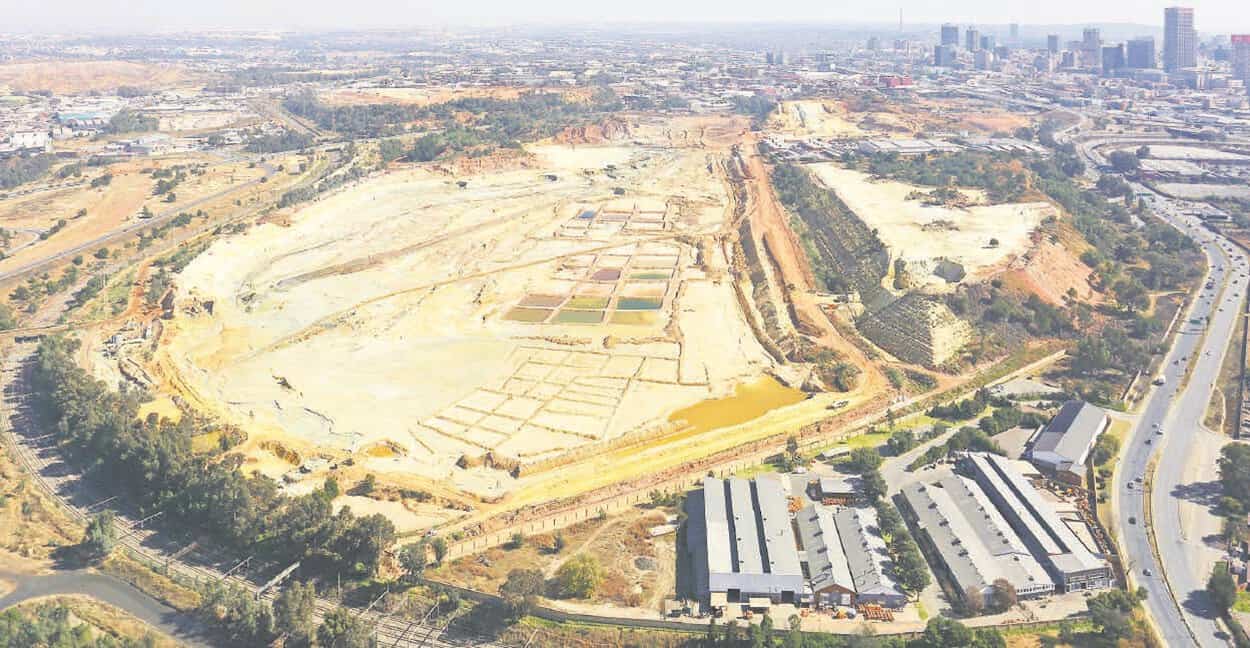
A million or more people in Gauteng's former goldfields face serious health risks from radioactive mine tailings. A million or more people in Gauteng’s former goldfields face potentially serious health and environmental risks from radioactive mine tailings and poorly managed mining waste, with environmental experts warning urgent intervention is needed to prevent further exposure. Eco-activists and mining experts say abandoned, ownerless and inadequately rehabilitated mines are exposing thousands of people to potentially hazardous substances, including uranium and other heavy metals. As many as a million people across the Witwatersrand live near or on mining deposits or tailing dams. Joburg is radiation hotspot In an interview with eNCA, Mariette Liefferink, an expert at the Federation for a Sustainable Environment (FSE), said most of these deposits contained radioactive material because gold ore in the region naturally occurred alongside uranium. According to Liefferink, Joburg’s mining belt has about 270 mine dumps over an area of 400km2 and tailings storage facilities, some of which are being reclaimed. She estimated these facilities contained about 600 000 tons of uranium. “Most of the mine residue deposits are radioactive. Besides, our gold ore occurs with uranium and, therefore, the tailings storage facilities contain large quantities of uranium,” she said. Liefferink added radioactive material had historically migrated from mine dumps into surrounding wetlands, while some mine tailings had also been used as construction material. She said investigations by the Council for Geoscience had identified elevated levels of radioactivity in large parts of Johannesburg’s CBD, with wetlands also among the areas affected. “Many radioactive hotspot sites have no access control, no fences and no warning signs,” she said. Uranium in mining tailings poses health risks Liefferink said uranium posed radiological and chemical health risks, with exposure potentially contributing to kidney damage and other complications. “It can cause nephrotoxicity, kidney disease or kidney failure. “It can also result in transgenerational impacts and endocrine-disrupting effects,” she said. Much of the radioactivity is associated with the release of radon, a gas and which is released continuously. As the uranium-238 and radium-226 in these exposed, unlined dumps decay, they give off radon-222 gas, which goes into the atmosphere and soil. Although mining guidelines recommend a 500-metre buffer zone around tailings, estimates are that 1.6 million people in Joburg and the West Rand live directly next to – or even on top of – these radioactive dumps. While radon dilutes quickly into the atmosphere, it can seep through foundation cracks and accumulate inside homes and schools, particularly during cold Highveld winters, when windows remain closed. Radon second-leading cause of lung cancer globally Radon is a group 1 carcinogen and the second-leading cause of lung cancer globally. According to the Cancer Association of South Africa inhaling radon gas products damages lung tissue and dramatically increases cancer risks, especially for smokers. Liefferink criticised what she described as regulatory gaps in the management of radioactive mine waste, arguing the National Nuclear Regulator (NNR) had interpreted its mandate narrowly. NNR was established under the National Nuclear Regulator Act of 1999 to protect people, property and the environment from nuclear damage. However, Liefferink said the regulator mainly dealt with radioactive waste on licensed sites, leaving contamination outside these sites inadequately regulated. She said the department of environmental affairs also did not regulate radioactive waste, while the NNR faced capacity constraints in implementing rehabilitation requirements. Communities living near abandoned, poorly managed mines faced risks Mining expert David van Wyk said communities living near abandoned and poorly managed mines along the Main Reef Road corridor, stretching from Springs in the east to Westonaria in the west, faced serious health and environmental risks. He said poorly managed tailings and other mining waste contained potentially dangerous substances, including uranium, lead, arsenic, silica, cadmium, strontium, copper and iron. “These unrehabilitated mine sites are toxic cauldrons containing heavy metals, including uranium, lead, arsenic, silica, cadmium, strontium, copper and iron. Most of these are carcinogenic. “We must worry about this because respiratory illnesses and cancer are rife in communities located close to these sites,” he said. “Spatial apartheid located most of the townships, including Soweto, on the wrong side of this mine waste,” added Van Wyk. He called for mining companies to be held accountable for failing to properly close and rehabilitate mines after completing their operations. Dept needs to strengthen oversight Mazi Choshane, an attorney at the Centre for Environmental Rights, said the department of mineral and petroleum resources (DMPR) needed to strengthen its oversight and enforcement of mining companies’ environmental rehabilitation obligations. She added the transfer of mining rights should not become a mechanism for companies to escape accountability. Choshane said larger mining companies increasingly transferred or sold mining rights to smaller operators after extracting most of the economically viable minerals. However, these smaller companies often lacked the financial and technical capacity to rehabilitate environmental damage accumulated over decades. “This creates a risk that the environmental liabilities associated with historical mining activities are effectively passed down to smaller companies, while the larger companies that generated much of the environmental damage are able to distance themselves from the consequences of their operations,” she said. DMPR did not respond to questions by the time of publication.
Joburg is radiation hotspot as million face risks from mine tailings
Full Article
Original Source
Read the full article at Citizen →KhanList aggregates and links to publicly available news content. We do not host full articles from third-party sources. Always verify important information with original sources.