
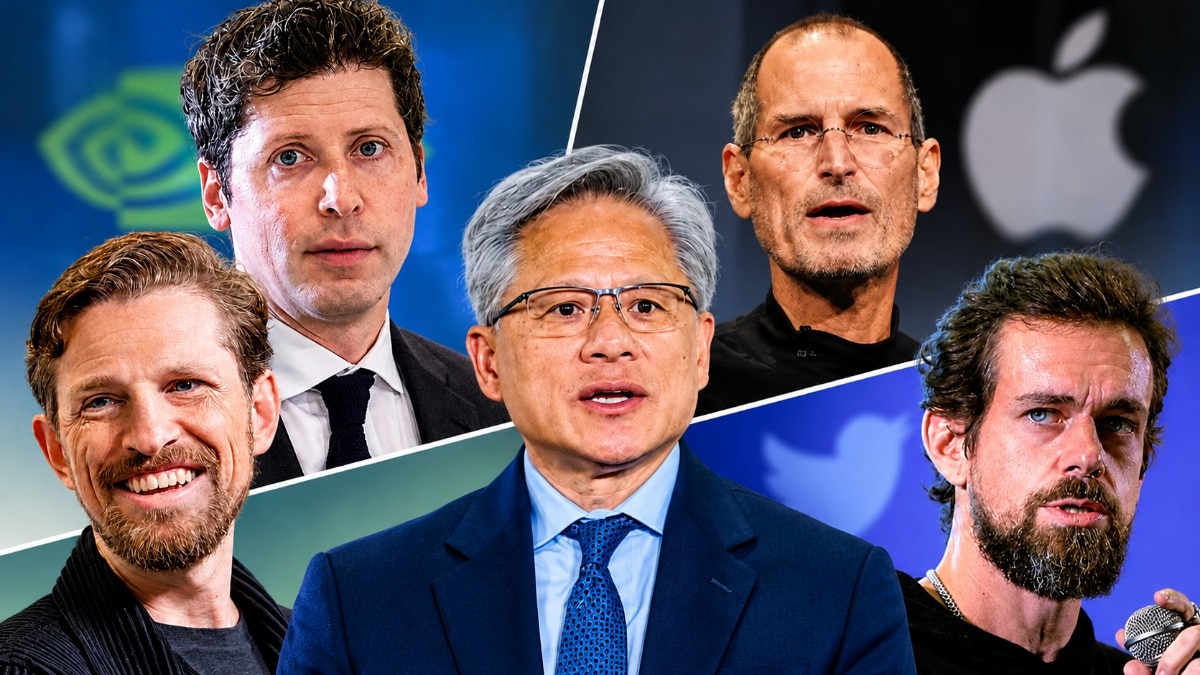
Losing the top job at a company you helped build does not always mean the end of your leadership journey. In the technology industry, some founders have experienced dramatic exits, only to return to the very companies they once created.Nvidia CEO Jensen Huang is the latest name in this unusual club. Less than two weeks after resigning from the company he co-founded, Huang was reinstated as its chief executive on November 23, following a unanimous decision by the board.His return comes after a turbulent period at Nvidia. The company had appointed Chief Financial Officer Colette Kress as interim CEO following Huang's November 12 resignation. However, after discussions with Huang, the board reversed its decision and said it had confidence in his leadership.Huang's comeback brings back memories of other technology leaders who lost their positions but eventually found their way back. From Steve Jobs to Sam Altman, here are five founders whose careers took an unexpected turn. JENSEN HUANG: A COMEBACK IN LESS THAN TWO WEEKSHuang co-founded Nvidia in 1993 with Chris Malachowsky and Curtis Priem. Under his leadership, the company grew from a graphics-chip maker into a major force in artificial intelligence computing.His resignation on November 12 triggered a leadership change, with Kress taking charge temporarily. But the transition did not last long. On November 23, Nvidia announced that its board had unanimously voted to reinstate Huang as president and CEO. The board said it believed he was the right person to lead the company. Huang's return came even as an independent investigation into the circumstances surrounding his departure continued.SAM ALTMAN: FIRED ON FRIDAY, BACK BY THE FOLLOWING WEEKSam Altman's November 2023 exit from OpenAI became one of the biggest boardroom controversies in the technology industry.The company's board removed him as CEO, saying it had lost confidence in his leadership. The decision triggered an employee revolt, with more than 700 staff members signing an open letter demanding his reinstatement.Microsoft, a major OpenAI investor, also offered Altman a position to lead a new artificial intelligence research team.Following days of uncertainty and negotiations, OpenAI announced on November 21 that Altman would return as CEO under a reconstituted board. He officially resumed the role on November 29.STEVE JOBS: THE RETURN THAT TRANSFORMED APPLESteve Jobs' comeback at Apple remains one of the most famous founder-return stories.In 1985, Jobs was pushed out of his operational role following disagreements with then-CEO John Sculley and Apple's board. He went on to establish NeXT and became involved with Pixar.In 1996, Apple acquired NeXT, bringing Jobs back to the company he had co-founded. He initially returned as an adviser before becoming interim CEO in 1997.His second stint transformed Apple's fortunes. The iMac, iPod, iPhone and iPad followed, turning the company into one of the world's most valuable technology businesses.JACK DORSEY: BACK AT TWITTER AFTER SEVEN YEARSJack Dorsey co-founded Twitter in 2006 and served as its first CEO. However, he was removed from the position in 2008 amid concerns about his management and the company's direction.He went on to build payment company Square, now known as Block, but remained associated with Twitter as its chairman.In 2015, around seven years after leaving the CEO role, Dorsey returned as interim chief executive and was later confirmed permanently. He continued leading Twitter until 2021, when he stepped down and was succeeded by Parag Agrawal.MATT MULLENWEG: BACK IN CHARGE IN 33 HOURSMatt Mullenweg's return to Automattic, the company behind WordPress.com, was considerably quicker.In September 2026, the company's board placed him on paid leave and appointed Chief Financial Officer Mark Davies as interim CEO. Mullenweg challenged the decision and subsequently returned as chairman and CEO.Automattic confirmed his return on September 12. The company told TechCrunch that he had been away for just 33 hours and 20 minutes.His comeback was followed by a boardroom shake-up. Mullenweg also had significant influence through his controlling voting stake in the company.WHEN LOSING THE TOP JOB IS NOT THE ENDThese five stories have different circumstances, timelines and outcomes. Some founders returned after employee pressure, others regained control following boardroom disagreements, while some retained enough ownership or influence to reclaim leadership.But they underline an important reality of the technology industry: losing the CEO title does not necessarily mean losing your connection with a company.For founders, ownership, boardroom influence, employee support and investor confidence can all shape what happens after an exit. Sometimes, the person who once walked out of the boardroom gets another chance to lead it.- Ends
Jensen Huang, Sam Altman, Steve Jobs : 5 tech founders who got their CEO jobs back
Full Article
Original Source
Read the full article at Indiatoday →KhanList aggregates and links to publicly available news content. We do not host full articles from third-party sources. Always verify important information with original sources.