
Humanoid robots are already running half marathons: “It was a test to check the robot’s stability, reliability and endurance, as well as the embodied intelligence algorithms it runs,” says Jian Tang, chief technology officer (CTO) of the Chinese company X-Humanoid, one of the businesses behind that event in 2025. Robots also perform spectacular dances that go viral: “They are a real business. You can earn some money from commercial shows, but that should not be the main focus of the whole industry,” Jian Tang adds.The first deployments are likely to be in ‘dangerous, dirty or dull’ environments, such as a hazardous materials lab, a logistics warehouse or at an earthquake. But the big step for these robots will be to win over homes and household chores. There’s still some way to go, Jian Tang says by videoconference from his office in Beijing. This Monday he is participating in the China-Spain Green Energy Forum in Madrid.Question. What is the biggest misconception about humanoid robots?Answer. People see a demonstration of a robot cooking a very complicated dish and start to believe: ‘This is very close, we’re almost there. Maybe next year I can buy one for my home.’ But that’s not the case. Doing a demo is easy because you collect data from the specific environment where the robot is going to do the demonstration. You collect a huge amount of data. But if you put it in thousands of homes, it would most likely not be able to repeat that performance. That’s the hardest part. When it encounters an object it has never seen before or a new environment, it can get stuck or fail.Q. But is it already capable of, for example, finding a clove of garlic in the refrigerator and chopping it into pieces?A. A small object shouldn’t be a problem. They can do precision tasks. If you collect thousands of trajectories, we should be able to do it. But if you take it to a new home, then no.Q. In how many years?A. In nine years it may be able to do perhaps not everything, but 90% of tasks.Q. And that 10%?A. In other words, it will do almost everything, but its success rate will not always be 100%.Q. Could you ask it to empty an entire closet to find a lost sock?A. Of course, exactly.Q. That’s crazy.A. A robot can devote more time than anyone and find that sock. It can use a search algorithm to scan the whole room.Q. Will there be anything before those nine years?A. Within four years products should start to appear that will already be true domestic service robots. Their functions may be limited: they will likely be able to pick up a glass of water and bring it, or perform some simple task. Later they will gain more and more functions. In the end, within nine years, it will be a true home service robot.Q. What will the first tasks be?A. We’re fairly sure the first thing will be picking up and placing objects.Q. Also a glass or bottle, which can break?A. I don’t think that will be a problem. Then, with the help of a washing machine, it should be able to put clothes in, start it, take the clothes out and fold them.Q. Will that be in five years?A. Yes. And also housecleaning tasks.Q. And will they cost the same as a car?A. About the same as a car. When the scale becomes larger, the price will fall. The idea is around $20,000 [€18,200].Q. What is slowing progress down?A. The AI model. We are waiting for a leap—when the whole industry reaches its ‘ChatGPT moment’, then we’ll be ready to mass-produce domestic service robots.Q. Is it a software issue?A. It’s purely a software issue. Right now everyone is working on what is called embodied general intelligence. We are trying to create a general model that can do almost everything. The main bottleneck is that the generalization capability of the AI model is not good enough.Q. That’s why remote control of robots is a common resource today.A. If they have remote control, they can do almost anything. The problem is generalization capacity, because the data you train your AI model on is limited. When the robot enters a new home, it often sees objects it has never seen before—a mug, a pen it doesn’t recognize—and it may not be able to manipulate them. But in the future, if the AI model of the physical world has a generalization ability equivalent to ChatGPT or Claude in the digital world, then it will be able to manipulate anything, even if it has not seen it before.Q. Haven’t you considered making robots that are not humanoid?A. The logic is that it should do what a human does. That’s the basic logic behind making a bipedal humanoid robot. But in some scenarios a wheeled robot is enough. For example, in a factory a wheeled robot is better: it’s faster and more precise.Q. Why is China so far ahead in these robots?A. China is ahead in hardware and in everything related to locomotion. As for the embodied general intelligence model, I think China and the United States are at the same level. No one has yet achieved that major breakthrough. China leads in hardware because the whole country has a practically complete and very wide supply chain.Q. What will the relationship between a robot and its owners be like?A. It will become a member of your family. That’s why we want it to look human, because you’ll feel more comfortable. You’ll have in front of you something that is at least partly human, instead of an appliance or a machine.Q. Does that make things easier?A. I used to work in appliances. We developed an AI model for the air conditioner so you could talk to it and ask it to lower or raise the temperature. But normally people only want to give the air conditioner a couple of commands. They don’t want to be talking to the air conditioner for ten minutes. It’s because of its appearance, which makes you think it’s just an appliance. But if a robot works for you for a long time, you may start to treat it as another family member.Q. And will they last like a car?A. Yes, their useful life will get longer, like a car. At least five years should not be a problem.Q. Won’t it be like having someone living in your home watching you in your private life?A. I understand the concern. One of the efforts we’re making is to have the robot do most of its computing on board rather than in the cloud. Especially vision-related tasks we want to process in the robot’s body. This is called edge computing. Or on a device in your home, a small server you can install, so not all data goes to the cloud. We try to transmit fewer data to the cloud rather than virtually everything.Q. How fragile are they?A. They are much more resilient than last year. When they fall, they get up most of the time: we tested them, we threw them to the ground 100 times and they kept getting up. Of course it depends on how they fall, just like a person.Q. Are the robots we’ll have at home like the ones we see now?A. No. They will evolve a lot. Companies are working on electronic skins.Q. Robots with skin would be terrible.A. No, it’s not like human skin. It’s a kind of soft material placed over the robot’s body. With a very light, very gentle touch the robot stops for safety. Also, it makes the robot look more human.Q. But will it have a head, five fingers?A. Yes. For the home, it should look exactly like a human, or increasingly like a human, so our customers feel comfortable.Sign up for our weekly newsletter to get more English-language news coverage from EL PAÍS USA Edition
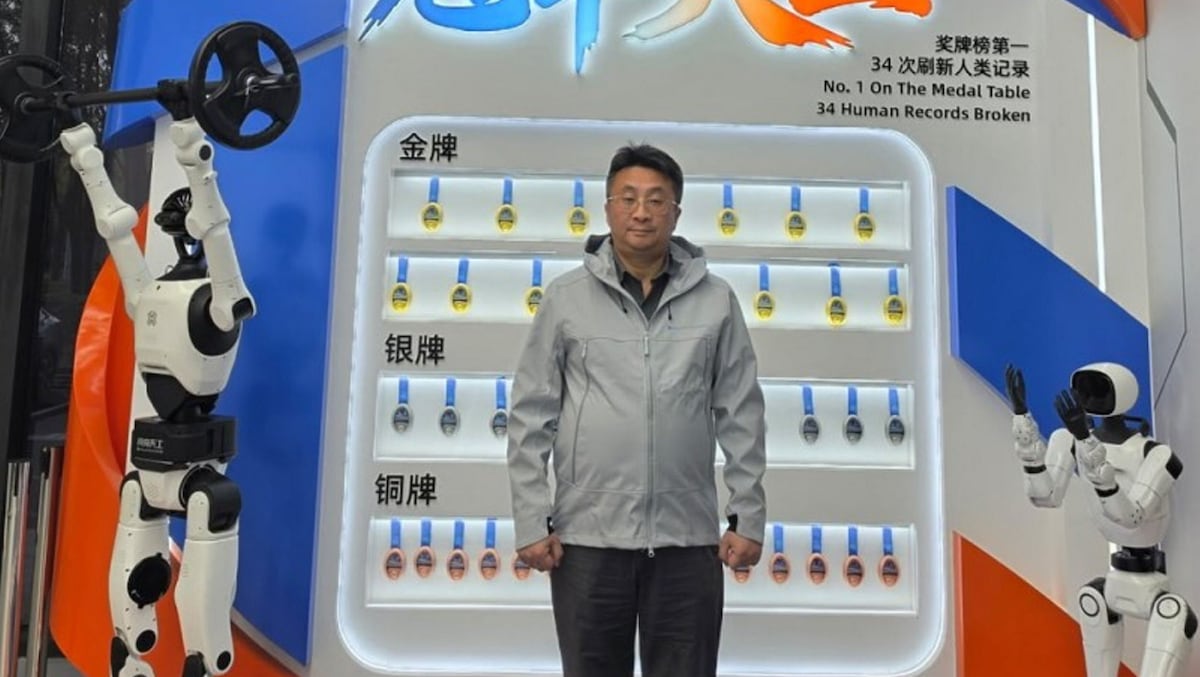
Jian Tang, robot maker: ‘The first things they will do will be to pick up objects and run washing machines’
Full Article
Original Source
Read the full article at English →KhanList aggregates and links to publicly available news content. We do not host full articles from third-party sources. Always verify important information with original sources.