
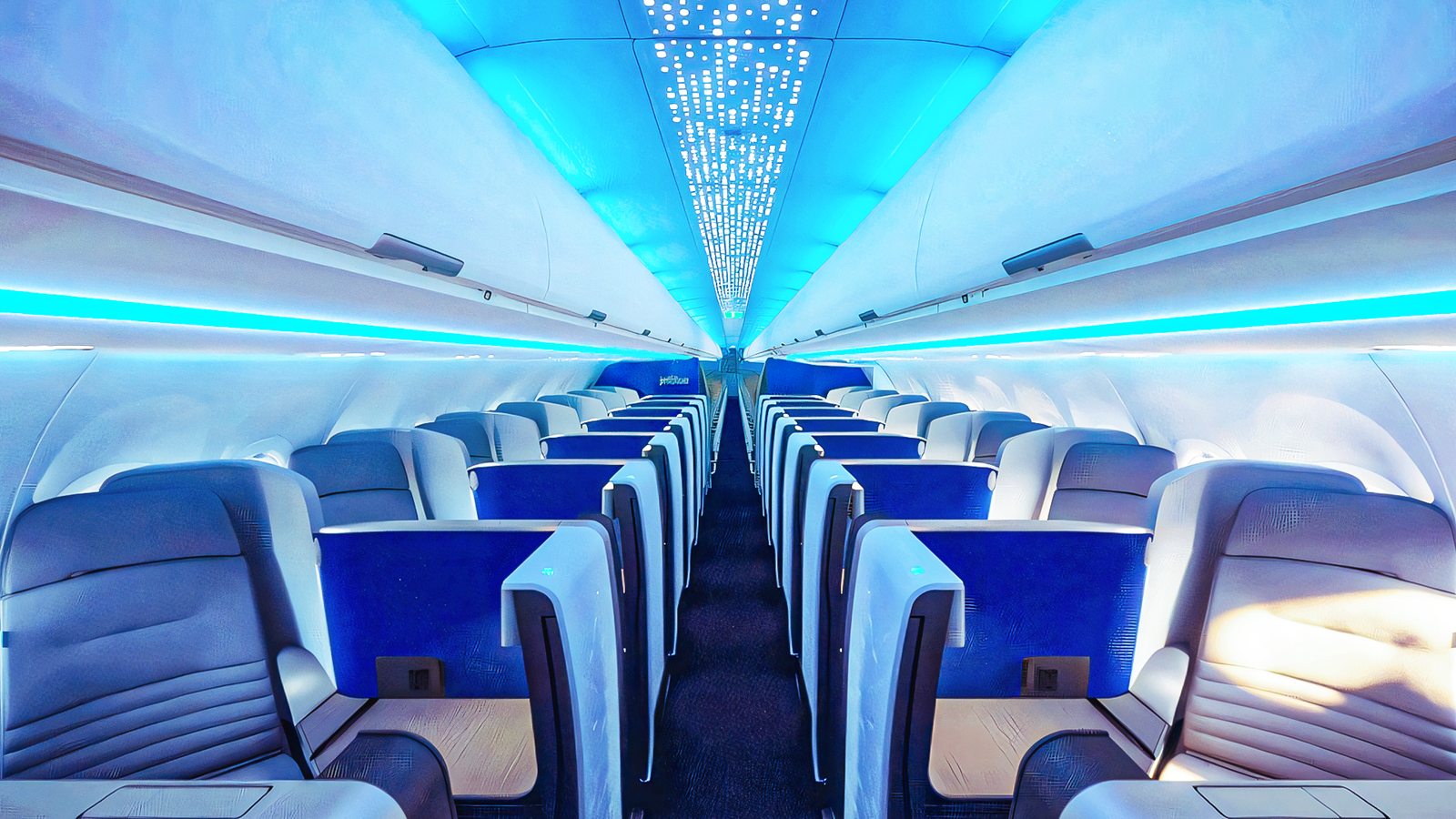
Credit: JetBlue Airways, Simple Flying Published Nov 1, 2026, 1:00 PM EST Jack comes to Simple Flying with a lifelong interest in all things aviation. He holds a degree in Aerospace Engineering from Georgia Tech, and is a certified private and remote pilot. Beyond these experiences, Jack previously worked for a corporate flight department where he gained first-hand experience in the world of business aviation. Currently, Jack works in the professional services industry and continues to build his flight hours outside of work. JetBlue Airways' Airbus A321LR has 24 seats in its Mint business-class cabin, but passengers generally can book only 23 of them on transatlantic flights. Suite 12A, which appears to be an ordinary premium seat on the cabin map, is reserved for a relief pilot to rest during the journey. The seemingly missing seat is not a sales-system error or a decision to withhold a desirable product from customers. It is part of the operational setup that allows JetBlue to fly long-haul routes with an augmented flight crew while meeting fatigue-management requirements. The arrangement illustrates how aircraft seat maps reflect more than the number of seats physically installed. Airlines must balance cabin revenue against the need to provide rest opportunities for crew members operating flights that exceed what a standard crew can safely cover under applicable duty limits. JetBlue uses a business-class suite for pilot rest and reserves seats in the rear economy cabin for flight attendants. Understanding why those places are blocked also reveals how the Federal Aviation Administration (FAA) classifies onboard rest facilities, why some crew seats occasionally appear for sale, and how staffing rules shape the passenger experience. Why Suite 12A Is Missing From JetBlue’s Available Mint Cabin Credit: JetBlue Airways, Simple Flying JetBlue’s A321LR has 24 Mint seats arranged in a one-one configuration across rows one through 12. The cabin combines individual suites with doors and two larger Mint Studios at the front. On transatlantic flights, however, suite 12A is designated for a relief pilot rather than a paying customer. That leaves 23 Mint seats available for sale even though the aircraft physically contains 24 premium seats. JetBlue’s A321LR was designed to make thinner transatlantic routes viable with a single-aisle aircraft. Its range and cabin configuration allow the airline to connect New York and Boston with European destinations without deploying a larger widebody jet. But flying across the Atlantic requires a crew rest plan: pilots cannot remain on duty for the entire flight without the legally required opportunity to rest, and an augmented crew allows pilots to rotate between active flight duties and rest periods. JetBlue A321LR Mint Configuration Cabin Total Seats Mint 24 Economy 114 The designated suite is a Class 2 rest facility. It offers a lie-flat sleeping surface within the passenger cabin, separated from the rest of the cabin by a thick curtain that reduces light and some noise. The seat therefore serves a safety-related operational purpose rather than a premium amenity. The Points Guy documented the arrangement when JetBlue introduced its A321LR, noting that suite 12A is reserved for relief pilots on transatlantic flights and that flight attendants use seats in the last row of the economy cabin. Three Classes Of FAA Crew Rests Credit: Matheus Obst | Shutterstock Federal regulations define three classes of rest facility for augmented flightcrew operations under 14 CFR Part 117. Class 1 is a bunk or other surface that permits flat sleeping in a separate space away from both the cockpit and passenger cabin. The area must allow temperature control and light management, and provide isolation from noise and disturbance. It is the most distinct type of rest space. Class 2, the category relevant to JetBlue’s pilot suite, is a cabin seat that allows a flat or near-flat sleeping position. It must be separated from passengers by at least a curtain that provides darkness and some sound mitigation, and it must be reasonably free from disturbance. Class 3 is less elaborate: a seat in the cabin or flight deck that reclines at least 40 degrees and provides leg and foot support. The federal regulation's definitions set out the precise requirements, while the FAA’s Advisory Circular 117-1 explains how approved facilities are used in augmented flightcrew operations. These categories are not simply labels for passenger comfort; the rest facilities available to pilots affect the maximum flight duty period permitted under the rules, alongside factors such as the scheduled start time and number of pilots assigned. Better rest facilities can support a longer permitted duty period under the applicable framework, while lower-class facilities can impose tighter limits. Operators must have the appropriate facility classification approved before using it for qualifying operations. The FAA’s system also helps explain why a curtain and a flat seat can matter operationally. The goal is not to create a luxury sleeping environment; it is to provide a defined opportunity for rest under conditions that meet the relevant standard. Crew Rest Has Safety Requirements Beyond A Blocked Seat Credit: Kevin Hackert | Shutterstock A crew rest area must do more than look private on a seat map. Its design and approval depend on the type of facility, the aircraft, and the applicable regulatory requirements. For Class 1 compartments, relevant design and safety provisions include features such as smoke detection, fire protection, lighting, oxygen equipment, seat-belt indications, and communication with the flight deck. The specific equipment requirements vary with the approved design and governing rules, so they should not be assumed to apply identically to every curtained cabin seat. The FAA’s Advisory Circular 117-1 also outlines criteria for rest facilities used in augmented flightcrew operations. It explains that airlines operating under Part 117 must obtain FAA approval and qualification for the class of onboard rest facility before using it for those operations. A facility’s status is therefore not determined solely by whether a seat reclines far enough or whether a curtain can be pulled around it. Its configuration must meet the relevant criteria. For passengers, the practical consequence is that crew rest seats can be treated differently from ordinary seats even when they share the same cabin. A blocked suite may remain unavailable throughout booking because it is needed for the scheduled operation. On aircraft with Class 2 or Class 3 facilities, the rest space may be embedded in the passenger cabin, using a seat and a curtain rather than a dedicated compartment. The arrangement saves cabin volume, but it requires airlines to manage passenger access and protect the intended rest period. Why United’s 767 Crew Seats Sometimes Appear For Sale Credit: Carlos Yudica | Shutterstock JetBlue’s blocked Mint suite is one example of a wider industry practice. United Airlines uses four enhanced-recline economy seats on some Boeing 767 configurations as flight-attendant rest facilities on long-haul flights. These seats have extra recline, leg rests, footrests, and a curtain that can separate them from the rest of the cabin. Depending on the aircraft version, the seats are found in the rear rows and may be identified as 43A, 43B, 44A, and 44B, although seat numbering can vary by configuration. On flights that require those seats for crew rest, they are held back from passenger selection. When an aircraft operates a domestic or shorter route that does not require the same crew-rest arrangement, the seats may be opened for sale. The Points Guy has described how United blocks the seats during advance booking and can release them closer to departure when they are not needed for the crew. Its report on United’s 767 crew-rest seats explains why the unusually spacious economy seats can sometimes be booked by passengers. Airline Contracts Can Set A Higher Bar Than FAA Minimums Credit: Coby Wayne | Shutterstock Federal regulations establish the baseline for flight crew rest and duty limitations, but they do not determine every detail of how an airline provides rest. Collective bargaining agreements and company policies can specify additional provisions, particularly for flight attendants. These can define which seats must be reserved, how much rest time crew members receive, where the seats are located, and what physical features they must include. United’s flight-attendant agreement, for example, sets out enhanced recline, leg-rest, and curtain requirements for certain 767 crew-rest seats. It also describes arrangements for other aircraft types, including dedicated bunks on widebody aircraft. The current United flight-attendant contract materials show how crew rest provisions can be spelled out in labor agreements. Such terms are distinct from the FAA’s classification framework, which defines the facility standards. Seat Map Reveals The Economics Of Long-Haul Flying Credit: JetBlue JetBlue’s decision to reserve suite 12A demonstrates that the commercially available cabin is not always the same as the installed cabin. A single premium suite can be essential to the crew rest plan that makes a transatlantic flight possible, and its absence from the booking inventory reflects operational constraints rather than an error. The FAA’s three-class framework establishes the standards for qualifying rest facilities, while airline policies and labor agreements can add further requirements. The broader implication is that airlines will continue to trade off passenger capacity against the resources needed to operate longer flights safely. As single-aisle aircraft serve more transatlantic markets, carriers must fit crew rest arrangements into cabins designed to generate revenue from a limited number of seats. That may mean blocking a business-class pod, reserving a row in economy, or installing dedicated bunks where the aircraft’s design permits. For travelers, an empty or blocked seat on a seat map should be read as a sign that the aircraft has operational needs beyond passenger demand. JetBlue’s 23 available Mint suites are not a shortcoming in the cabin design. They are part of the arrangement that lets the airline offer nonstop transatlantic service with a narrow-body aircraft while preserving a required rest opportunity for the crew.
JetBlue's Airbus A321LR Has 24 Mint Suites, But Only Sells 23 Of Them
Full Article
Original Source
Read the full article at Simpleflying →KhanList aggregates and links to publicly available news content. We do not host full articles from third-party sources. Always verify important information with original sources.