
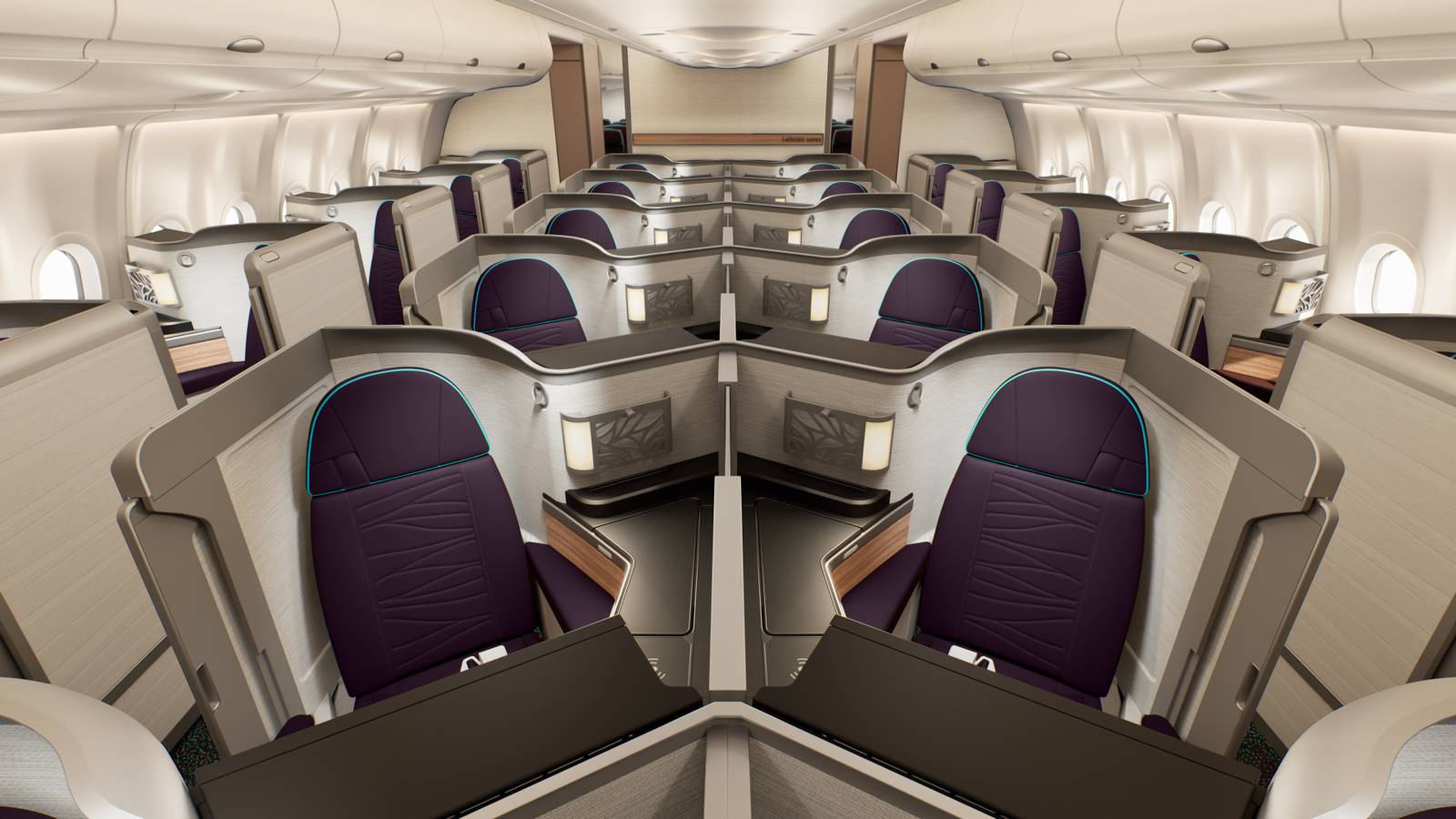
Published Nov 1, 2026, 2:00 PM EST Aaron is an aviation enthusiast and world traveler with a deep interest in aerospace history and technology. He has traveled around the world numerous times, often incorporating visits to aviation museums and historic aircraft collections into his journeys. A native of New Zealand, he is an expert in aviation and maintains a broad interest in a variety of other subjects. Alaska Airlines has completed its acquisition of Hawaiian Airlines and is in the process of modernizing and changing its fleet. Modernization is somewhat nuanced, as the takeover has deprived Hawaiian of its planned Boeing 787-9 Dreamliner fleet without direct replacement. For now, Alaska is concentrating on upgrading the interiors of Hawaiian's fleet of 24 Airbus A330-200 airliners and retiring its aging fleet of Boeing 717 regional airliners. At the same time, Alaska is mulling the future of Hawaiian Airlines' most modern fleet, the A321neo. Alaska's CFO has previously said Hawaiian's A321neo fleet will either double in size or be phased out entirely, so investing in new interiors would be risky until that's decided. This means that Hawaiian's A321neos are in limbo while the A330 fleet is cleared to receive a mid-life cabin upgrade. Hawaiian Airlines' 2025 Announcement Credit: Karolis Kavolelis l Shutterstock In September 2026, Hawaiian Airlines announced it was overhauling its interisland fleet and A330 cabins. At the time, Hawaii's parent company, Alaska Air, hosted an Investor Day in Seattle unveiling new lie-flat suites for both its brands: Aurora and Leihoku. The statement said Hawaiian will reconfigure its A330s with new interiors and four cabin types by 2028. Hawaiian Airlines CEO Diana Birkett Rakow explained, "The front cabin will be the Leihoku Suites, full lie flat seats with a door closed suite. The second cabin is something called premium reserve, so think of that as like domestic business class with a little bit larger seats, larger pitch, a different level of service, and then there’s premium economy and main cabin." The retrofit will remove four economy (main cabin) seats and replace them with 12 high-class seats. The airline said the changes won't directly lower interisland prices, but they will indirectly help by letting the airline earn more from high-class passengers. Rakow explained, "When you have more revenue coming from the front of the airplane, that takes the pressure off the back of the airplane." The airline also said it will retire its older Boeing 717 aircraft as these aircraft are becoming increasingly expensive to operate, partly because there are more fuel-efficient alternatives. Hawaiian Airlines Fleet Credit: Markus Mainka l Shutterstock Hawaiian currently operates a fleet of 71 aircraft, or 61 if the 11 cargo A330-300P2F freighters are excluded. The widebody passenger fleet is composed of 24 Airbus A330-200s. These are currently configured with 18 business class seats and 260 economy class seats, of which 68 are classified as 'Premium Class.' These will be retrofitted with 22 business class seats, 28 premium economy seats, and 204 economy class seats, of which 48 will be 'Premium Class.' The A330s are now an average of 13.4 years old, meaning they are approaching midlife. The 19-strong fleet of 717s is to be replaced with mid-aged 737-800 aircraft, which are to be transferred from Alaska starting in 2028. Hawaiian has currently received one 737-800 from Alaska. The airline also operates a fleet of 18 A321neo aircraft, the most modern and fuel-efficient in the fleet. The Boeing 717s serve interisland routes, while the A321neos have the range to reach farther destinations. Hawaiian Airlines Fleet Quantity Future Airbus A321neo 18 Undetermined Airbus A330-200 24 To receive cabin upgrade Airbus A330-300 11 Continue as cargo aircraft Boeing 717 19 To be replaced by 737-800s Boeing 737-800 1 Replacing 717s Hawaiian was originally a customer for Airbus' shorter A350-800 variant, which was never built, as Airbus instead elected to upgrade the A330ceo to the A330neo. The airline then switched its order to the A330-800neo variant of the A330neo family, but, seeing the type was extremely unpopular, it dropped the order and selected to purchase 12 787-9s. As Alaska acquired Hawaiian, it took over the order for 787-9s to develop its own long-haul network. Hawaiian is therefore left with its existing A330-300 widebody fleet. Hawaiian Is Set To Retire Its Boeing 717 Fleet Credit: Wangkun Jia l Shutterstock Hawaiian is leaving its 717 regional aircraft out of the planned cabin upgrades as they are due to be retired and replaced in the next few years. Hawaiian Airlines and Delta Air Lines are the last two commercial passenger airlines operating the 717 after QantasLink retired its fleet. The Boeing 717 was developed for the 100-seat regional market and was originally marketed by McDonnell Douglas in the early 1990s as the McDonnell Douglas MD-95. It shares a common lineage with the MD-80 and the broader Douglas DC-9 family. However, the type is aging, and its fuel efficiency is becoming a growing problem, especially during periods of high fuel prices. Delta is the larger operator of the two, and it is accelerating the retirement of its Boeing 717 fleet and pulling select jets from service ahead of a full scheduled phaseout. Beyond high fuel costs, the type is increasingly suffering from high maintenance costs from heavy maintenance checks, structural inspections, and corrosion remediation, as well as issues maintaining its Rolls-Royce BR715 engines. While Delta is partly replacing its fleet with modern Airbus A220s, Hawaiian will get older 737-800s, which are an improvement but still previous-generation aircraft. It is unclear when Hawaiian's 717 fleet will fully retire, but the phase-out is set to begin in 2028. The Uncertainty Around Hawaiian's A321neo Fleet Credit: Minh K Tran l Shutterstock Alaska Airlines operates an all-Boeing fleet; until taking delivery of the 787s, it was an all-737 mainline fleet, excluding Embraer commuter aircraft. Its acquisition of Hawaiian has thrown the future of the A321neos into question, even though they are the airline's most modern aircraft with an average age of just seven years. Currently, Alaska has not said it would divest of them, but it also hasn't committed to retaining them. The A321neos were originally a very important part of Hawaiian's strategy to serve thinner mainland-Hawaii routes, mostly from the West Coast. They also offer considerably better economics than its existing A330 fleet on thinner routes. Alaska Air Group has around 168 firm 737 MAX orders (deliveries through 2035) and options for another 71. Alaskan executives have previously said that Hawaiian's fleet of 18 A321neos is probably too small to justify maintaining and operating as a permanent subfleet. Currently, Alaska is considering either retiring them or significantly expanding the fleet. No final decision is expected yet, and the aircraft will remain in a holding pattern until around 2027-2028. With this uncertainty, there is little sense in Hawaiian retrofitting the cabins as it is with the A330 fleet. Alaska's Decision Regarding The A321neo Fleet Credit: Wirestock Creators l Shutterstock Alaska has said it could double the A321neo fleet for Hawaiian if it chooses to retain them. The A321neo is extremely well suited to Hawaiian's existing longer, thinner mainland routes and can bridge the gap between the A330 and Boeing 737 MAX in capacity and range. With a fleet of 30-40 A321neos, the fleet would likely make much more economic sense for Alaska. Another attraction of retaining the aircraft is that they are young and owned, rather than old leased aircraft. Alternatively, Alaska could replace the A321neo with the stretched 737 MAX 10. That aircraft offers similar passenger capacity, although it has a shorter range. The MAX 10 could likely substitute the A321neo on routes like Honolulu to Salt Lake City, Kona to Sacramento, and Lihue to Sacramento. One potential option for Hawaiian is the longer-range A321XLR; this could theoretically open up new longer-haul thin routes, although it doesn't seem Hawaiian planned to purchase the variant pre-acquisition. Instead, Hawaiian was looking to expand its longer-haul capacity with the 787-9 widebodies. In theory, the A321XLR could open routes such as Honolulu to Chicago, Auckland, and Fukuoka. For now, it remains to be seen where Alaska will take Hawaiian's future narrowbody fleet. The bottom line is that the A321neos fit well within Hawaiian's current network, but poorly within Alaska's maintenance infrastructure. The New Interiors For The A330s Credit: Angel DiBilio l Shutterstock With the 717s set to retire and the future of the A321neos uncertain, Hawaiian is only pushing forward with revamping its A330neo aircraft. The front cabin will be equipped with Leihoku Suites: 22 lie-flat suites in a 1-2-1 layout with sliding doors, replacing today's 18 lie-flat seats in a 2-2-2 layout. Each suite will feature a 19-inch 4K screen. Passengers will be treated to chef-designed dining with wine pairings, as well as hotel-quality bedding, Starlink WiFi (for Atmos Rewards members), and a dedicated check-in and concierge service (in Honolulu and Seattle). The A330's premium economy cabin will be branded as 'Premium Reserve,' with passengers enjoying 38 inches of seat pitch and a 16-inch OLED touchscreen. Economy passengers can expect a new 13-inch 4K OLED touchscreen. Also part of the A330 refresh is a new lounge in Honolulu's Terminal 1 with capacity for 200 guests. It is set to open in early 2028. Meanwhile, the ex-Alaskan Boeing 737-800s will not be getting these interiors and will instead be coming with an Alaska-style premium narrowbody interior. These will have 16 domestic 'First Class' seats featuring reclining leather Recaro seats.
Hawaiian Airlines Is Overhauling The Premium Experience On 24 Airbus A330s, But Isn't Even Touching Its Narrowbodies
Full Article
Original Source
Read the full article at Simpleflying →KhanList aggregates and links to publicly available news content. We do not host full articles from third-party sources. Always verify important information with original sources.