
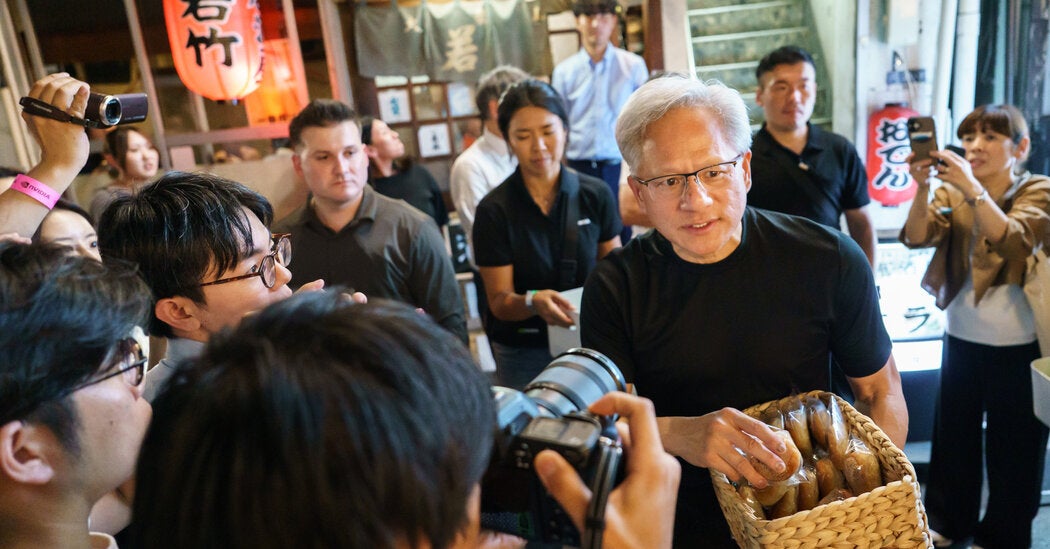
AdvertisementSKIP ADVERTISEMENTThe ex-Nvidia C.E.O. was a bridge between companies and governments. His exit will reverberate, especially in China where it could accelerate a self-reliance drive.In July, Jensen Huang handed out snacks to journalists after a dinner event outside a restaurant in Tokyo.Credit...Tomohiro Ohsumi/Getty ImagesNov. 13, 2026Updated 8:18 a.m. ETIn Indonesia, Jensen Huang was called the leader of the artificial intelligence revolution. In Japan, he was “the next Steve Jobs,” according to the technology investor Masayoshi Son. In Taiwan, where he was born, he is just called Dad.Mr. Huang, who resigned this week from the powerhouse Silicon Valley chip company Nvidia, was celebrated across Asia — from South Korea to Japan, Indonesia to Kazakhstan. He traveled frequently to the region, cultivating close ties with business leaders and wooing government officials.Outside of China, he pitched Nvidia chips as a path to “sovereign A.I.,” the idea that countries had to build their own A.I. supercomputers and data centers, a vision that many government leaders bought into.Even in China, where the business relationships he forged for Nvidia were made more complicated by the rivalry between Beijing and Washington, Mr. Huang was often seen as a bridge. That role was cast in a new light by the explosive revelations about his relationship with a woman the U.S. government believes was spying for China.Nvidia is valued at about $4 trillion, one of the largest corporate valuations in the world. Now Mr. Huang’s sudden departure from the company hangs over the region’s technology industry, raising questions about what it portends for the region’s A.I. boom, U.S. policy on China and the continued expansion of data centers in Southeast Asia, where Nvidia chips power A.I. development throughout the region.For China, Mr. Huang’s exit could accelerate a drive toward self-sufficiency as Beijing and Chinese companies fear Washington will tighten export controls on American-designed chips.Many Chinese companies use data centers in Malaysia and other countries to access chips they would not otherwise be able to bring into China. In recent days, Chinese companies in Malaysia have begun racing to lease space inside data centers with advanced American-designed A.I. chips before any new restrictions can be put in place, said a data center executive in Malaysia, who spoke on the condition of anonymity to discuss the ongoing efforts.China had already been positioning itself to be self-sufficient in chips, but many of its companies doing frontier A.I. development relied on Nvidia chips. Mr. Huang’s resignation has pushed up the timeline, according to analysts.“The Chinese A.I. industry must prepare for the worst-case scenario: pairing domestic chips with domestic models and building a complete, self-contained ecosystem,” said Zhong Yang, an investor focused on A.I. who is based in Guangdong Province, in an email.Companies could soon face an “existential necessity” to replace foreign chips with ones made in China, he said.In China, Mr. Huang was seen as a moderating force on contentious questions about access to advanced technology. He has long argued that strict U.S. export controls would open the doors for more Chinese competition. He has said exporting the “American tech stack” is vital to winning the A.I. race and that the blocking of chip exports forces China away from American technology.“His departure means that China has lost an influential advocate within the U.S. tech sector for business cooperation,” said Poe Zhao, an independent China technology analyst.Mr. Zhao said he believes that Mr. Huang’s resignation could hurt China’s A.I. industry in the short term, but may benefit domestic chip manufacturers such as Huawei. But he pointed out that Chinese-made chips still lag in performance.“In the long run, whether China can benefit depends on whether domestically produced chips can truly narrow the technological gap,” he added.Joe Mazur, a senior analyst at Trivium China, a consultancy, said Mr. Huang’s departure could “embolden the voices in Washington that are less in favor of cooperation, more in favor of a hard-line approach.”Over time, Mr. Huang’s departure is a “dream scenario for China,” said Dan Ives, a prominent technology analyst on Wall Street.“The biggest gating factor between the U.S. and China was Jensen and Nvidia,” Mr. Ives said. One of the distinguishing features of Mr. Huang’s role in the Asia tech world was his ability to cultivate personal relationships with Nvidia’s suppliers that kept a steady stream of critical components flowing to the company.Last year, with the industry starting to face a shortage of the high-speed memory chips that work alongside Nvidia’s A.I. semiconductors, Mr. Huang embarked on a charm offensive aimed at the leaders of South Korea’s two memory chip giants, Samsung Electronics and SK Hynix.Now South Korea is fretting about the future of those joint business projects, which are valued at about $510 billion. It is also concerned about Washington’s export controls on China, which accounts for 40 percent of the semiconductors that South Korea exports.“It is no exaggeration to say that the semiconductor supercycle we are currently riding is thanks to the A.I. ecosystem cultivated by Nvidia,” the Korea Economic Daily wrote in an editorial. “While one might argue that these are merely risks to be born by the C.E.O. personally, the issue lies in the fact that ‘Jensen Huang is, in effect, Nvidia itself.’”In Southeast Asia, Mr. Huang’s departure “would put a damper on demand for A.I. compute in existing and future data centers,” according to Ong Kian Ming, Malaysia’s former deputy minister for investment, trade and industry.“Malaysia would take the brunt of the likely drop in demand, but this may also have spillover effects on Thailand and Indonesia,” Mr. Ong said.On Friday, Malaysia said it was working to determine whether any A.I. chips imported by a unit of Megaspeed were re-exported. Megaspeed is the Singapore-based firm that is run by Alice Huang, the woman who had a relationship with Mr. Huang and who U.S. intelligence has determined was spying for China. China has denied the espionage claims. Megaspeed said in a statement that it has cooperated with U.S. government inspections and will continue to do so. Ms. Huang hasn’t been able to be reached.Mr. Huang was a rare chief executive who huddled with business titans over fried chicken and beer and mingled with the public while eating street food. He made it a point to meet many Asian officials on his trips, including China’s leader, Xi Jinping.“What Southeast Asia will struggle to find is another Nvidia boss willing to fly in, sit down with its prime ministers and argue its case in Washington,” wrote Jude Chan, a journalist from The Business Times, a Singapore newspaper, which called Mr. Huang “Nvidia’s best salesman.”Mr. Huang was seen as a megastar in Taiwan. His visits to Taipei are typically live streamed for hours at a time. The domestic media frenzy that surrounds his visits have been called “Jensanity.”He has met regularly with executives from TSMC, the Taiwanese giant that manufactures chips. He has hosted banquets for his Taiwanese suppliers, and is known particularly for his close relationship with TSMC’s founder, Morris Chang.In Japan, which Mr. Huang visited in July, Mr. Huang said the country could use its prowess in manufacturing and industrial robots to become a leader in sovereign development of physical A.I. All it needed was to install tens of thousands of Nvidia chips.Japan’s economy minister, Ryosei Akazawa, and dozens of Japanese corporate leaders attended a launch event in Tokyo for a tech consortium to build these physical A.I. models.Mr. Akazawa wore a black leather jacket. He told the audience his clothing choice was meant to express his “great respect” for Mr. Huang, who made leather jackets his signature look.Forty-four major Japanese companies ended up joining the consortium, including Sony Group, SoftBank, NEC and Honda. Share prices of companies whose executives reportedly shared meals with Mr. Huang on his Tokyo trip surged.At the time, analysts and researchers also questioned whether the state-backed initiative would actually further sovereign Japanese A.I. or just create a risky dependency on a single foreign company: Nvidia.Li You and Choe Sang-Hun contributed reporting from Seoul, Zunaira Saieed from Kuala Lumpur, Malaysia, and Alexandra Stevenson from Hong Kong.Sui-Lee Wee is the Asia business correspondent for The Times.Adam Satariano is a technology correspondent for The Times, based in London.Xinyun Wu is a reporter and researcher covering technology and business in China and Taiwan and is based in Taipei, Taiwan.River Akira Davis covers Japan for The Times, including its economy and businesses, and is based in Tokyo.Related ContentAdvertisementSKIP ADVERTISEMENT
Jensen Huang’s Fall Costs Asia an A.I. Ambassador to the U.S.
Full Article
Original Source
Read the full article at Nytimes →KhanList aggregates and links to publicly available news content. We do not host full articles from third-party sources. Always verify important information with original sources.