
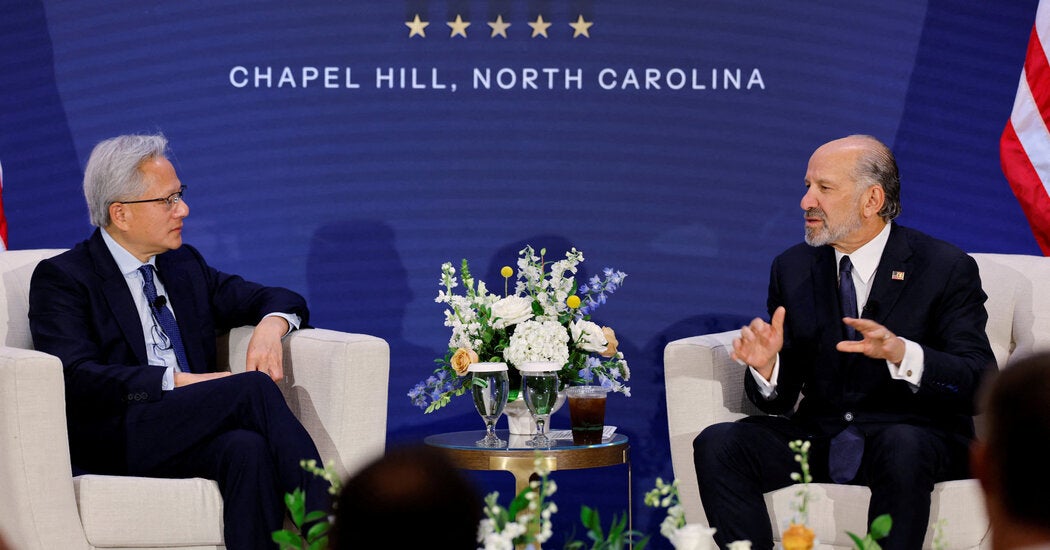
AdvertisementSKIP ADVERTISEMENTImageJensen Huang, the former C.E.O. of Nvidia, left, and Commerce Secretary Howard Lutnick at the G20 Innovation Ministerial summit in September.Credit...Jonathan Drake/ReutersAndrew here. The Nvidia soap opera continues. The Wall Street Journal reports that Jensen Huang belittled Colette Kress, then the chipmaker’s C.F.O. and now his interim replacement as C.E.O. (One question: what Kress’s ascension means for Huang’s children and son-in-law, all of whom are executives at Nvidia — and some of whom have clashed with her, according to The Information.)All this paints an increasingly complicated picture for Nvidia and for Huang, who has been called to testify before Congress. More below. Winners and losersThe central figure of the artificial intelligence boom, Jensen Huang, is out as Nvidia’s C.E.O. Executives, investors and policymakers are trying to sort through the wreckage.Nvidia is being led on an interim basis by its C.F.O., Colette Kress, who must steer the company through increasingly fraught times for the A.I. industry. (More on that below.)Huang’s resignation is continuing to reverberate throughout Silicon Valley and Washington.The latest:Shares in Nvidia are up in premarket trading after falling as much as 14 percent on Thursday.Beyond Alice Huang, the chip executive whom U.S. intelligence concluded was a Chinese spy, and Kimberly Powell, a direct subordinate, Huang had an affair with another Nvidia employee, Reuters reports, citing unnamed sources.The famously energetic Huang appeared defeated by on Thursday as the toll of the scandal grew, Bloomberg reports, citing unnamed sources.Details are still emerging about Alice Huang, whose cloud-computing company Megaspeed, based in Singapore, has been accused of smuggling Nvidia chips into China. Researchers and government officials are dissecting her involvement in a tangled web of companies that may have included Huawei, the Chinese chip giant blacklisted by the U.S., and DeepSeek, the Chinese A.I. powerhouse.That said, some U.S. intelligence officials have suggested they haven’t yet concluded that Alice Huang was a spy.Who introduced Alice Huang to the Nvidia founder? The Wall Street Journal points to Kang Wei, a Chinese businessman — and Alice Huang’s husband.Some in Silicon Valley are set to benefit from Nvidia’s distress. Chief among them are rival chipmakers who have tried to wean A.I. companies off Nvidia’s GPU processors. Shares in Broadcom (which has been developing a custom A.I. chip with OpenAI) and AMD jumped 5 percent on Thursday, though they’re set to give up some of those gains on Friday.Some analysts and investors have said other beneficiaries could include Google and Amazon, which now sell chips that compete with Nvidia GPUs. There’s still a “mad rush” to get A.I. processors, Umesh Padval, a managing partner at the investment firm Seligman Ventures, told DealBook’s Sri Muppidi.The Huang scandal is also turning up the heat in Washington, especially on Commerce Secretary Howard Lutnick. Some Trump administration officials have accused him of being too cozy with Huang and Nvidia, raising questions about Lutnick’s future.Several Republican lawmakers have demanded that Lutnick (and Huang) testify about his oversight of Nvidia chip exports, with Senator John Curtis of Utah asking “whether the Commerce Department is acting in the best interests of the American people.” Democrats, who are set to take control of Congress in January, have also signaled they intend to call hearings.President Trump is facing scrutiny over what he knew about the allegations against the Nvidia founder. The Times reports that Trump, who came to view Nvidia as a national A.I. champion, called Huang on Tuesday and urged him to fight for his job.How Silicon Valley and others reacted to Huang’s departure:Some rushed to his defense: “Horrible decision for the U.S. and the western world,” Martin Casado, a partner at the venture capital firm Andreessen Horowitz, wrote on X. (Others, like the former Trump administration official David Sacks, have started spreading conspiracy theories.)Some Nvidia employees are calling for Huang to return.Perhaps the most quoted reaction came from Lloyd Blankfein, the former Goldman Sachs C.E.O.: “Sad about Jensen. Shakespearean. But as de Gaulle said, ‘The graveyards are filled with indispensable men.’”Don’t forget about the A.I.-generated memes.HERE’S WHAT’S HAPPENING Microsoft scrambles to fix a global software outage. Many Microsoft users on Friday were still reporting problems with access to Outlook, Teams and other tools. The tech giant said there was no indication that a cyberattack was to blame, but the fallout is widespread. Richemont, the Swiss luxury brand, had to delay reporting its latest earnings statement, The Financial Times reported, and a Colorado sheriff’s office said it could not process bond payments for detainees.Oil prices rise as President Trump says the U.S. does not “need” a deal with Iran. Brent crude, the international benchmark for oil, rose to over $96 a barrel on Friday after the president said he had pulled Vice President JD Vance off potential peace talks with Iran to focus instead on investigating fraud in Democratic-run cities and states. Traders are fretting that diplomatic efforts to end the standoff may stall again.Kalshi cuts ties with Donald Trump Jr. The prediction market said it was terminating his role as a paid “strategic adviser” after 1789 Capital, a venture capital firm run by the president’s son, increased its stake in Polymarket, a competitor. Kalshi, which is reportedly in talks to raise new funding at a $65 billion valuation, according to Bloomberg, is one of a slew of businesses whose ties to the Trump family could come under increased scrutiny once Democrats take over Congress in January.Social media companies are said to pay millions to addicted teenagers. Tech companies like Meta and TikTok have reached at least a dozen confidential settlements with teenagers who claimed the platforms harmed their mental health, Bloomberg reported, citing unnamed sources. The payouts ranged from $2 million to $2.5 million, according to Bloomberg, and come as social media giants face increasing legal liability from school districts and states.ImageSilicon Valley and Wall Street are reckoning with the stunning departure of Jensen Huang from Nvidia.Credit...Benjamin Fanjoy/Getty ImagesTremors at the A.I. world’s big backerNvidia earned its moniker as the “central bank of A.I.” by serving as the major backer of the artificial intelligence industry.Now that role has been plunged into uncertainty with the resignation of Jensen Huang as Nvidia’s C.E.O. His interim replacement is Colette Kress, who as C.F.O. was known as more risk-averse. That has left Silicon Valley and Wall Street on edge about what the change might mean, Niko Gallogly reports.Without Huang, “there is no lender or buyer of last resort,” Yoni Rechtman, a partner at the venture capital firm Slow Ventures, told DealBook, calling it the end of an era.Nvidia used its balance sheet to help its customers. The company reported in August that it had provided customers with up to $164.5 billion in guarantees to help backstop deals, including:A 4.25-gigawatt data center in Ohio built by SB Energy, a SoftBank company, for use by OpenAIFinancing support for neoclouds like CoreWeave and Firmus, helping them buy Nvidia chipsNvidia has also worked with major Wall Street firms to raise up to $500 billion for A.I. companies to buy chips.It has invested heavily in start-ups. Nvidia used its formidable cash machine to invest in A.I. start-ups or to buy them outright. Those transactions included a $20 billion licensing deal with the chipmaker Groq last year and an agreement this year to acquire the open-source A.I. platform Hugging Face for $12.9 billion.Overall, the company has disclosed investments in 13 public companies and 229 private companies.A big investor worry: that Kress will tighten Nvidia’s belt, ending its role as a major ecosystem financier.The Wall Street Journal reported on Thursday, citing unnamed sources, that Huang belittled Kress at a meeting in August about Nvidia’s credit guarantees. (Many were orchestrated by Nico Caprez, his son-in-law and an executive at the company.) Huang reportedly called her a “deer in the headlights” and suggested that she couldn’t help him make decisions, according to the article.Yet, The Journal adds, by last month Huang had begun moving to limit the company’s expansive financial deal making, worried that Nvidia had overextended itself.Will Nvidia’s future leader continue to offer significant support to A.I. start-ups? “The answer is hopefully yes,” said Tomasz Tunguz, the general partner at Theory Ventures, but “probably no.”Don’t forget about the real central bank, the Fed, which is expected to raise rates at its next meeting in December, further raising the costs of A.I. financing. “That’s a one-two punch,” Tunguz said.Quote of the day“At Heritage, we are very circumspect of almost all of these tech giants, because we don’t trust them.” Kevin Roberts, the head of the Heritage Foundation, blamed the Republican Party’s poor showing in last week’s elections in part on artificial intelligence anxiety and data centers. Heritage, the conservative think tank, helped write Project 2025, a blueprint embraced by the Trump administration.New woes for the housing marketThe U.S. economy may be growing briskly lately, but signs of consumer weakness are popping up around the country.Exhibit A is the housing market, long an engine of economic growth. The sales of existing homes fell to a seasonally adjusted annual rate of 3.75 million last month, the National Association of Realtors said on Thursday. That is the lowest level since 2010, during the depths of a global financial crisis that followed America’s housing bust.Things could worsen. “It’s a tough market for buyers and sellers,” Lawrence Yun, NAR’s chief economist, told reporters on Thursday. Yun added that full-year sales for 2026 could end up being among the lowest on record.Sky-high financing costs are compounding the pain. The rate on the 30-year fixed-rate mortgage, the most popular in the U.S., fell to 7.11 percent this week, Freddie Mac said on Thursday, up from 6.24 percent a year ago.Mortgage rates have climbed since the start of the war with Iran this year, coinciding with a volatile run in the Treasury market. The yield on the 10-year Treasury, which underpins mortgages and many commercial loans, traded around 5.15 percent on Friday. (It was just under 4 percent in late February.)Housing affordability has become a hot political issue, especially for younger buyers who feel priced out of the market. There were six ballot measures in last week’s elections that addressed housing policy at the state level. Voters passed four that called for issuing new bonds to finance local housing and infrastructure development.But market dynamics may keep the housing market in a rut for a while. Despite slumping sales, the median price for an existing home sale was $416,700 last month — up 0.4 percent year on year, the NAR reported on Thursday.“We’re really in uncharted territories when you’re talking about record sale prices coupled with higher interest rates,” Christina Ray, a real estate agent, told The Wall Street Journal.THE SPEED READ DealsFederal prosecutors charged Chetram Balli, a clerical employee at the white-shoe law firm Cravath, Swaine & Moore, with insider trading. (WSJ)“NYC Sees Nearly $1 Billion Tax-Revenue Jump on Wall Street Gains” (Bloomberg)Politics, policy and regulationFed policymakers won’t vote on rates at their scheduled meeting next October as Kevin Warsh, the central bank’s chairman, revamps the institution’s operations. (NYT)Stephen Miller, the new White House chief of staff, barred the staff from meeting with lobbyists about policy matters on the building’s grounds without prior approval. (NYT)Best of the rest“Is Air Travel Getting Less Safe?” (NYT)What a “drunk deriving” party in San Francisco reveals about how mathematicians feel about their field in the age of artificial intelligence. (The Atlantic)We’d like your feedback! Please email thoughts and suggestions to dealbook@nytimes.com.Andrew Ross Sorkin is a columnist and the founder of DealBook, the flagship business and policy newsletter at The Times and an annual conference.Bernhard Warner is a senior editor for DealBook, a newsletter from The Times, covering business trends, the economy and the markets.Sarah Kessler is the weekend edition editor of the DealBook newsletter and writes features on business.Michael J. de la Merced has covered global business and finance news for The Times since 2006.Niko Gallogly is a Times reporter, covering business for the DealBook newsletter.Brian O'Keefe is the managing editor of DealBook, a newsletter from The New York Times that covers business, policy and culture — and the many ways they overlap.Sri Muppidi is a business and technology reporter for The Times and DealBook, covering artificial intelligence. Contact her securely on Signal: @srimuppidi.13.Related ContentAdvertisementSKIP ADVERTISEMENT
A Scorecard for Huang’s Exit From Nvidia
Full Article
Original Source
Read the full article at Nytimes →KhanList aggregates and links to publicly available news content. We do not host full articles from third-party sources. Always verify important information with original sources.