
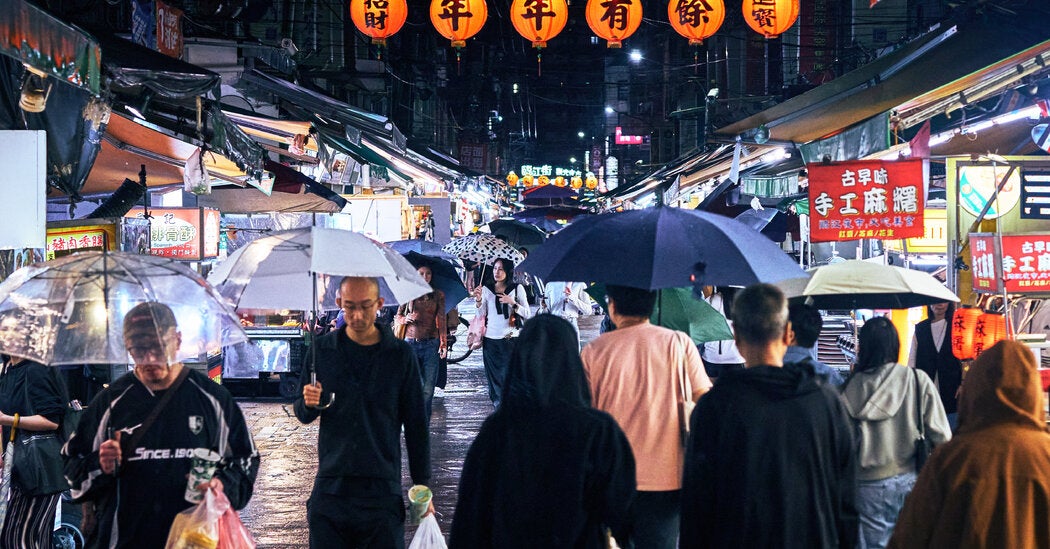
The Linjiang Night Market in Taipei.the new new worldTears and Disbelief in Taiwan, Where Jensen Huang Is a CelebrityThe Nvidia chief executive’s resignation shocked people in his birthplace, where he is called “the people’s dad.”The Linjiang Night Market in Taipei.Credit...When the news broke in Taiwan on Thursday night that Jensen Huang had resigned as Nvidia’s chief executive, Ray Wang was too upset to sleep. He drank a whole bottle of red wine and prayed for Mr. Huang.A hairstylist, Mr. Wang, has been cutting Mr. Huang’s hair, watching it change from salt-and-pepper to silver, for nearly a decade.“Maybe they’ll bring him back,” Mr. Wang said, “the way Apple brought back Steve Jobs.”Mr. Huang has many well-wishers like this in Taiwan. An American citizen, he moved to the United States when he was 9 years old, but he was born on the island and enjoys a godlike status there. Fans mobbed him at night markets and lined up for autographs. Restaurants where he has eaten hang his photo, Hollywood-celebrity style. He has been hailed as the “pride of Taiwan” and affectionately called “the people’s dad.” The frenzy around his visits became known as “Jensanity,” a play on the “Linsanity” that followed Jeremy Lin, the Taiwanese-American professional basketball player.Mr. Huang co-founded Nvidia in 1993, and it became one of the world’s most valuable companies in recent years by making advanced chips for artificial intelligence. Over the decades, Mr. Huang made Nvidia’s relationship with Taiwan personal. Taiwan is home to TSMC, the premier semiconductor chip maker that produces roughly 90 percent of the world’s most advanced chips and is the main reason Taiwan’s economy is projected to grow around 12 percent this year. It is Taiwan’s most important company, and Nvidia is TSMC’s biggest customer.ImageRay Wang, Jensen Huang’s hair stylist in Taipei.ImageIn his salon, Ray Wang displays a signed copy of a book about Jensen Huang, as well as messages from the Nvidia founder.ImageRed envelopes given to Ray Wang by Jensen Huang for the Lunar New Year.Mr. Huang’s resignation followed reports of affairs, one with an Nvidia executive and another with a businesswoman, Alice Huang, whom U.S. intelligence officials suspected of providing intelligence for China. Beijing has denied the allegation.His downfall landed with dismay and disbelief in Taiwan, where he had effectively cultivated relationships. Mr. Huang knew the people who made his chips and servers, and he made a point of crediting them in public.He went to great lengths to show his appreciation for business partners — and get what he wanted. Last November, when he needed TSMC to allocate more production capacity to Nvidia, he flew to Taiwan and sat down for hot pot with its senior executives, Liang-Rong Chen, a tech journalist who was there, told me. He patiently signed whiskey bottles for its employees.Mr. Chen explained why that mattered. Squeezing more chips out of a busy factory took many managers willing to rearrange production and staff willing to work overtime. Mr. Chen, who writes the newsletter Tech Taiwan, suspected they would not have been as eager to do it for other American tech giants because none of them had gone to the great lengths as Mr. Huang in cultivating relationships.ImageA photo of Jensen Huang and the owner of a pork sausage stall at the Linjiang Night Market in Taipei.ImageRestaurants where Mr. Huang has eaten hang his photo and autograph, Hollywood-celebrity style.ImageA signed plate and messages at Fu Ba Wang, a restaurant in Taipei.A longtime semiconductor analyst, who was not authorized to speak publicly, told me that without Nvidia there would be no A.I. as we see it today. Suppliers have grown accustomed to taking their cues from Mr. Huang, he said, who had a sense of where the technology was headed and was able to persuade the companies to go along with him despite the risks at times. With him gone, the analyst wondered whose judgment they would trust.“We hope things won’t change too much because he understands Taiwan better than anyone.” Chin-Tsang Ho, Taiwan’s deputy minister of economic affairs, told me just hours before Mr. Huang stepped down.Four days before Mr. Huang’s resignation, TSMC was arranging a call with Mr. Huang to discuss plans for the next few years, said Chun-Hsien Yeh, who heads Taiwan’s National Development Council and sits on TSMC’s board. Mr. Yeh told me he expected Mr. Huang’s resignation would have little impact on TSMC, however. Demand for A.I. chips was already exceeding supply, and other customers, including AMD, needed them, too. “If Nvidia takes less,” he said. “others will take more.”Quite a few people I talked to, including semiconductor insiders, said they believed that Mr. Huang didn’t deserve the treatment. “We felt the process didn’t seem quite fair,” Da-Xiang Hu, a tech professional in Taipei, told me. “We felt it all happened too fast.”A few even saw his downfall in conspiratorial terms, imagining that other American business and political leaders grew wary of the growing influence of tech executives of Taiwanese and Chinese descent and worked to push Mr. Huang out.Image“The Fruit Auntie,” a vendor at the Linjiang Night Market in Taipei.ImageA a Nvidia Graphics card signed by Jensen Huang on display at Flowers Restaurant in Taipei.Other people were annoyed that their Nvidia shares fell. In a place where many people own shares in TSMC, social media quickly filled with joking anxieties about the fate of that company. On Threads, one user posted a photo of TSMC’s chief executive, Che-Chia Wei, captioning it, “Please don’t have an affair. Please. Please.” A commenter responded, “If you do have an affair, please don’t choose a Chinese spy. Please 🙏” Both the post and the comment were liked tens of thousands of times.Many Taiwanese commentators and social media users are supportive of Mr. Huang. They thanked him for bringing business to the island and for shining a spotlight on its companies.Emmy Hu, a financial content creator, wrote on Facebook that other tech giants had squeezed Taiwanese suppliers on price. “His generosity toward Taiwan was unusual,” she wrote of Mr. Huang. Yu Ting-hao, a financial commentator, called Mr. Huang “Taiwan’s biggest advocate” on his YouTube program. Kang Wen-teng, who runs a hot pot restaurant in Taichung City, told me he wanted people to remember what Mr. Huang had done for Taiwan. “Thank you, Papa Huang,” he wrote on Threads.Still, the accusations that Mr. Huang had an affair with a woman suspected of being a Chinese intelligence asset troubled even his fans. Da-Xiang Hu, the tech professional in Taipei, told me how moved she was whenever Mr. Huang spoke about Taiwan abroad. After decades of Chinese pressure that has kept Taiwan isolated internationally, hearing him say “Taiwan” mattered to her. At the same time, she said, she feels uneasy about Mr. Huang’s public push to sell advanced chips to China. In a Threads post in which she thanked him, Ms. Hu wondered whether Nvidia’s chips might someday help a Chinese missile strike Taiwan more precisely. “I wish you well,” she wrote, “and I hope Taiwan stays safe.”ImageThe owner of Ice World, a dessert shop at the Linjiang Night Market in Taipei.ImageThe frenzy around Mr. Huang’s visits to Taiwan became known as “Jensanity.”In Taiwan, there is even chatter that maybe Mr. Huang could come back and become the chief executive or a board member of TSMC.To Mr. Wang, the hairstylist, Mr. Huang was both a visionary entrepreneur and an old friend. He was planning to write to him. “If he comes back to Taiwan,” he said, “I’m sure he’d come in for a haircut.”Li Yuan writes The New New World column, which focuses on China’s growing influence on the world by examining its businesses, politics and society.Related ContentAdvertisementSKIP ADVERTISEMENT
Jensen Huang’s Downfall Brings Disbelief in Taiwan
Full Article
Original Source
Read the full article at Nytimes →KhanList aggregates and links to publicly available news content. We do not host full articles from third-party sources. Always verify important information with original sources.