
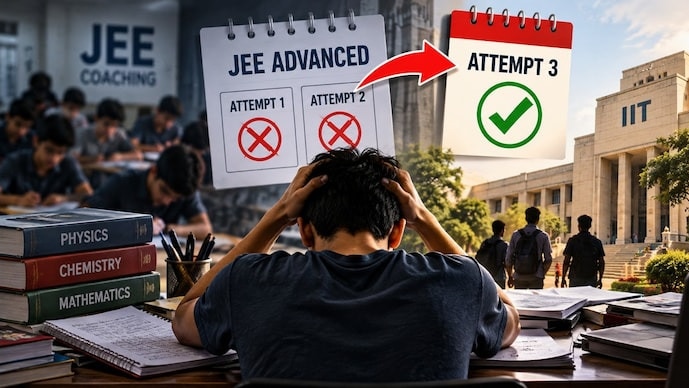
A petition signed by nearly 12,700 students urges the JAB, IIT Council and Ministry of Education to review JEE Advanced eligibility rules, citing concerns that CBSE's attendance requirement and the two-attempt limit restrict preparation time for regular school students.JEE Advanced students seek third attempt, raise concerns over CBSE attendance rule (AI generated image)New Delhi,Oct 27, 2026 16:14 ISTA petition signed by over 12,000 students seeks a third attempt at the Joint Entrance Examination (JEE) Advanced, citing concerns over how CBSE’s 75 percent attendance requirement affects preparation for the IIT entrance exam.The campaign is urging the Joint Admission Board (JAB), the IIT Council and the Ministry of Education to review the eligibility rules, arguing that the two-attempt limit leaves regular school students with limited time to prepare.The demand has sparked a debate over balancing school attendance requirements with the preparation demands of one of India's most competitive entrance examinations.THE CBSE ATTENDANCE RULE AND JEE ADVANCED ATTEMPT LIMITUnder CBSE rules, students generally need at least 75 per cent attendance to be eligible for their Class 10 and Class 12 board examinations, subject to applicable provisions and exemptions. The board has also taken action against schools facilitating dummy enrolments by withdrawing affiliations and downgrading schools. For JEE Advanced aspirants, this means balancing regular classes, practicals and board examination preparation with studying Physics, Chemistry and Mathematics for the entrance test.JEE Advanced allows a maximum of two attempts in two consecutive years. The first must be taken in the year of passing Class 12 and the second in the following year, subject to other eligibility conditions. According to the student movement, this can disadvantage candidates who prioritise regular schooling. With much of Class 12 devoted to school and board examination requirements, they may have only one fully dedicated year after school to prepare for JEE Advanced, which is also their final attempt.The campaign argues that students who can devote more time to competitive examination preparation during Classes 11 and 12 may have an advantage over those balancing regular schooling with entrance test preparation.IS ONE DROP YEAR ENOUGH TO PREPARE FOR JEE ADVANCED?The debate goes beyond the number of attempts to the time required to develop the conceptual understanding and analytical skills tested by JEE Advanced. The examination requires candidates to apply concepts, solve multi-step problems and connect topics across Physics, Chemistry and Mathematics.Building these skills requires sustained practice, revision and a thorough understanding of the Class 11 and Class 12 syllabus.Students with limited access to coaching, academic guidance or study resources may need more time to prepare. Medical emergencies, family circumstances and other unforeseen disruptions can also affect their performance within the limited eligibility window.Supporters of the third-attempt demand argue that an additional opportunity would give students more time to prepare without lowering the examination’s difficulty or changing its selection standards.JEE MAIN ALLOWS MORE ATTEMPTS. WHY IS JEE ADVANCED DIFFERENT?Another concern raised by the movement is the difference between the eligibility windows for JEE Main and JEE Advanced, the two stages of the engineering admission process.According to the JEE Main 2026 Information Bulletin, candidates can appear in two sessions annually over three consecutive years, subject to eligibility criteria. This offers multiple opportunities to improve scores or overcome missed sessions.JEE Advanced, however, permits only two attempts in consecutive years, with one opportunity each year. Candidates must also qualify through JEE Main to become eligible for JEE Advanced.The movement questions why the first stage offers a wider eligibility window while the examination determining admission to the IITs has stricter limits. It argues that the difference warrants a review of the existing policy.IIT KANPUR DIRECTOR ON JEE ADVANCED REVAMPMeanwhile, IIT Kanpur Director Manindra Agrawal has said that JEE Advanced has become heavily dependent on coaching and needs a revamp. He said discussions are underway to reduce this dependence, with a possible third attempt also under consideration.Agrawal said an additional attempt could benefit students who discover the examination late or miss an opportunity due to illness, accidents or other circumstances. However, it could also lead candidates to spend another year preparing, often with additional coaching expenses, as reported by The Indian Express.He said the advantages and disadvantages would need to be balanced. While a revision could come in the next few years, no immediate changes are planned, and no decision has been taken on a third attempt.WILL JEE ADVANCED 2027 CANDIDATES GET A THIRD ATTEMPT?The existing eligibility rules remain unchanged, with no official approval for a third attempt announced so far. The demand has renewed calls for the Joint Admission Board, the IIT Council and the Ministry of Education to review the attempt limit.For now, candidates should continue preparing according to the existing eligibility criteria. Whether the authorities will accept the proposal and introduce changes for JEE Advanced 2027 remains to be seen.- Ends
JEE Advanced students seek third attempt, raise concerns over CBSE attendance rule
Full Article
Original Source
Read the full article at Indiatoday →KhanList aggregates and links to publicly available news content. We do not host full articles from third-party sources. Always verify important information with original sources.