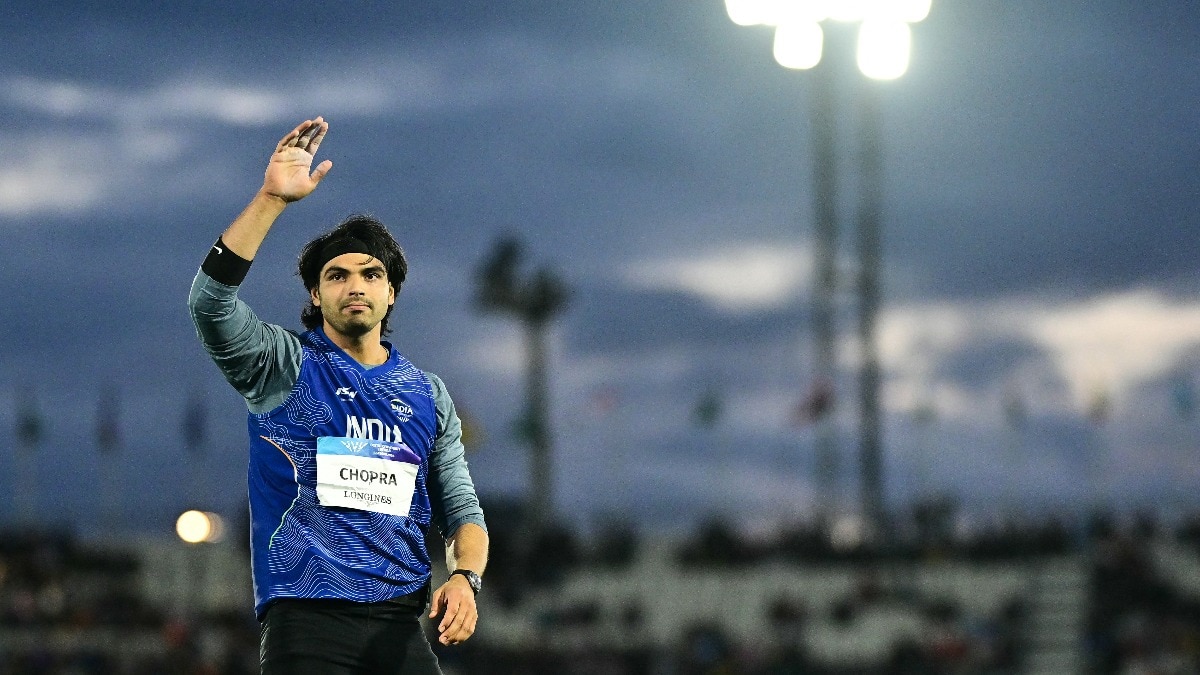
Neeraj Chopra won a silver in the Commonwealth Games javelin on Friday, July 31. He threw a season-best of 85.83m in gruelling, windy, chilly conditions in Glasgow. It was only his second competition since a back injury flared up at the World Championships last year, where he finished eighth and ended a streak of 2,566 days of podium finishes.It was his first podium finish of the year after a fourth-place showing at the Doha Diamond League. His second Commonwealth Games medal, to go with the gold in 2018. A stacked, Olympic-level field, and he still walked away with silver.India at Commonwealth Games: July 31 Wrap Courtesy: PTI Commendable, right? That's one way to look at it. Neeraj was back, and back on the podium, 10 months after one of the worst nights of his career.But Neeraj carries a curse he helped build himself. When he won silver at the Paris Olympics two years ago, beaten by Pakistan's Arshad Nadeem and his two 90m-plus throws, including the Olympic record of 92.97m, it should have been treated as a huge achievement. No Indian had ever won a medal in a field event at the Games before Neeraj. Instead, a country that had spent decades starved of Olympic greatness felt disappointed. That's what seven years of habit does. Neeraj never finished a competition off the podium for seven straight years, thirty-three tournaments without being pushed out of the top three. He didn't just win. He made winning look inevitable, and he made a nation addicted to that inevitability. So now, anything less than gold feels like less. We're only allowed to say this because it's Neeraj. Nobody else would be held to it.Commonwealth Games July 31: HighlightsA DISTANT SECOND IN CWG 2026And this time, in Glasgow, it wasn't even close. Nearly four metres separated him from the gold medallist, Sri Lanka's Rumesh Tharanga Pathirage.We were not used to seeing Neeraj beaten in a major final. The first real jolt came in Paris. It came at a time when he was relentlessly clearing 88m: 16 throws past that mark before 2024 ended. He threw 89.45m in the final that day and still lost to a man who cleared 90m twice. Then came the World Championships last September, when Neeraj gambled on managing an injury in Tokyo and the gamble didn't pay off. He threw 84.03m, finished eighth, and his then-coach, the legendary Jan Zelezny, watched from the sidelines with nothing he could do.Now Glasgow. And the gold medallist, Rumesh Pathirage, doesn't look like a rival any more. The Sri Lankan, who idolises Neeraj, looks like the man setting the terms. He threw a monstrous 92.62m earlier this season. He's been winning Diamond League meetings at will, five throws in excess of 88m this year alone. He has age on his side, brute power, and the tactical nous to read conditions, the very thing Neeraj used to pride himself on.Rumesh is doing to the field now what Neeraj did to it a couple of years ago: finding a way to win regardless of what the day throws at him.On Thursday, in qualifying, the wind was vicious enough that Julius Yego, an Olympic medallist, couldn't clear 75m. On Friday, conditions eased only slightly, still biting, still swirling, and Neeraj was the only one of the four Olympic medallists in the field to cross 85m. Rumesh, in the same wind, looked entirely at ease. 89.75m, with a couple of fouled throws that the commentators reckoned went even further.Neeraj unleashed that 85.83m in his second attempt, then had no answer once Rumesh's mark went up. He tried and tried. He didn't look, at any point on Friday night, like a man with a big throw in him.Neeraj said afterwards he was fine with it. He didn't look it. Neither did his coach and childhood friend Jai Veer Chaudhary, who cut a frustrated figure on the sidelines at Scotstoun. Screengrab: Sony Sports "Definitely improvement will happen. I will try to get better throws in the next competitions. I think the main difference is that if you are 100 per cent fit, you have the fighting spirit that you'll overcome anything. But with injury, it makes you think. You are scared. Today as well, I was scared. I did not want to run very hard, I wanted to keep my body in control," Neeraj said afterwards, as honest an account of a compromised mind as he has ever given.Senior journalist Sundeep Misra, who has covered track and field for decades, watched the same final and saw a man who looked a little lost."This is probably the first time he has fallen back on a person who is his friend," Misra says. "But, how many world-class athletes of Neeraj's stature have found success working with a friend?" Courtesy: PTI THE SPLIT WITH ZELEZNYIt's worth asking how Neeraj got here, because the answer isn't the injury. The injury is just where the story becomes visible.It was during his year with Zelezny, the world record-holder turned coach, that Neeraj finally got the monkey off his back: 90.23m at the Doha Diamond League in 2025, the first time he had ever crossed the barrier that had followed him around for years. It should have been the beginning of something. Instead, the superstar pairing lasted barely a year. The eighth-place finish at the World Championships was a bitter pill, and not long after, Neeraj moved on.Before Zelezny, there was Dr. Klaus Bartonietz, the German coach with whom Neeraj forged his most successful partnership. That one didn't end in disagreement. Klaus simply wanted a break from coaching, to spend time with his family, and Neeraj respected it.Which is why it stung, even if Neeraj never quite said so out loud, to see Klaus in the stands at the 2025 World Championships working with Keshorn Walcott, the 2012 Olympic champion nobody had thought about in years. Walcott won gold in Tokyo at 32. He hadn't won a world event in 13 years. Within a year of linking up with Klaus, of taking that leap into someone else's method at an age when most careers are winding down, he had a world title again.DIFFERENT ROUTENeeraj chose a different route. He went back to Jai Veer, his childhood coach and his friend, after Zelezny. He walked away from JSW, the organisation that had backed him for the better part of a decade, and set up his own foundation, Vel Sports. He said, at the start of the year, that he was trying to work out what suited a body that is no longer twenty-five. Fair enough. A two-time Olympic medallist who has won everything there is to win knows more about throwing a spear than anyone telling him what to do differently.But Misra's question sits there anyway, uncomfortable and hard to argue with."Imagine this. You are a math graduate and if you have to advise a double PhD holder, at some point you will hesitate and think, should I suggest this to him?"There is a version of loyalty that becomes its own limitation.Champions don't just need belief. They need disagreement. They need someone willing to tell an Olympic champion that his rhythm is off, that his technique needs rebuilding, that comfort is becoming a liability. Courtesy: Reuters Whether Jai is that voice only Neeraj can answer. At 28, with a body that now demands more careful management than ever before, it is perhaps the most important question of his career.That question doesn't have an answer yet, and neither, really, does the bigger one hanging over Friday night. Are Neeraj's best days behind him?A RETURN TO THE TOP?He's not just anyone, and it would be foolish to write him off on the back of one wind-battered evening in Glasgow.We've watched big names, Johannes Vetter, Anderson Peters, Nadeem himself, all struggle to find their old range again after injury. Neeraj is still out there, still putting himself through the grind, still turning up to be measured against the best in the world instead of hiding from it. That alone tells you something.But it will not be an easy route back, and it will not look like the last one. Unlike Vetter, unlike Peters, unlike Nadeem, Neeraj has never been a power thrower. Rumesh is all of it at once, power, technique, nerve, the full package, and if Neeraj is going to find a way past him, it won't be by trying to out-muscle a man built for exactly that fight.It will be in the small adjustments. The unglamorous, repetitive work of finding 88m again, consistently, throw after throw, until 90m stops feeling like a miracle and starts feeling like a Tuesday. That's how it worked the first time. There's no reason to believe it works any differently the second.For years, the pressure of that 90m mark was something Neeraj carried. Lately, it looks like something that's started carrying him, pulling him toward decisions that come from urgency rather than clarity. Walcott needed a jolt out of his comfort zone to find his way back to the top. Neeraj might need the same, whatever shape that takes for him.A break wouldn't be the worst idea in the world. Watching the Asian Games from the sidelines, if it came to that, wouldn't be either. Courtesy: Reuters Neeraj built something in this sport that nobody in India had built before him, seven years of never losing on the biggest stages, and greatness like that doesn't evaporate over one distant silver medal in the cold.Great athletes aren't remembered for never losing. They're remembered for what they do after they stop looking invincible.Glasgow isn’t the end of the Neeraj Chopra era. It may just have been the end of the first chapter.For Neeraj, and for the millions who have watched him redefine Indian athletics, here's hoping the second is even better.- EndsPublished By: Kingshuk KusariPublished On: Aug 1, 2026 12:22 IST
Javelin: Is the Neeraj Chopra era coming to an end?
Full Article
Original Source
Read the full article at Indiatoday →KhanList aggregates and links to publicly available news content. We do not host full articles from third-party sources. Always verify important information with original sources.